
Water parameters
Overview
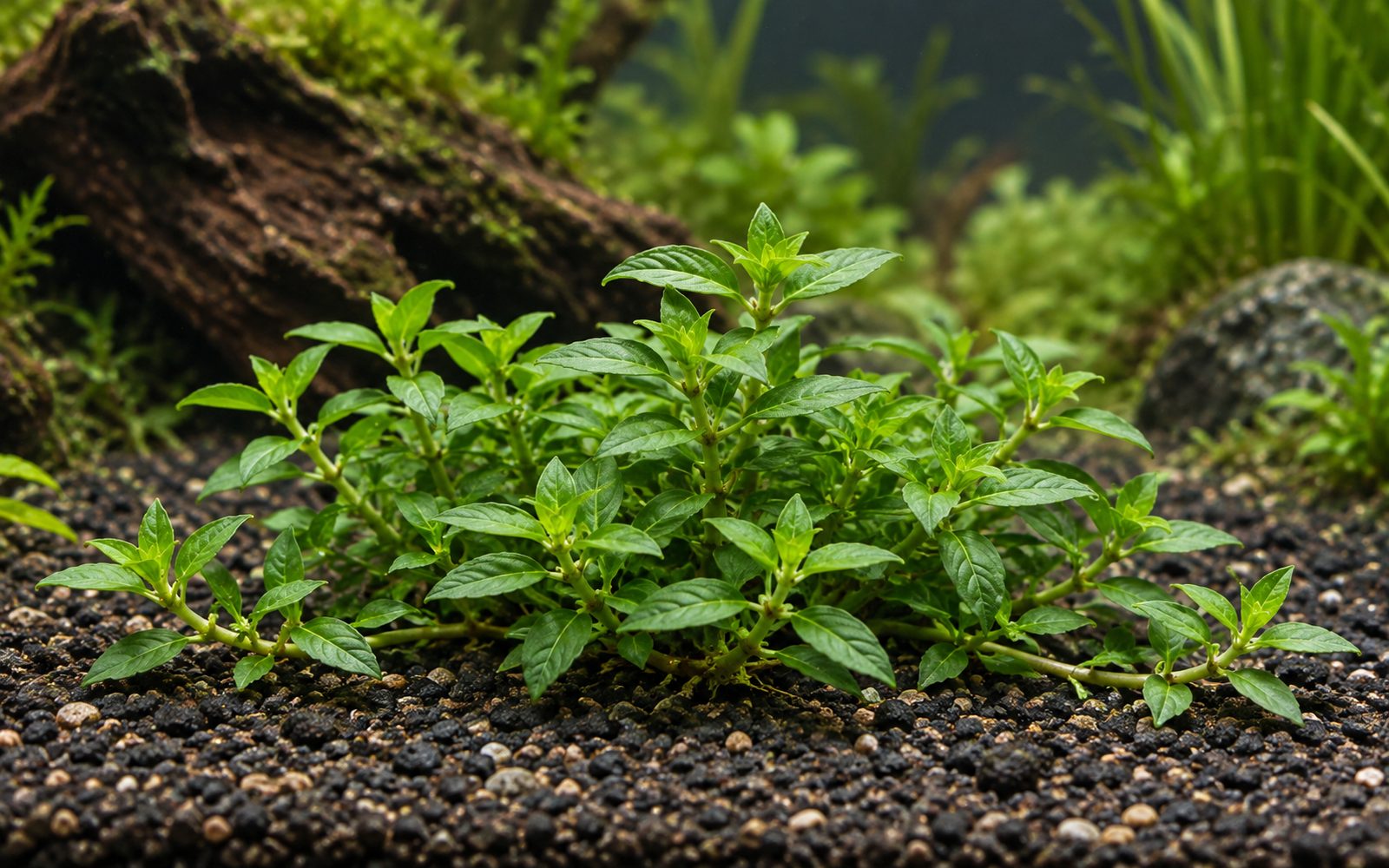
Staurogyne repens is a short stem plant introduced to the hobby from the Mato Grosso region of Brazil. Its leaves are 2–3 cm long, lance-shaped and bright green; because its internodes are very short, the plant spreads on horizontal stems close to the substrate instead of growing upward, and builds dense clumps.
It is one of the easiest carpeting plants: it survives and spreads slowly under medium light in an aquarium without CO₂. It does not melt right away like fine-leaved carpeting plants, and thanks to its tough leaves it is not damaged by shrimp and small fish. With CO₂ and strong light the clumps become lower and denser.
Planting and Placement
- Plant the stems singly or in twos and threes, 2–3 cm apart.
- Remove the lower leaf pairs and bury the stem about 2 cm; burying it deeper can rot the stem.
- It is used in the foreground, at the base of stones and driftwood, or as a transition to the midground.
Care and Fertilization
- Light: Medium; under strong light it stays lower and denser.
- CO₂: Not required, but beneficial.
- Fertilizer: Root tabs and regular liquid fertilizer; when nutrients are low the leaves turn pale green.
- Trimming: Stems growing upward are trimmed; each cut produces new side shoots and the carpet becomes denser.
Propagation
It is propagated by replanting the top cuttings. Roots and new upright shoots grow from the nodes of the horizontally creeping stems; these can be separated and planted elsewhere.
Common Problems
- Growing upward and thinning out: the light is weak; trim more often or increase the light.
- Yellowing or holes in the leaves: nitrogen or potassium deficiency.
- Algae on the leaf surface: can appear because it grows slowly; a balanced photoperiod and algae-eating shrimp help.
Hobbyist notes
Things you won't find in books, learned by trial and error. The most helpful ones are on top.
Change history and contributors
- Page created · October 16, 2026