
Water parameters
Overview
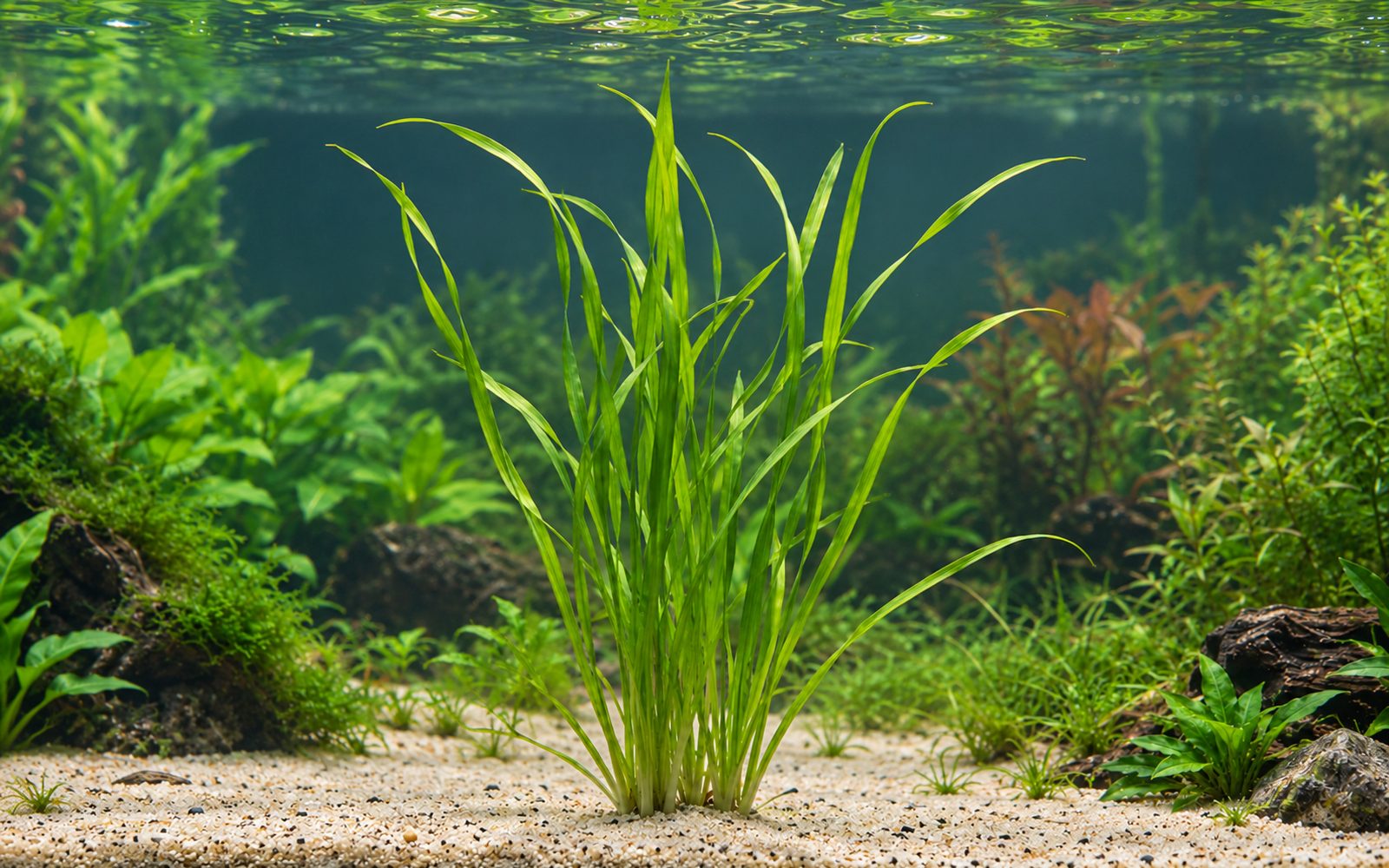
With its thin, long, ribbon-like leaves, Vallisneria quickly turns the background of an aquarium into a natural "underwater forest". When the leaves reach the surface, they spread out on top of the water. It is easy, fast and hardy; unlike many species, it grows well in hard, alkaline water. That is why it can also be used in Malawi and Tanganyika aquariums (with species that do not uproot plants) and in goldfish tanks. There are species such as "spiralis", "gigantea" (very long) and "nana" (thin and short).
Planting and Placement
The roots are buried in the sand, with the crown (the white area where the leaves emerge) left exposed; if the crown is buried, it rots. It is planted in the background and in corners, 3–5 cm apart. Within a few weeks it begins to spread by runners.
Care and Fertilization
- Light: Medium; it also survives in low light but slows down.
- CO₂: Not required.
- Fertilizer: Root tabs and liquid fertilizer speed up growth.
- Trimming: Cut leaves spreading too much at the surface off at the base; cutting a leaf in the middle makes its tip turn brown.
Propagation
It multiplies on its own by runners growing from the roots: new plants appear next to the mother plant. When these have opened a few leaves, they can be cut off and planted where you want.
Common Problems
- Melting in the first weeks: an adjustment reaction to the new environment; if the roots are healthy, new leaves appear.
- Sensitivity to liquid CO₂ (glutaraldehyde) products: these products can melt Vallisneria.
- Yellowing leaves: iron and potassium deficiency.
Hobbyist notes
Things you won't find in books, learned by trial and error. The most helpful ones are on top.
Change history and contributors
- Page created · October 16, 2026