
Water parameters
Overview
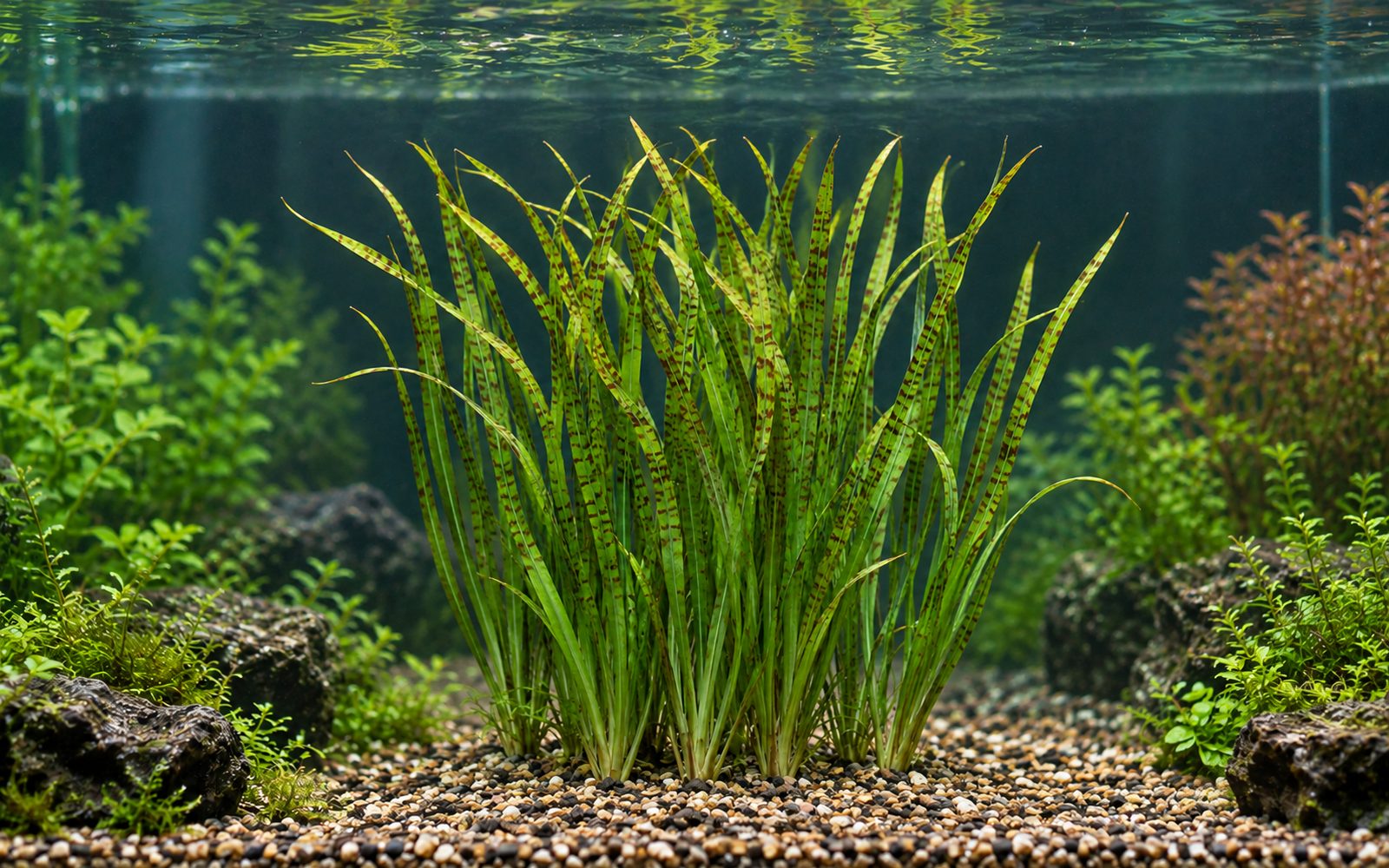
Vallisneria 'Tiger' is recognized by the fine, dark reddish-brown stripes and spots on its long, ribbon-like leaves; it takes its name from this tiger pattern. In the trade it is mostly sold as Vallisneria spiralis 'Tiger'. However, DNA studies have shown that this plant is a form of the Australian Vallisneria nana, which is why some sources list it as V. nana 'Tiger'.
The leaves reach 30–50 cm in length and about 1 cm in width, and can exceed 60 cm under the right conditions. In stronger light the leaves turn reddish and the pattern becomes more distinct. Because its leaves are narrow, it does not shade the plants in front of it much, which makes it suitable for medium-sized aquariums as well. As is typical of the genus Vallisneria, it likes hard, carbonate-rich water.
Planting and Placement
- Bury the roots in the substrate; the white crown, where the leaves emerge, must stay exposed, because a buried crown rots.
- Plant in the background and corners, 3–5 cm apart, in groups of 5 or more plants.
- Within a few weeks runners appear and the group thickens into a curtain.
Care and Fertilization
- Light: Medium; it also survives in low light, but the pattern fades.
- CO₂: Not required.
- Fertilizer: Because it feeds through its roots, root tabs are helpful; liquid fertilizer is supportive.
- Trimming: Cut leaves spreading across the surface at the base, not at the tip; a cut leaf tip turns brown and rots.
- Caution: Liquid carbon (glutaraldehyde) products can cause melting in vallisnerias.
Propagation
It multiplies on its own through runners that extend under the substrate or across its surface. Once the daughter plants have formed a few leaves and roots, the runner can be cut and they can be planted where you want them. To limit spreading, regularly pinch off unwanted runners.
Common Problems
- Leaf melt: Seen after new planting, sudden water changes or when liquid carbon is used. A healthy crown will produce new leaves.
- Faded pattern and yellow leaves: Light or root nutrition is insufficient.
- Slow growth in soft water: It struggles in very soft water; GH above 5 is more suitable.
Hobbyist notes
Things you won't find in books, learned by trial and error. The most helpful ones are on top.
Change history and contributors
- Page created · October 16, 2026