
Water parameters
Overview
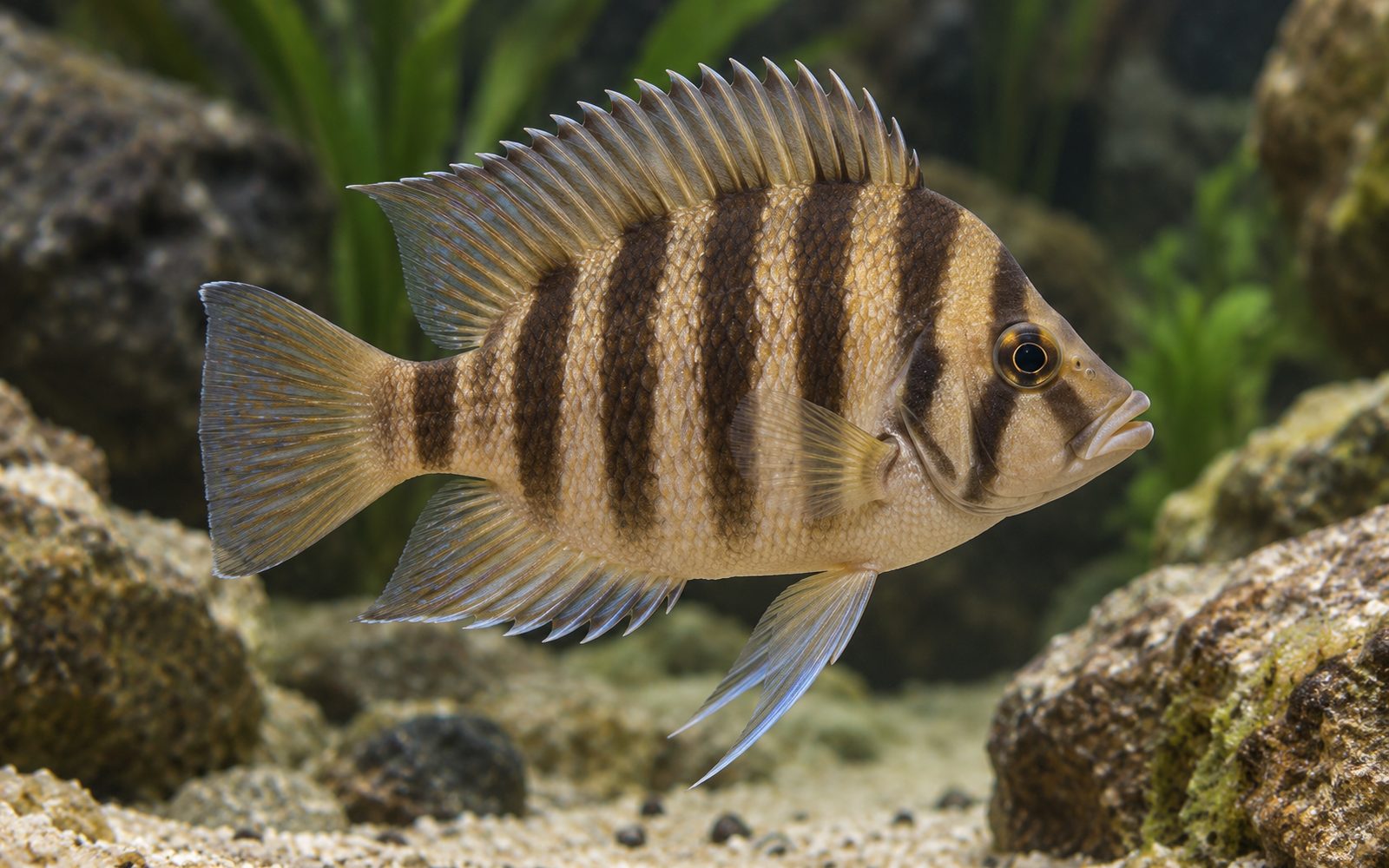
The compressiceps is an ambush predator from the same genus as the calvus, with a very laterally compressed body. Compared with the calvus it is shorter and higher-backed; its body usually carries dark vertical bands on a light brown, golden or orangish background. Its head tapers at a steep angle and its mouth points upward. Thick scales and a broad, spiny dorsal fin protect it even against fish larger than itself.
Because it is spread over most of the lake, it has many local forms. Like the calvus it grows slowly and requires patience; in return it is a long-lived, hardy aquarium fish with plenty of personality.
Color and Fin Varieties
- Gold Face: a form whose head and front of the body are in golden-yellow tones.
- Red Fin: a form with reddish-orange toned fins.
Natural Habitat
It lives along many shores of the lake, in areas rich in rock piles and crevices. With its compressed body it enters narrow crevices and picks up eggs and fry from other cichlids' nests, as well as small shrimp and insect larvae between the rocks. It is mostly seen alone or in loose pairs.
Tank Setup
- Volume: 150 liters for a pair; 200 liters or more with other Tanganyika species.
- Rockwork: stacked rock groups with narrow crevices; crevices bring out the fish's natural hunting behavior.
- Shells: large snail shells, or narrow hollows only the female can fit into, for the female to spawn in.
- Water: pH 8–9, hard and stable; a 25% water change every week.
- Substrate: fine sand; it rarely digs under rocks.
Diet
Carnivorous. Frozen mysis, brine shrimp, cyclops and krill along with a carnivorous cichlid granule are suitable. It eats slowly and usually catches food in midwater; when it is kept with fast fish, make sure it gets enough to eat.
Behavior and Compatibility
Calm toward fish too big to fit in its mouth, but it stalks small fish and the fry of other species. It defends its territory not aggressively but with a determined stance.
Good companions: large Julidochromis species, adult Cyprichromis, Synodontis catfish, Tropheus in a large aquarium.
Avoid: shell-dwelling cichlids and their fry, all small fish, shrimp; calvus in a small aquarium (they compete for the same crevices and prey).
Group and Colony Structure
- Kept as a pair or as 1 male : 1–2 females.
- 5–6 juveniles are grown up together and the pair that forms is chosen; extra individuals are removed.
- The male becomes noticeably larger than the female; the female spawns in a shell or crevice the male cannot fit into.
- More than one male can live together only in a very large aquarium with plenty of rockwork.
Breeding
The female chooses a narrow crevice she can enter or a large snail shell and lays her eggs inside. The male fertilizes them at the entrance and guards the surroundings; the female tends the eggs and fry. The fry become free-swimming after about a week to ten days; they are fed newly hatched brine shrimp and powdered food.
Health and Common Problems
- Hardy; problems mostly stem from soft water and poor water quality.
- Bloat and digestive problems: seen with overfeeding and a monotonous diet.
- Newly arrived individuals should be watched to see whether they are taking food; shy individuals may lose weight in the first weeks.
Sexing
Adult males are noticeably larger and higher-backed; females stay smaller. It is difficult to tell juveniles apart.
Tank mates
This list is calculated automatically from the species profile and grows as new species are added to the catalog. Try it in the planner for a definite answer.
Usually compatible
 Yellow Regal Peacock
 Egyptian Mouthbrooder
 Yellow Tail Acei
 Butterfly Goodeid
Eastern Happy
Red Shoulder Peacock
Butterfly Goodeid
Eastern Happy
Red Shoulder Peacock
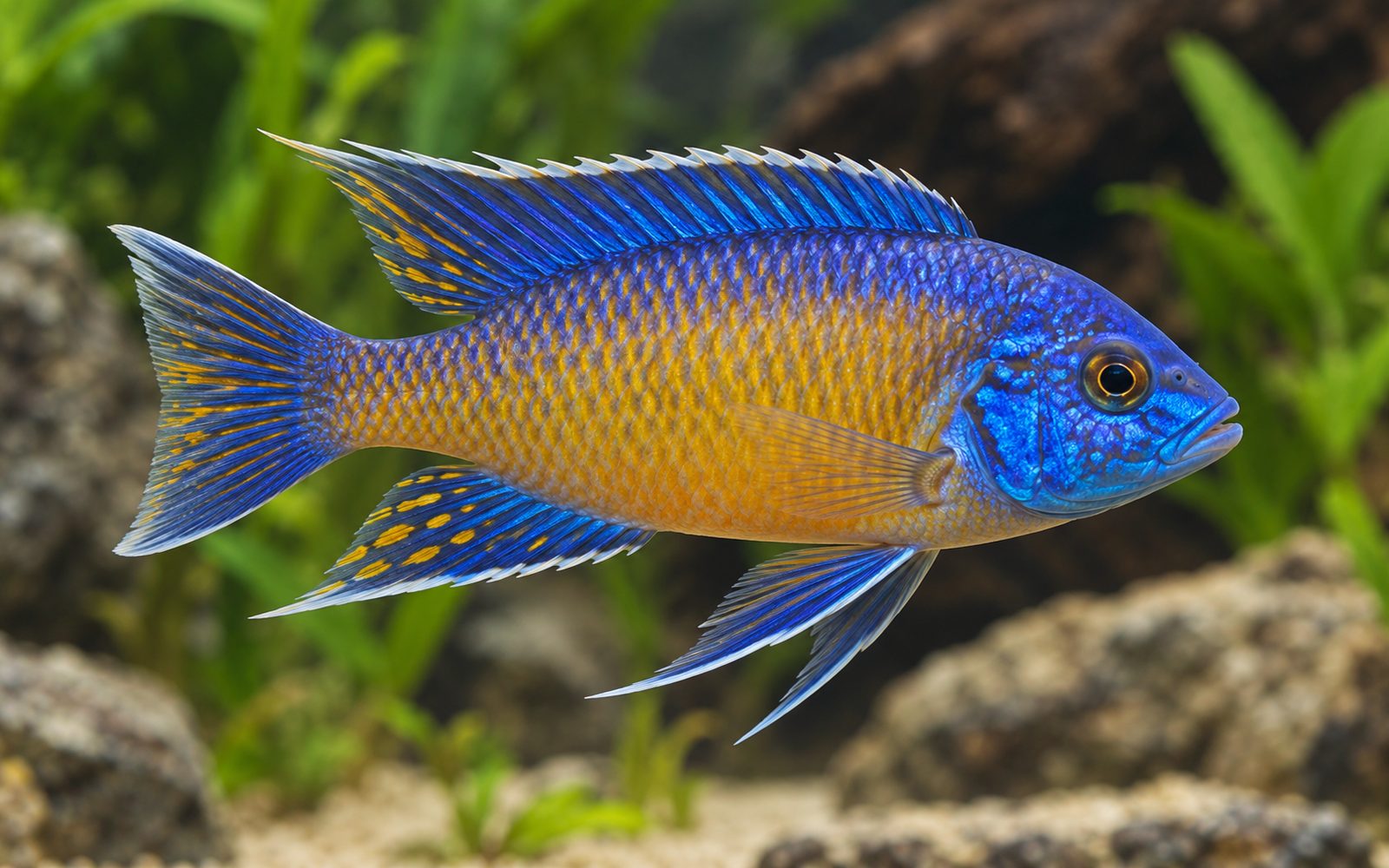 Fairy Cichlid
Blue Orchid Peacock
Sulphur Head Peacock
Fairy Cichlid
Blue Orchid Peacock
Sulphur Head Peacock
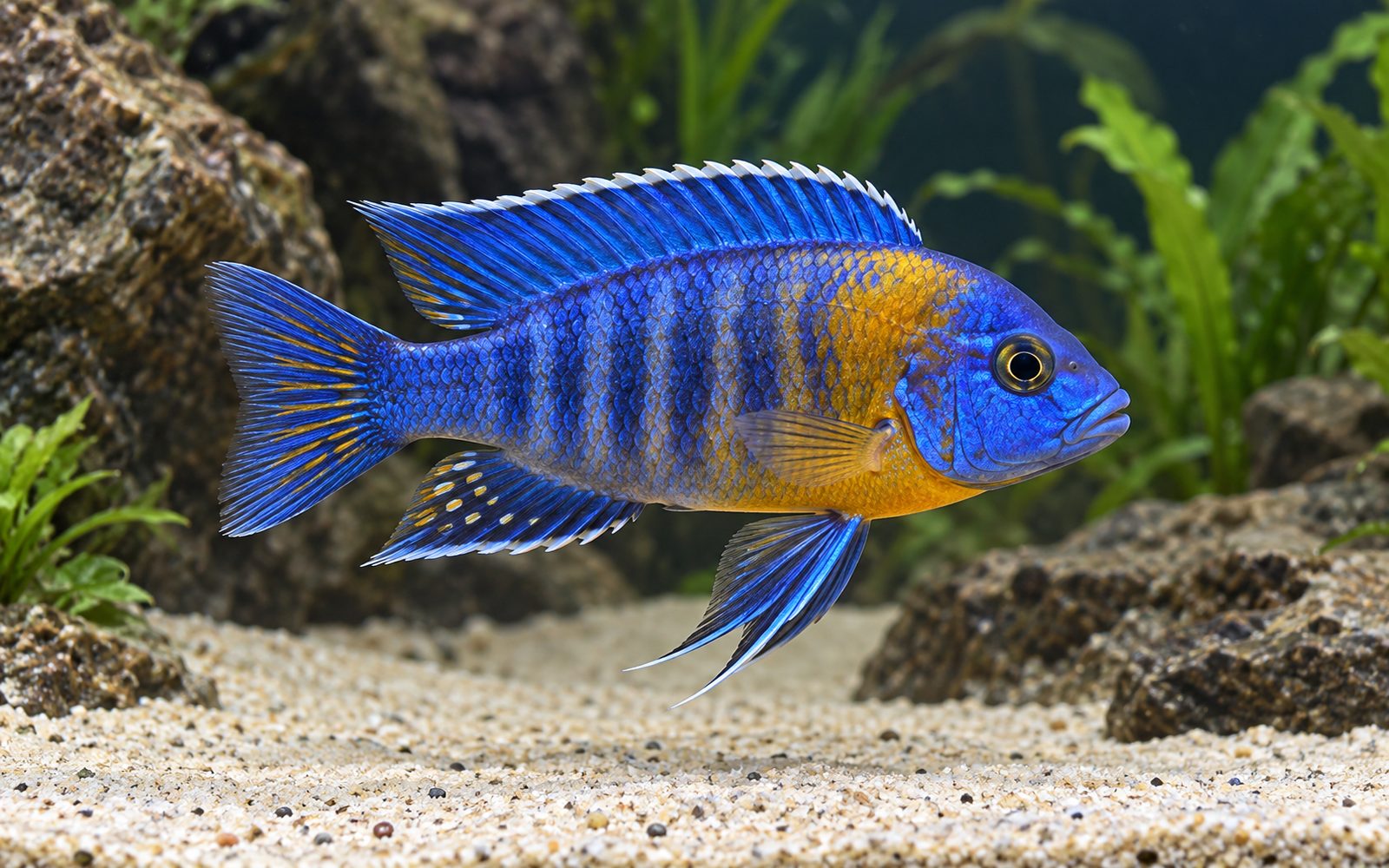 Peacock Cichlid
Should not be kept together





Hobbyist notes
Things you won't find in books, learned by trial and error. The most helpful ones are on top.
Change history and contributors
- Page created · October 16, 2026