
Water parameters
Overview
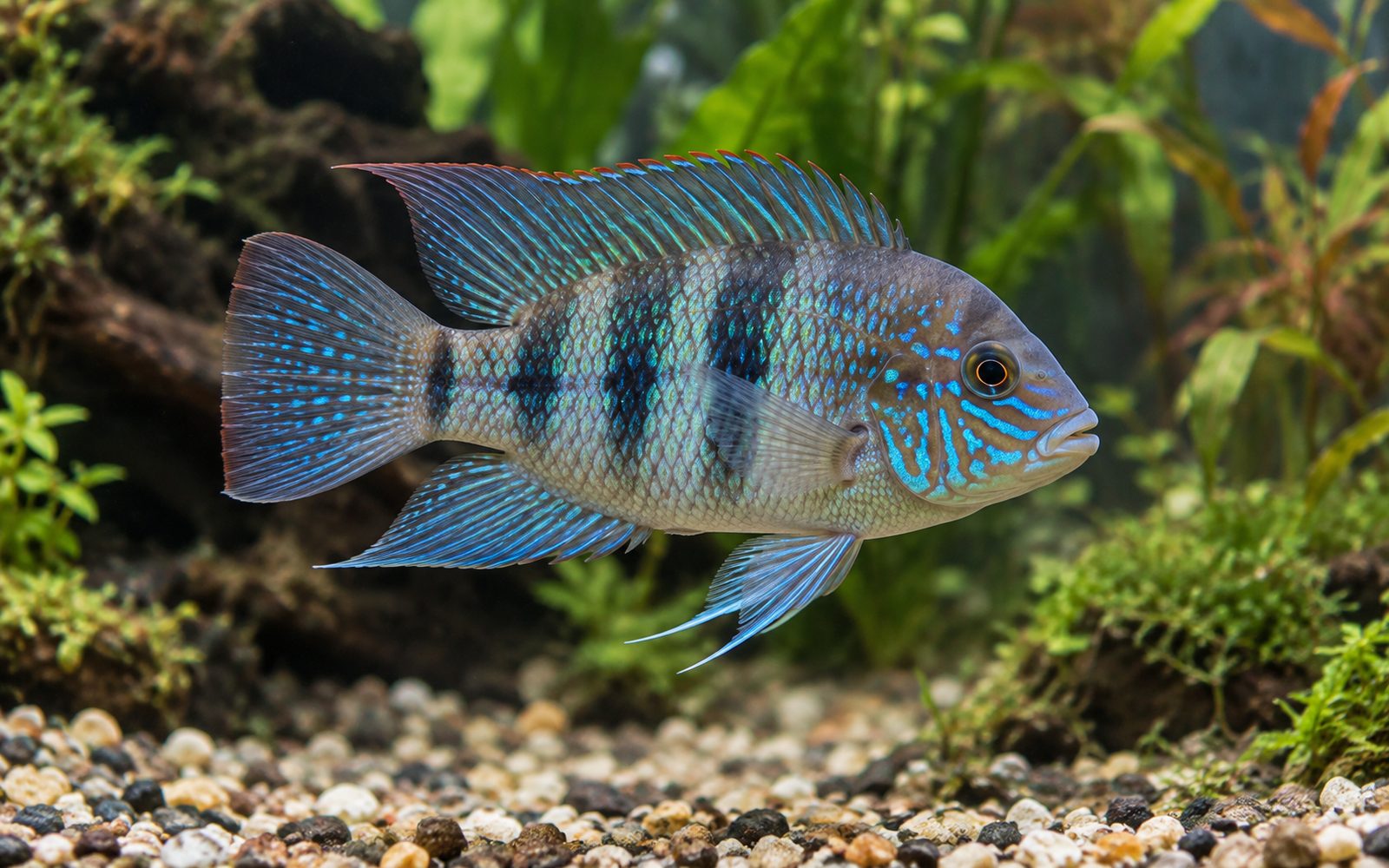
With iridescent blue-green spots on its gray-blue body, bright blue lines on its face and dark bars on its body, the blue acara is a beautiful and hardy cichlid. It is a good species for anyone who wants to start fishkeeping with cichlids: it adapts to a wide range of water values and breeds easily.
Natural Habitat
It lives in northern South America in slow-flowing streams, lakes and ditches, in vegetated waters with stones and roots on the bottom.
Tank Setup
- Volume: At least 150 liters for a pair.
- Decor: Flat stones (spawning sites), roots, hiding places; fine sand.
- Plants: It leaves most plants alone but may dig during breeding; rooted plants can be protected with stones.
- Water: 24–26°C.
Diet
Omnivorous. Cichlid granules, frozen bloodworms, brine shrimp and mysis shrimp, with vegetables from time to time.
Behavior and Compatibility
Relatively calm among cichlids; it shows its real territorial behavior during breeding. It eats small fish and shrimp that fit in its mouth.
Good companions: Peaceful to semi-aggressive fish of similar size: large tetras, angelfish, severum, corydoras, ancistrus.
Avoid: Small fish such as neons, shrimp, very aggressive Central American cichlids.
Group and Colony Structure
The blue acara is kept as a pair. To get a pair, raise 4–6 juveniles together; remove all but the pair that forms. A single acara also does fine. In a tank of 300 liters or more, two pairs can be kept, with territories divided by rocks.
Breeding
The pair lays a few hundred eggs on a flat stone they have cleaned, and together they fan the eggs and guard the fry. A few days after hatching, the young are moved into pits, and later they swim as a school around the parents.
Health and Common Problems
Hardy. In poor water, hole-in-the-head disease (HLLE) and bacterial infections can occur.
Sexing
Males are larger, with longer and more pointed dorsal and anal fins; females are smaller and rounder. A reliable distinction is made by checking the papilla during spawning.
Tank mates
This list is calculated automatically from the species profile and grows as new species are added to the catalog. Try it in the planner for a definite answer.
Usually compatible
 Yellow Regal Peacock
Glass Tetra
Yellow Regal Peacock
Glass Tetra
 Emerald Betta
 Firemouth Cichlid
 Buffalohead Cichlid
 Chocolate Cichlid
 Festivum
 Geophagus altifrons
 Geophagus surinamensis
 Rainbow Cichlid
Should not be kept together






Hobbyist notes
Things you won't find in books, learned by trial and error. The most helpful ones are on top.
Change history and contributors
- Page created · October 16, 2026