
Water parameters
Overview
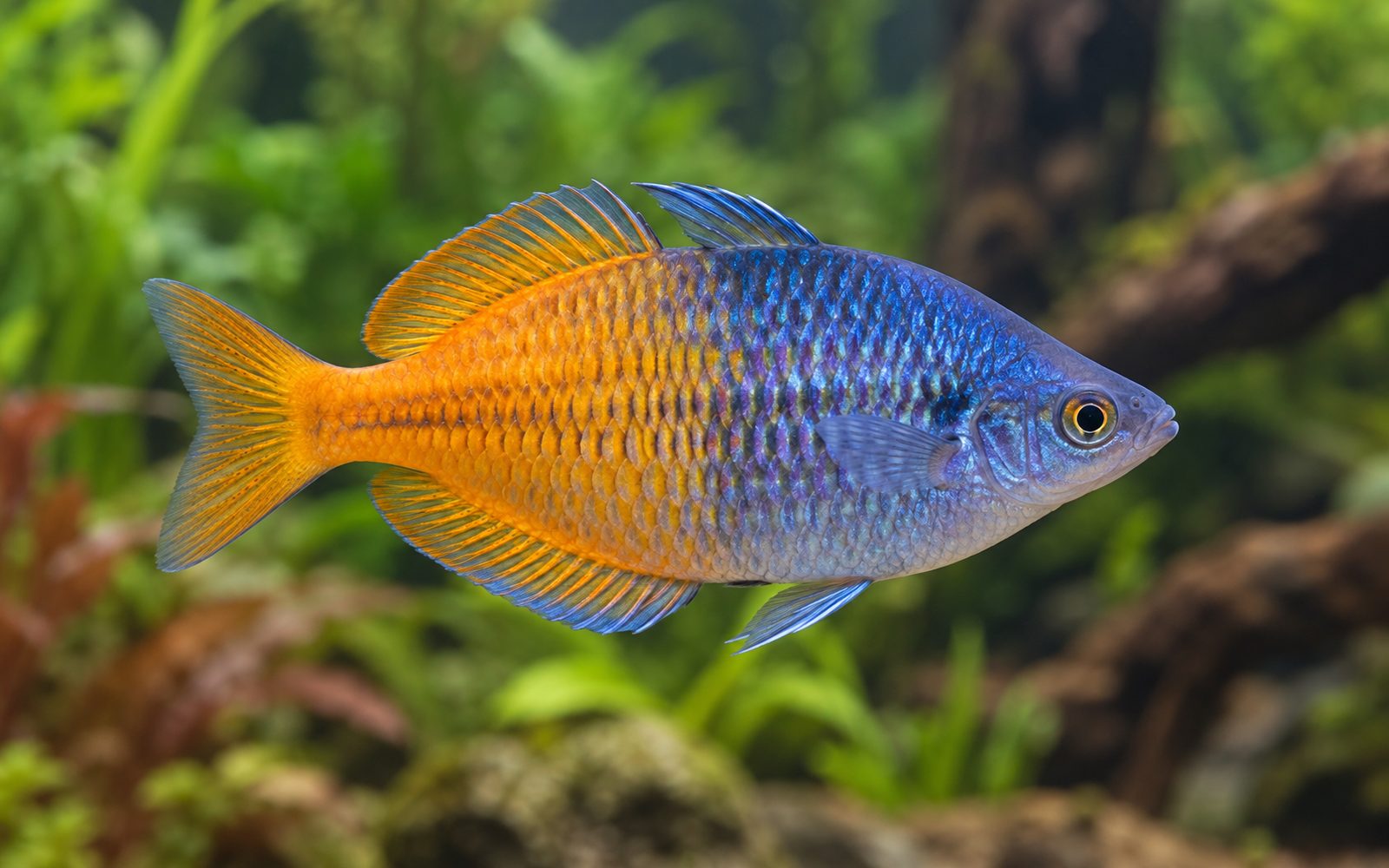
Boeseman's rainbowfish is the best-known member of the rainbowfish thanks to the sharp color split in males, where the front half of the body is blue-purple and the rear half orange-yellow. In the wild it lives only in a few small lakes in western New Guinea; the wild population is endangered by overcollection and habitat pressure. Almost all individuals sold today are bred on farms in Southeast Asia and Europe.
Young fish in stores look gray and dull; the true colors appear at 6–12 months, especially in males. It is an active, hardy schooling fish, but because of its size of up to 10 cm and its fast swimming it needs a long, wide aquarium.
Natural Habitat
It lives along the clear, planted shores of the Ajamaru Lakes and the streams connected to them. These waters, in a limestone landscape, are warm, moderately hard and slightly alkaline. The fish move in groups along sunny, shallow shores, around aquatic plants.
Tank Setup
- Volume: at least 160 liters and 120 cm in length for a school of 6–10; these fish swim long distances, so tank length matters more than volume.
- Water: 26–28°C, neutral to slightly alkaline (pH 7–8), moderately hard water. 25–30% water changes every week keep the colors vivid.
- Decor: Dense plants at the back and sides, plenty of open swimming space at the front and in the middle. Roots and rocks provide shelter.
- Lighting: Colors are at their brightest in a tank that gets morning sun or is well lit; a dark substrate increases contrast.
- Lid: It jumps when startled; a tight-fitting lid is essential.
Diet
Omnivorous with a good appetite. Make quality flakes and granules the staple; vary the diet with frozen brine shrimp, mysis, bloodworms and daphnia. Foods containing spirulina and carotenoids bring out the orange tones. Feed 2–3 times a day, only as much as is eaten within a few minutes; it eats from the surface and in midwater and rarely searches for food that has fallen to the bottom.
Behavior and Compatibility
A peaceful but very active schooling fish. In the morning hours males spread their fins and display to each other; during this their colors darken and a light-colored stripe appears on the forehead. Fights that cause injuries are rare. Because it is fast and has a big appetite, it can leave calm, slow fish behind at feeding time; it eats shrimplets and small shrimp.
Good companions: Corydoras, bristlenose plecos, synodontis, Congo tetras, large rasboras, botias, large rainbowfish from other genera.
Avoid: Neocaridina shrimp, slow long-finned fish (bettas, fancy guppies), aggressive cichlids; if you plan to breed, other Melanotaenia species.
Group and Colony Structure
At least 6, ideally 10 or more individuals. A female-heavy group (2 females per male) prevents the females from being chased constantly; at the same time, having at least 2–3 males in the group makes the males display to each other and take on their most vivid colors. An all-male group can also be kept and gives the most colorful look, but chasing increases somewhat.
Breeding
A continuous-spawning egg scatterer: under suitable conditions pairs lay a small number of eggs every morning for several weeks. The eggs attach with fine sticky threads to fine-leaved plants or a wool spawning mop. The parents eat eggs and fry; collect the eggs by moving the mop to a separate container every few days. At around 26°C the fry hatch in 7–12 days; in the first days they are fed infusoria or liquid fry food, and after a week newly hatched brine shrimp. Growth is slow.
Hybridization: It hybridizes easily with other Melanotaenia species, and hybrid offspring do not carry the colors of the pure species. For a pure line, breed the species on its own; do not pass hybrid fry on to others as the pure species.
Health and Common Problems
- Color loss: colors fade with stress, poor water and a monotonous diet; color is a good indicator of health.
- White spot: can appear after sudden temperature drops; keep the temperature stable.
- Water quality: sensitive to nitrate buildup; regular water changes are essential.
- In general it is hardy and lives long in good conditions.
Sexing
Males are larger, deeper-bodied and much more colorful: the front half is blue-purple and the rear half orange-yellow. Females are smaller and slender; their bodies are silvery-gray with only a faint yellowish tone on the rear half. The difference is unclear in young fish and becomes clear after 4–6 months.
Tank mates
This list is calculated automatically from the species profile and grows as new species are added to the catalog. Try it in the planner for a definite answer.
Usually compatible
 Polystictus Corydoras
 Emerald Betta
 Emerald Cory
 Porthole Catfish
 Keyhole Cichlid
 Cryptocoryne Parva
 Gold Spot Pleco (L001)
 Egyptian Mouthbrooder
 African Glass Catfish
Should not be kept together







Hobbyist notes
Things you won't find in books, learned by trial and error. The most helpful ones are on top.
Change history and contributors
- Page created · October 16, 2026