
Water parameters
Overview
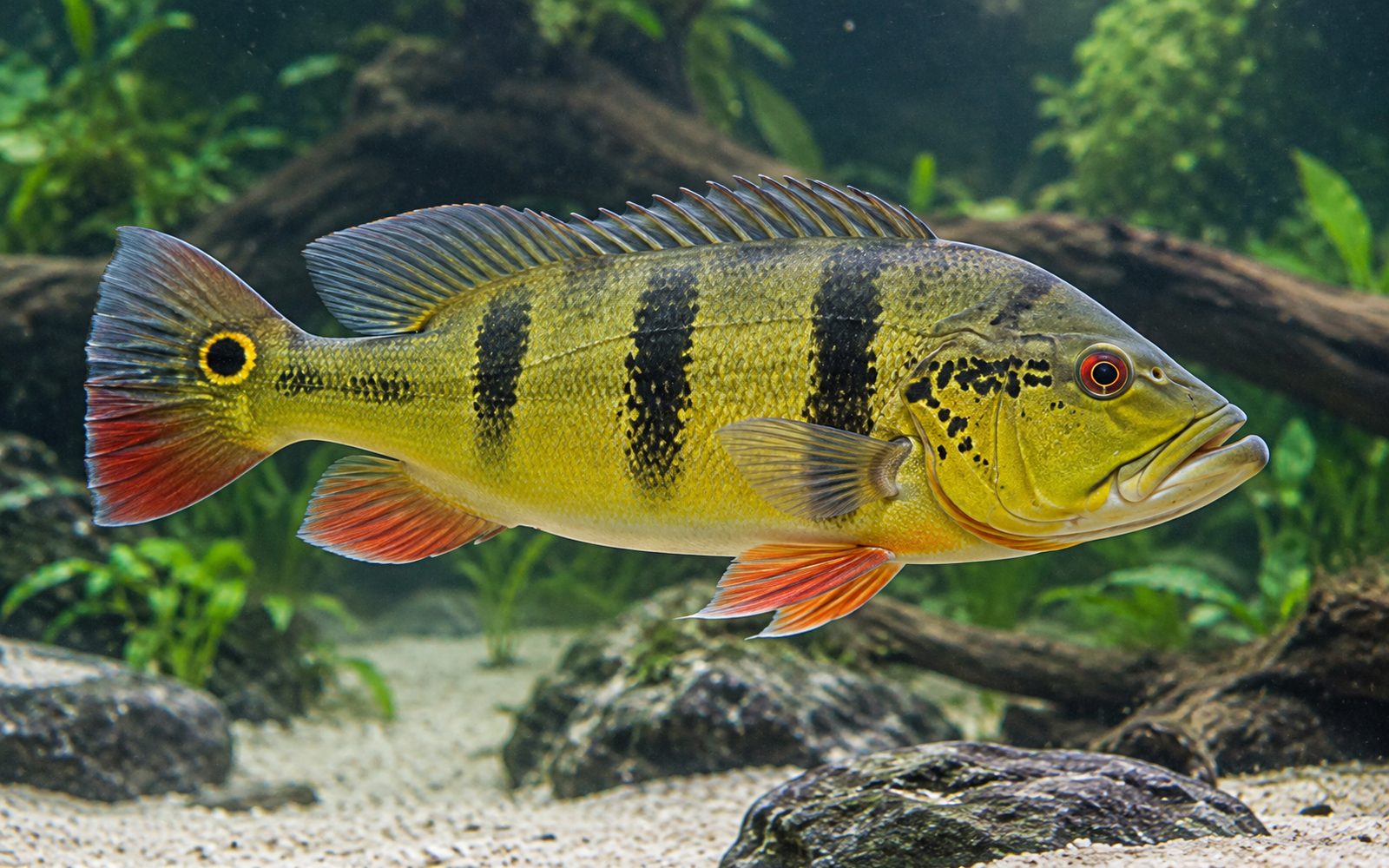
The peacock bass (tucunaré) is one of South America's most famous game fish, and it is a cichlid. Its golden-yellow or olive body has three dark vertical bands, a large gold-ringed eyespot on the caudal peduncle and red–orange eyes. In the wild it exceeds 60 cm and grows fast. Some of the "Cichla ocellaris" sold in the hobby are actually related Cichla species. In many countries it has been released into the wild for sport fishing and has put pressure on native species; it must never be released into the wild.
Tank Setup
- At least 1500 liters and 250–300 cm of length for a single adult; even juveniles grow quickly.
- A wide open swimming area, with minimal, sturdy decor.
- Very powerful filtration and a heavy lid; it jumps and crashes into the glass when startled.
- A 30–50% water change weekly.
Diet
Carnivorous and eats a lot. Offer frozen fish fillet, shrimp and mussels; some individuals get used to carnivore sticks. Live feeder fish are not recommended because of the risk of disease.
Behavior and Compatibility
Usually calm toward fish of its own size, but it eats anything that fits in its mouth. It becomes tougher during breeding.
Good companions: only giant fish of its own size: large plecos, big silvery fish, giant cichlids; in a very large tank.
Avoid: any creature smaller than itself; standard home aquariums.
A short profile for this species
The Butterfly Peacock Bass page has the basics, but the sections below have not been written yet. If you keep this species, write a section from your own experience; it will be published under your name after editor approval.
Tank mates
This list is calculated automatically from the species profile and grows as new species are added to the catalog. Try it in the planner for a definite answer.
Usually compatible
 Spotted Tilapia
 Chocolate Cichlid
 Flowerhorn
 Jack Dempsey
 Redhead Cichlid
 Red Devil Cichlid
 Red Terror Cichlid
 Cryptocoryne Parva
 Zebra Tilapia
Adonis Pleco
Zebra Tilapia
Adonis Pleco
Should not be kept together








Hobbyist notes
Things you won't find in books, learned by trial and error. The most helpful ones are on top.
Change history and contributors
- Page created · October 16, 2026