
Water parameters
Overview
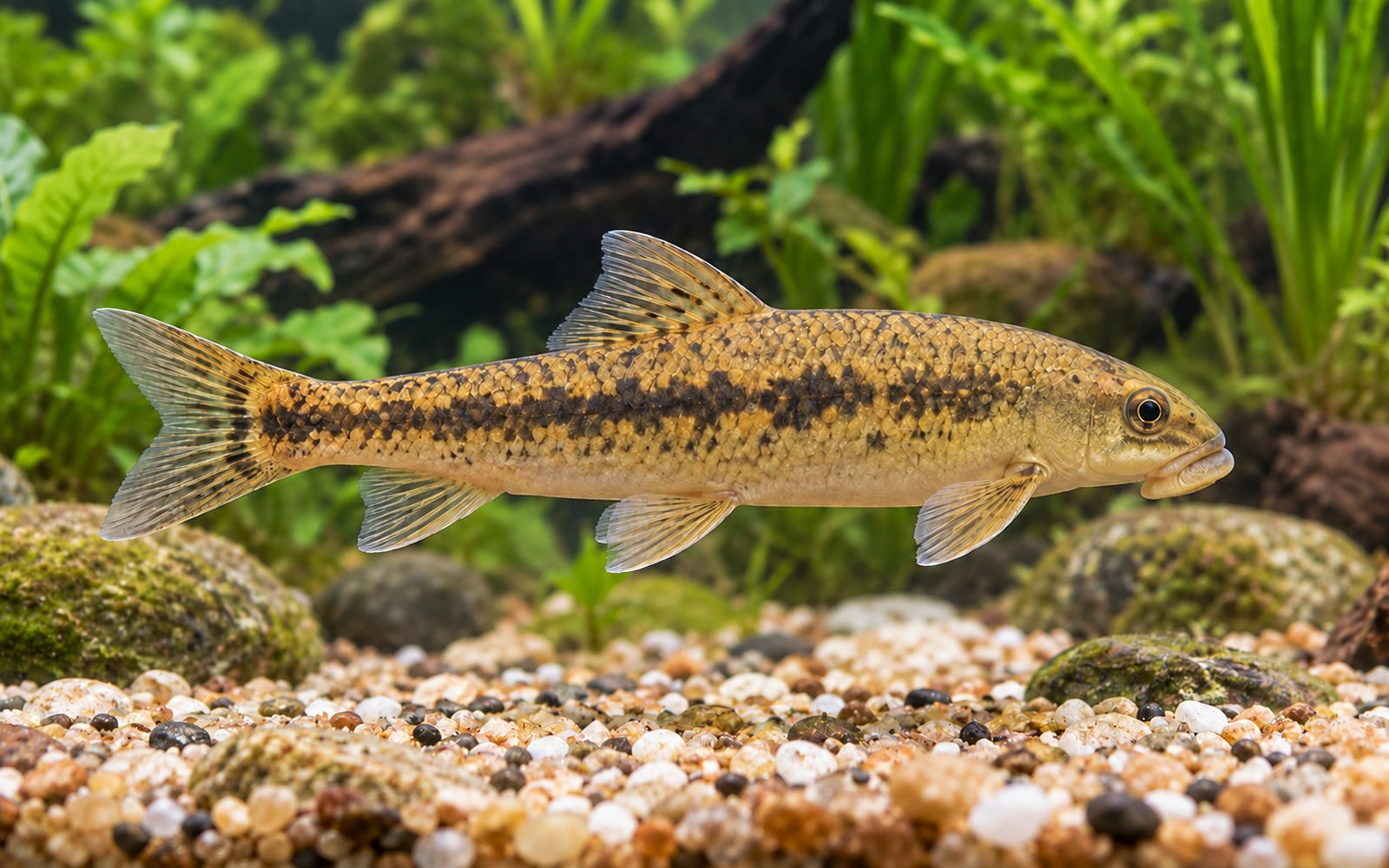
The Chinese algae eater is the best-known member of its own family (Gyrinocheilidae). Despite its name, its main range is Thailand, Laos, Cambodia and Vietnam. Its mouth works like a suction cup; while clinging to surfaces, the fish can breathe by taking in water through a small extra opening above the gill cover.
It is sold in stores as 4–5 cm juveniles under the label "algae cleaner". It does this job well when young; but it reaches 20–25 cm as an adult, loses interest in algae and becomes grumpy. The golden-yellow form is very common in the trade.
Color and Fin Varieties
- Golden (golden algae eater): a form with a yellow–gold body and no pattern or a very faint one; its behavior is the same as the wild form.
Natural Habitat
It lives in flowing rivers and streams of the Mekong, Chao Phraya and Mae Klong basins, on bottoms full of rocks, roots and submerged branches. In strong current it holds on to surfaces with its mouth.
Tank Setup
- Volume: at least 250 liters and 120 cm of length for one adult.
- Water: 24–27°C; clean, oxygen-rich water and moderate current.
- Decor: rocks, roots and caves; wide surfaces it can graze.
- Lid: a tight lid is recommended.
Diet
When young it feeds mainly on algae and biofilm. Adults are omnivorous and want more protein: sinking tablets and granules, spirulina, blanched vegetables, frozen bloodworms and brine shrimp. A well-fed individual turns on other fish less often.
Behavior and Compatibility
Peaceful when young. As it matures it sets up a territory and chases its own kind and similar bottom dwellers. Its best-known problem is latching onto the bodies of slow, flat-bodied fish such as discus, angelfish, gouramis and goldfish and rasping off their slime coat; this leads to wounds and infection.
Good companions: fast-swimming medium to large schooling fish (barbs, large danios, rainbowfish), robust medium-sized cichlids.
Avoid: discus, angelfish, gouramis, goldfish and other slow, flat-bodied species; a second Chinese algae eater; peaceful small bottom dwellers.
Group and Colony Structure
Keeping it alone is recommended. Several individuals can live together only in very large, divided aquariums with enough territories and hiding places; otherwise they fight constantly.
Breeding
Breeding in the home aquarium is not known. Commercial breeding is done on farms with hormone support.
Health and Common Problems
Hardy. It is sensitive to sudden water changes and low oxygen. In an adult, insufficient protein can increase the tendency to go after other fish. Fish whose slime coat has been rasped show pale, whitish patches and wounds on the body; in that case the Chinese algae eater should be removed immediately and the injured fish monitored for infection.
Sexing
Hard to tell apart externally. In mature males, small bumps (breeding tubercles) may appear around the snout during the breeding season; females are plumper.
Tank mates
This list is calculated automatically from the species profile and grows as new species are added to the catalog. Try it in the planner for a definite answer.
Usually compatible
 Yellow Regal Peacock
Glass Tetra
Yellow Regal Peacock
Glass Tetra
 Emerald Betta
 Firemouth Cichlid
 Buffalohead Cichlid
 Chocolate Cichlid
 Demasoni Cichlid
 Festivum
 Geophagus altifrons
 Geophagus surinamensis
Should not be kept together
Hobbyist notes
Things you won't find in books, learned by trial and error. The most helpful ones are on top.
Change history and contributors
- Page created · October 16, 2026