
Water parameters
Overview
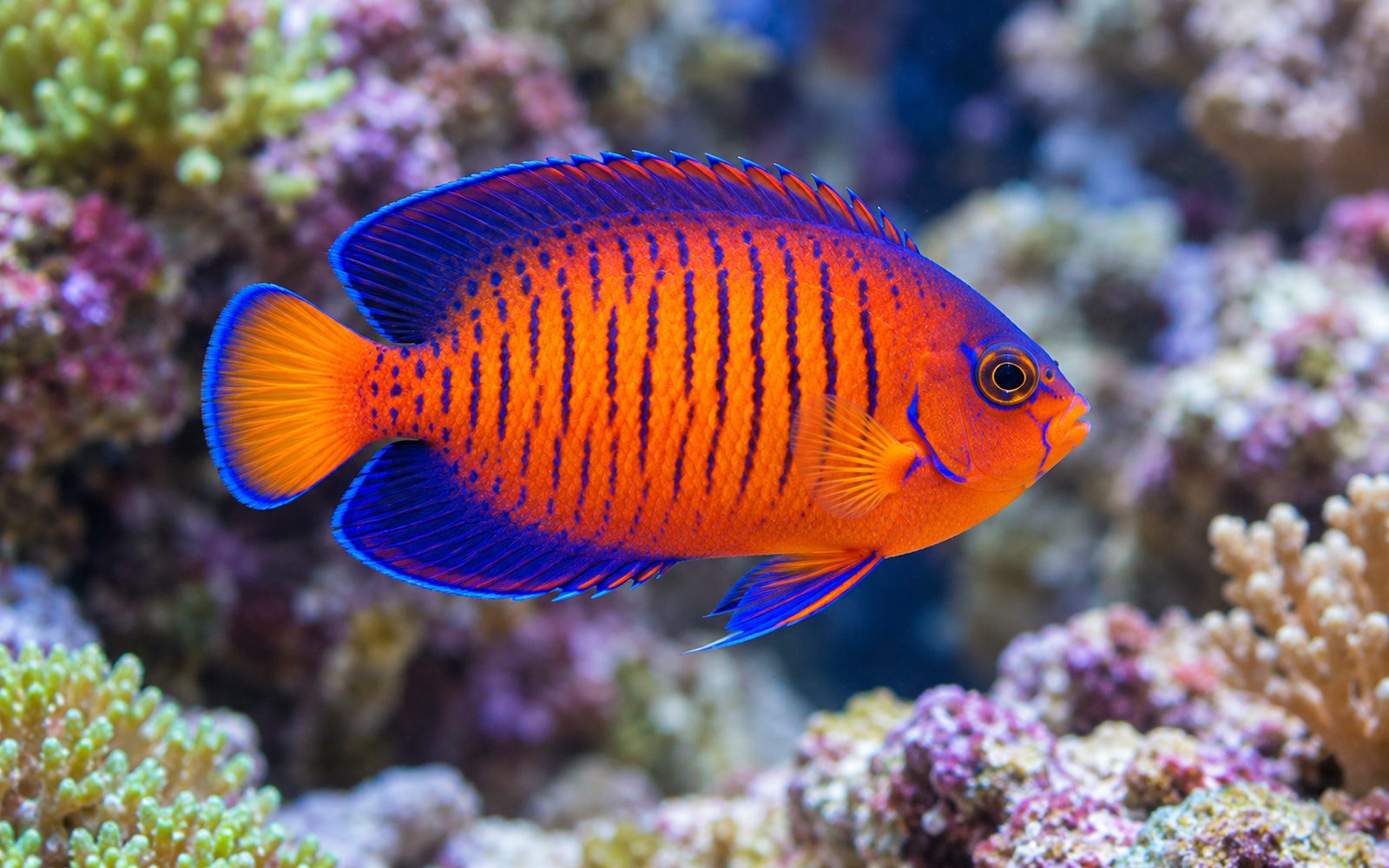
The coral beauty is one of the dwarf angelfish that adapt most easily to the aquarium. The edges of its body are dark blue-purple, the middle ranges between orange and red, and it is covered in many thin dark vertical lines. The color pattern varies greatly by region; some individuals are almost entirely blue, while others have large orange areas. The "bispinosa" in its name refers to the two spines on its gill cover.
Most individuals are wild-collected, but the species is generally robust and switches to prepared foods quickly.
Natural Habitat
It lives in lagoons and on outer reef slopes of the Indo-Pacific, in areas with rich coral growth, close to crevices among rocks and corals. In the wild it is seen in small harems.
Tank Setup
- Volume: at least 200 liters; live rock with many hiding places and caves.
- Water: salinity 1.023–1.026 specific gravity, pH 8.1–8.4, temperature 24–27°C.
- Maturity: an aquarium a few months old, with algae and small organisms on its rocks.
- Reef compatibility: reef safe with caution. Most soft corals and SPS corals are generally safe; LPS corals, zoanthids and Tridacna clams may be picked at.
Diet
Omnivorous. Angelfish foods containing spirulina and seaweed, frozen mysis, brine shrimp and chopped seafood, plus dried seaweed. Feed small amounts 2–3 times a day; grazing on the rock surfaces is its natural behavior.
Behavior and Compatibility
A relatively peaceful dwarf angelfish, but it defends its territory. It may be aggressive toward other dwarf angelfish, especially newcomers. It has no problems with larger fish of a different shape.
Good companions: clownfish, tangs, anthias, wrasses, gobies, blennies, cardinalfish, cleaner shrimp.
Avoid: a second dwarf angelfish (except in a very large aquarium), large aggressive species, lionfish.
Group and Colony Structure
Keep a single individual in the aquarium. Dwarf angelfish start out as females and the dominant individual changes into a male; in a large aquarium a pair can be formed by adding two juveniles of different sizes together. Ready-made pairs are sometimes sold.
Breeding
Pairs release pelagic eggs in the water column in the late afternoon. Spawning can be seen in the aquarium; raising the fry, however, is a job for experts because it requires very small planktonic foods.
Health and Common Problems
- Marine ich and velvet: as with other marine fish; observe a new fish in quarantine.
- Copper sensitivity: dwarf angelfish may lose their appetite during copper treatment; dose and duration should be monitored carefully.
- Underfeeding: an individual that finds no surfaces to graze on in a very clean, newly set-up aquarium wastes away.
Sexing
The sexes cannot be reliably told apart externally; in a pair, the larger one is usually the male.
Tank mates
This list is calculated automatically from the species profile and grows as new species are added to the catalog. Try it in the planner for a definite answer.
Should not be kept together


Hobbyist notes
Things you won't find in books, learned by trial and error. The most helpful ones are on top.
Change history and contributors
- Page created · October 16, 2026