
Water parameters
Overview
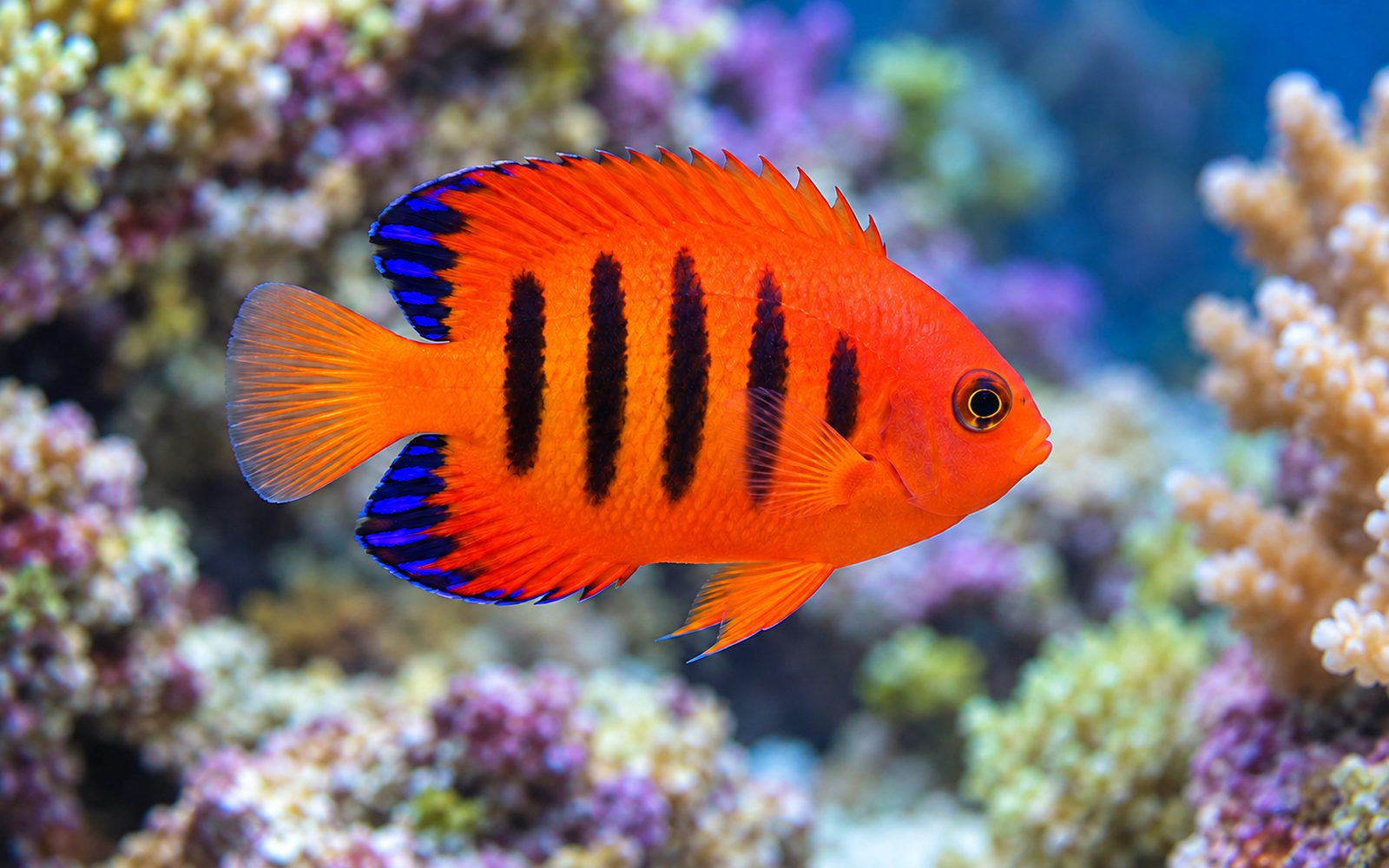
The flame angel is the best-known and best-selling species of dwarf angelfish (Centropyge). Its body, ranging from orange to blood red, carries several black vertical bars, with blue and black bands on the rear edges of the dorsal and anal fins. The shade varies by region; deep red individuals from the Marshall Islands are the most sought-after and the most expensive. On the lower corner of the gill cover there is a backward-pointing spine typical of all angelfish; it can get caught in a net.
Most individuals in the trade are wild-collected; a small number of captive-bred fish are also available. Do not buy one without seeing in the store that it is eating, that its fins are intact and its eyes clear.
Natural Habitat
It lives on the outer reef slopes of oceanic islands, usually below 10 meters, in crevices among rocks and coral rubble. In the wild it forms small harems of one male and several females and picks at algae and small invertebrates on the rocks.
Tank Setup
- Volume: at least 200 liters; a live rock aquascape with plenty of crevices and caves.
- Water: salinity 1.023–1.026 specific gravity, pH 8.1–8.4, temperature 24–27°C.
- Maturity: a mature aquarium whose rocks carry algae and microfauna to pick at makes acclimation easier.
- Reef compatibility: reef safe with caution. Many individuals never touch corals; others pick at LPS corals, zoanthids and the mantles of Tridacna clams. This behavior cannot be predicted in advance.
Diet
Omnivorous. Angelfish foods containing spirulina and seaweed, frozen mysis and brine shrimp, and dried seaweed (nori). It also grazes constantly on algae on the rock surfaces. Feed small amounts 2–3 times a day.
Behavior and Compatibility
It starts out shy, grows bolder as it settles in and claims its own territory. It is aggressive toward other dwarf angelfish and similarly colored fish; it usually gets along with other species.
Good companions: clownfish, tangs, anthias, wrasses, cardinalfish, gobies, cleaner shrimp.
Avoid: other dwarf angelfish (except in a very large aquarium), large aggressive triggerfish, lionfish, sensitive coral collections.
Group and Colony Structure
Usually kept as a single individual in the aquarium. Dwarf angelfish start out as females, and the dominant individual in a group changes into a male; for this reason, in very large aquariums a pair can be formed by adding two juveniles of clearly different sizes together. Two adults of the same size kept together will fight.
Breeding
Pairs rise into the water column in the late afternoon and release pelagic eggs. Spawning can be seen in the aquarium, but raising the fry takes expertise because the larvae need very small plankton.
Health and Common Problems
- Marine ich and velvet: common in new arrivals; quarantine is essential.
- Acclimation problems: individuals stressed by shipping may refuse food in the first weeks; a calm quarantine tank and a variety of foods help.
- Copper sensitivity: dwarf angelfish may lose their appetite during copper treatment; monitor the dose carefully.
Sexing
The sexes cannot be reliably told apart externally. In a pair, the larger individual is usually the male.
Tank mates
This list is calculated automatically from the species profile and grows as new species are added to the catalog. Try it in the planner for a definite answer.
Should not be kept together


Hobbyist notes
Things you won't find in books, learned by trial and error. The most helpful ones are on top.
Change history and contributors
- Page created · October 16, 2026