
Water parameters
Overview
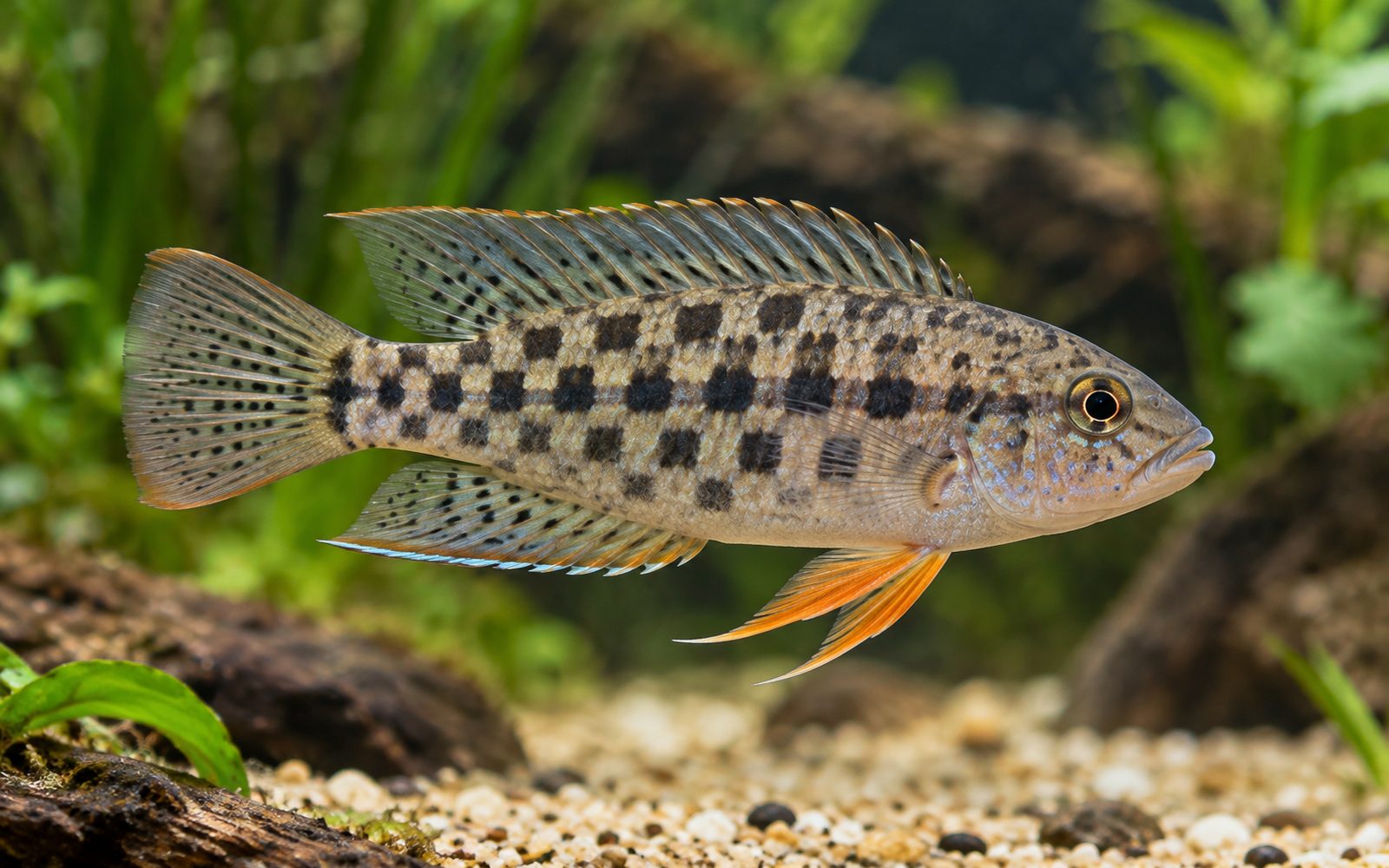
Crenicara punctulata is recognized by its checkerboard pattern made up of rows of dark squares on its body. Because its males reach 10–12 cm, it is not a true dwarf, but thanks to its calm nature it is kept alongside dwarf cichlids. Its most interesting feature is sequential hermaphroditism: all the young develop as females; the dominant female in the group gradually turns into a functional male. If there is no male in the aquarium, the strongest female makes this change.
Tank Setup
- At least 120 liters and a large footprint for a group of 3–4.
- 24–27°C; soft to moderately hard water is enough for everyday care, but breeding requires soft, acidic water.
- Fine sand, dried leaves, roots and plants; flat stones and broad leaves serve as spawning surfaces.
Diet
Carnivorous. Frozen bloodworms, brine shrimp, mysis and daphnia along with sinking granules are suitable. Live food strengthens breeding condition.
Behavior and Compatibility
Peaceful; the male guards the area where the females are, and the females care for the eggs and fry. It spawns on open surfaces. Females ready to breed are easily recognized by their bright orange pelvic fins. Because of its size, it hunts dwarf shrimp.
Good companions: medium-sized tetras, hatchetfish, Corydoras, bristlenose plecos, other peaceful South American species.
Avoid: shrimp, aggressive cichlids, very small and slow fish (small enough to fit in its mouth).
A short profile for this species
The Crenicara punctulata page has the basics, but the sections below have not been written yet. If you keep this species, write a section from your own experience; it will be published under your name after editor approval.
Tank mates
This list is calculated automatically from the species profile and grows as new species are added to the catalog. Try it in the planner for a definite answer.
Usually compatible
 Flame Tetra
Glass Tetra
Flame Tetra
Glass Tetra
 Blackfin Corydoras
 Polystictus Corydoras
 Emerald Betta
 Emerald Cory
 Porthole Catfish
 Keyhole Cichlid
 Cupid Cichlid
 Geophagus altifrons
Should not be kept together







Hobbyist notes
Things you won't find in books, learned by trial and error. The most helpful ones are on top.
Change history and contributors
- Page created · October 16, 2026