
Water parameters
Overview
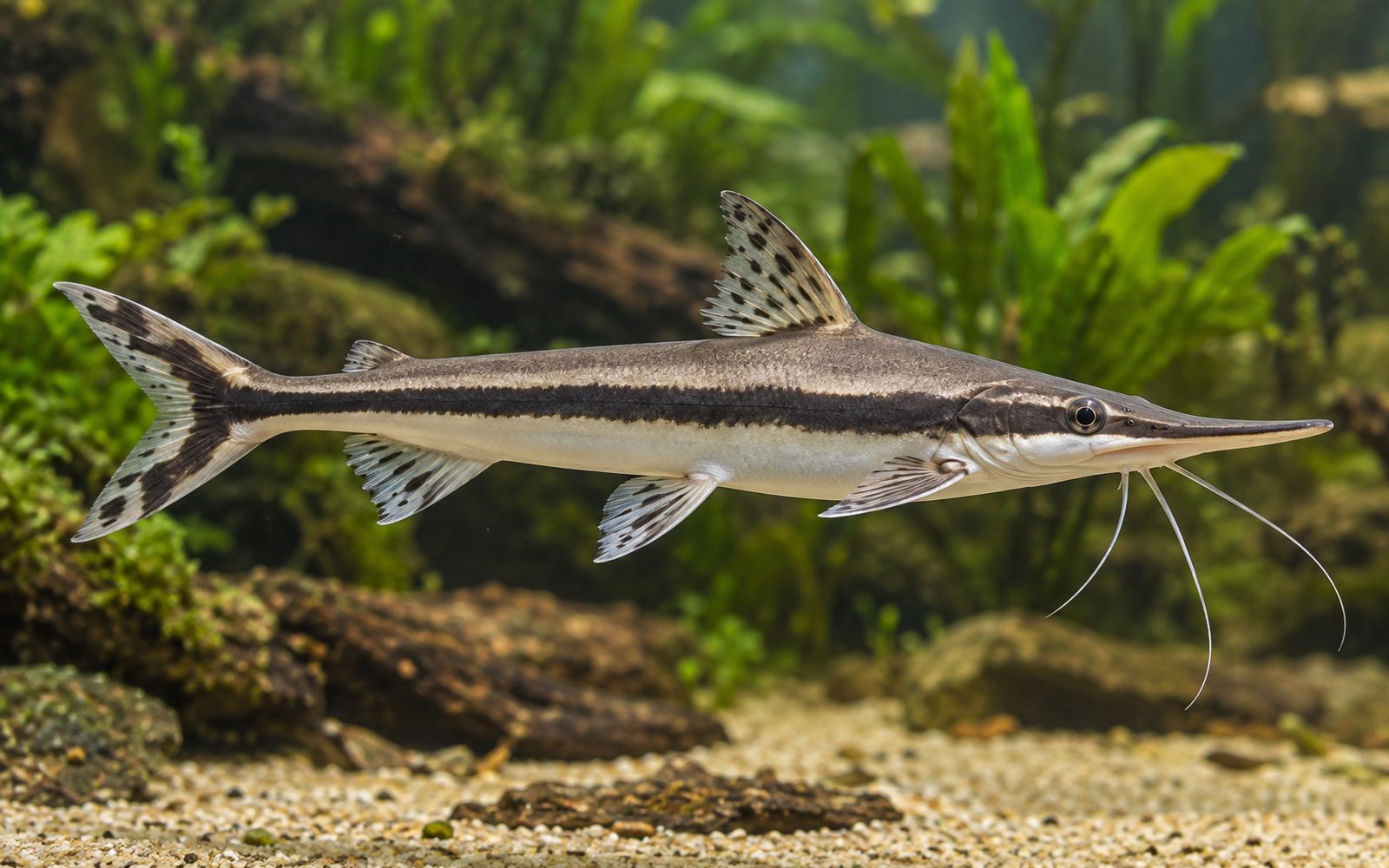
The duckbill catfish is one of the "shovelnose" members of the family Pimelodidae. Its long, slender body starts with a flat, wide snout like a duck's bill; the upper jaw projects clearly beyond the lower jaw. A thick black stripe runs through the middle of the silvery gray body, from the tip of the snout to the tail.
Mind its size: it is sold in stores as 8–10 cm juveniles, but adults reach 45–50 cm. It is a predator that needs a long aquarium and eats fish that fit in its mouth; it is therefore suited not to community aquariums but to tanks for large fish.
Natural Habitat
It lives in the large rivers of South America, in flooded forests and among clumps of vegetation along the banks. During the day it rests motionless among roots and plants, and it hunts at night.
Tank Setup
- Volume: at least 600 liters and 180 cm of length; a depth (front to back) of at least 60 cm.
- Decor: roots, sturdy long-leaved plants or artificial plants; vertical structures among which it can rest during the day.
- Substrate: soft sand.
- Lighting: dim; avoid sudden changes in light.
- Water: 24–28°C, pH 6.0–7.5; strong filtration and good oxygenation.
Diet
Carnivorous. Offer fish fillet, shrimp, mussels, large frozen foods and carnivore granules. Individuals that arrive used to live fish can gradually be weaned onto dead food offered with tongs. Feed in the evening. Feeding juveniles every other day and adults two or three times a week is enough; overfeeding leads to obesity and poor water quality.
Behavior and Compatibility
It is peaceful toward fish too large to fit in its mouth and does not bother them. Any fish that does fit in its mouth, however, it hunts at night. It spends most of the day motionless among roots and plants, holding its body parallel to them. When startled it can dart off and crash into the glass.
Good companions: fish larger than itself or too deep-bodied for it to swallow: large cichlids, silver dollars, large plecos, big Synodontis.
Avoid: tetras, rasboras, small barbs, shrimp; narrow aquariums.
Group and Colony Structure
It can live alone; it is tolerant of its own kind, and 3 or more individuals can be kept together in very large aquariums. The sex ratio does not matter.
Breeding
It does not breed in home aquariums. The fish sold are wild-caught or produced on farms with hormone treatment.
Health and Common Problems
- Snout injuries: scrapes and infection on the tip of the snout from crashing into the glass when startled; dim lighting and a calm environment prevent this.
- White spot (ich): common after transport; its scaleless skin is sensitive to medications.
- A dirty bottom leads to barbel rot; clean the bottom regularly and do weekly water changes.
Sexing
Cannot be reliably sexed externally.
Tank mates
This list is calculated automatically from the species profile and grows as new species are added to the catalog. Try it in the planner for a definite answer.
Usually compatible
 Chocolate Cichlid
 Geophagus altifrons
 Geophagus surinamensis
 Pearl Cichlid
 Threadfin Acara
 Redhead Cichlid
 Cryptocoryne Parva
 Gold Spot Pleco (L001)
African Brown Knifefish
Gold Spot Pleco (L001)
African Brown Knifefish
 Weeping Moss
Should not be kept together









Hobbyist notes
Things you won't find in books, learned by trial and error. The most helpful ones are on top.
Change history and contributors
- Page created · October 16, 2026