
Water parameters
Overview
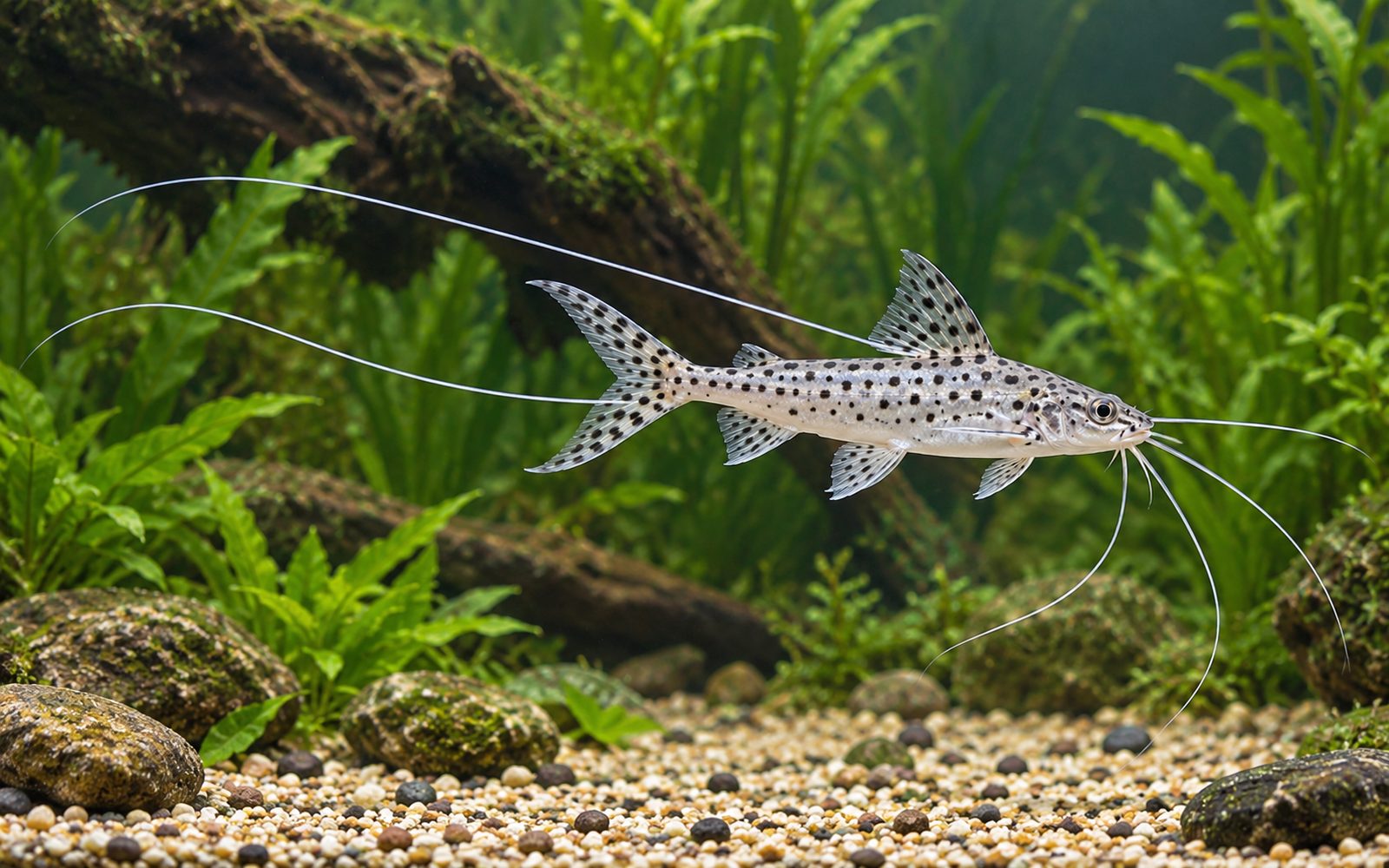
The pictus is one of the most commonly kept and smallest-growing members of the long-whiskered catfish family (Pimelodidae). Its silvery white body is covered with small black spots; the barbels on its upper jaw are longer than its body and trail back as it swims. Unlike most catfish, it swims constantly during the day as well, especially when kept in a group.
It is sold in stores as 5–7 cm juveniles and reaches 11–13 cm as an adult. Although it looks small, its fast and active nature means it needs a long aquarium. It has sharp spines in its dorsal and pectoral fins, and a sting is quite painful.
Natural Habitat
It lives in groups on the sandy bottoms and near-shore areas of large rivers in the Amazon and Orinoco basins. These waters are generally soft, slightly acidic and well oxygenated. The fish search for food by sweeping the bottom with their long barbels.
Tank Setup
- Volume: at least 250 liters and 120 cm of length for a group of 3–5; length matters more than volume.
- Substrate: fine, soft sand. The barbels are easily injured on sharp gravel.
- Decor: roots and caves along the edges, a large open swimming area in the middle.
- Water: 23–26°C, pH 6.0–7.5; clean, well oxygenated and with gentle flow.
- Lid: because it can be startled by sudden movements, a covered aquarium is safer.
Diet
Omnivorous but prefers animal-based food. Offer sinking granules and tablets, frozen bloodworms, brine shrimp, mysis shrimp and small worms. It is a fast and hearty eater; make sure the slow bottom dwellers it lives with also get food.
Behavior and Compatibility
It is not aggressive toward other fish, but it sees anything that fits in its mouth as prey. Small fish such as neons, endlers and guppies are at risk, especially at night. Its restless swimming can unsettle calm and timid species.
Good companions: medium to large peaceful fish: Congo tetras, large barbs, rainbowfish, gouramis, calm American cichlids, large corydoras and plecos.
Avoid: small tetras and rasboras, guppies and endlers, shrimp; very calm and timid species.
Group and Colony Structure
It is a social species: at least 3, ideally 5 or more individuals. In a group it is more relaxed and visible; a pictus kept alone often hides or roams the tank restlessly because of stress. The sex ratio does not matter.
Breeding
There are almost no known records of it being bred in home aquariums. Most of the fish sold are wild-caught.
Health and Common Problems
- White spot (ich): common after transport. Because it is scaleless, it is sensitive to medications; start at half the dose and monitor closely.
- Barbel injuries: sharp substrate and a dirty bottom are the main causes.
- Nets: the spines easily get caught in nets; catch the fish with a container and avoid handling it.
Sexing
Cannot be reliably sexed externally. Mature females may look slightly plumper when viewed from above.
Tank mates
This list is calculated automatically from the species profile and grows as new species are added to the catalog. Try it in the planner for a definite answer.
Usually compatible
 Blackfin Corydoras
 Emerald Betta
 Emerald Cory
 Porthole Catfish
 Keyhole Cichlid
 Buffalohead Cichlid
 Geophagus surinamensis
 Rainbow Cichlid
 Cryptocoryne Parva
Should not be kept together






Hobbyist notes
Things you won't find in books, learned by trial and error. The most helpful ones are on top.
Change history and contributors
- Page created · October 16, 2026