
Water parameters
Overview
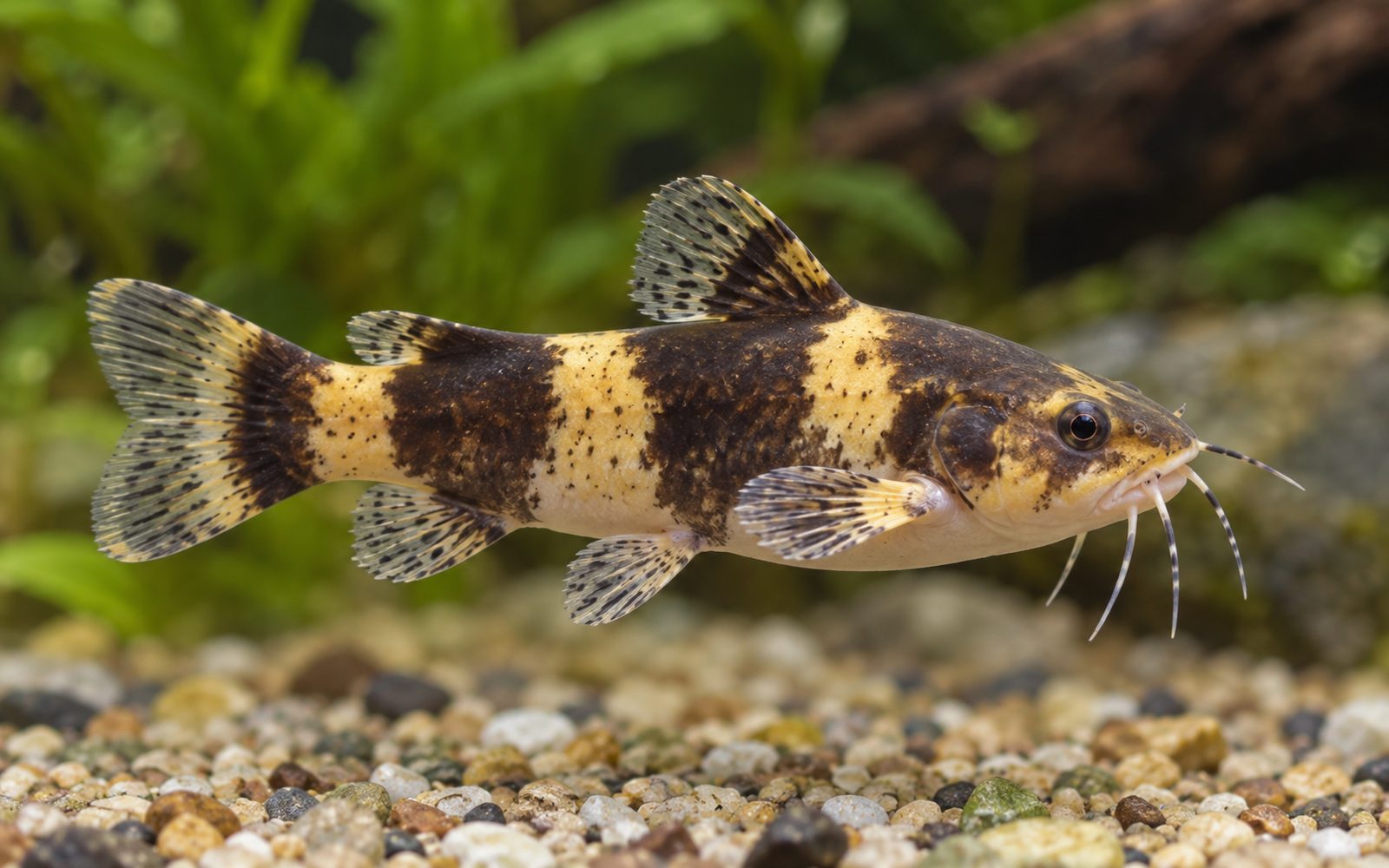
The bumblebee catfish is a small member of the family Pseudopimelodidae. Its thick, yellowish-cream and dark brown bands give it the look of a bumblebee. Its head is broad and flat, and its mouth is surprisingly large for its body; thanks to this mouth it can swallow prey that is fairly large relative to its own size.
Adults stay at 6–7 cm, and it suits small aquariums. It should not be confused with the Asian bumblebee catfish (Pseudomystus siamensis), which is sold under the same name in the trade; that species grows twice as large and is more territorial.
Natural Habitat
It lives in the clear, flowing, rocky streams and rivers of Venezuela and Colombia. It spends the day hiding under rocks, among roots and in leaf litter; at night it hunts small creatures on the bottom.
Tank Setup
- Volume: at least 60 liters for one or two individuals.
- Decor: A separate cave, space under a rock or root hollow for each individual; the fish claims its hiding place.
- Substrate: Fine sand or rounded gravel.
- Water: 22–25°C, pH 6.0–7.5; clean, well-oxygenated, with gentle flow.
- Lighting: In a dim setting it may come out during the day as well.
Diet
Carnivorous. Frozen bloodworms, mysis, brine shrimp, small sinking granules and carnivore tablets are suitable. Because it is active at night, feed after the lights go off. It does not care much for flakes. Feeding juveniles every day and adults every other day is enough.
Behavior and Compatibility
Peaceful toward larger fish and hides most of the time. However, it sees any creature that fits into its mouth as prey: fry, dwarf shrimp and very small fish of 2–3 cm are at risk at night. It may have brief squabbles with members of its own species over hiding places. It likes to wait for food around the cave it has settled in; over time it learns to come out at feeding time.
Good companions: Peaceful fish over 5 cm: medium-sized tetras, barbs, corydoras, gouramis, calm dwarf cichlids.
Avoid: Very small fish such as Boraras and micro rasboras, dwarf shrimp, aquariums where fry are being raised.
Group and Colony Structure
It lives comfortably as a single individual. If the aquarium is large enough and has plenty of hiding places, several individuals can be kept together; each should have its own cave. The sex ratio does not matter.
Breeding
It breeds in the aquarium very rarely, and reliable information on its breeding behavior is scarce. The fish sold are mostly collected from the wild.
Health and Common Problems
- A hardy species; the main risks are poor water and low oxygen.
- Its scaleless skin is sensitive to copper and strong medications.
- Overfeeding leads to bloating; feeding every other day is enough for adults.
Sexing
Difficult to tell apart from the outside. Mature females look plumper when viewed from above.
Tank mates
This list is calculated automatically from the species profile and grows as new species are added to the catalog. Try it in the planner for a definite answer.
Usually compatible
 Flame Tetra
 Blackfin Corydoras
 Polystictus Corydoras
 Emerald Betta
 Emerald Cory
 Porthole Catfish
 Keyhole Cichlid
 Geophagus surinamensis
 Cryptocoryne Parva
 Gold Spot Pleco (L001)
Should not be kept together






Hobbyist notes
Things you won't find in books, learned by trial and error. The most helpful ones are on top.
Change history and contributors
- Page created · October 16, 2026