
Water parameters
Overview
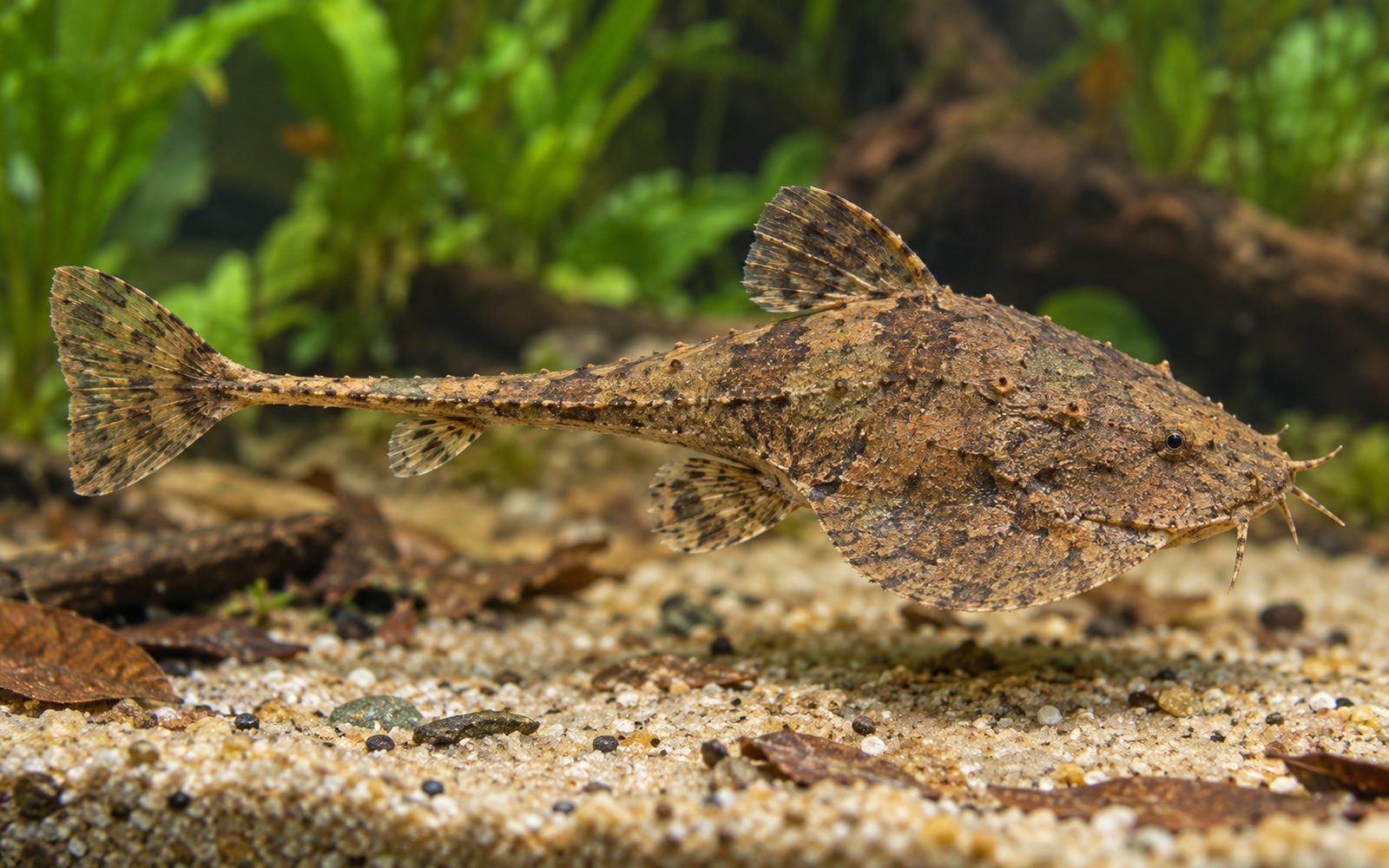
The banjo catfish is named after its broad, flat front body and thin, long tail. With its rough, warty skin and brown-spotted coloring it resembles a dry leaf or a piece of twig fallen to the bottom; this camouflage protects it from predators. Because it can lie motionless for hours, it is common for aquarists to think it has "disappeared".
It periodically sheds its scaleless skin all at once; seeing a thin, transparent piece of shed skin in the aquarium is normal. Adults reach 12–15 cm; it usually looks smaller than that, because most of its body is made up of the flat head.
Natural Habitat
It lives in slow-flowing streams, lakes and ponds of the Amazon basin, on bottoms with leaf litter and soft mud. It spends the day buried in sand or under leaves, and at night it roams the bottom looking for small creatures.
Tank Setup
- Volume: 100 liters is enough for a few individuals; floor area matters more than swimming space.
- Substrate: Fine, soft sand is a must; the fish buries itself in the sand during the day.
- Decor: Dried leaves (catappa, oak), roots and dim corners.
- Water: 22–27°C, pH 6.0–7.5, soft to moderately hard water.
- Current: Gentle; it does not like strong flow.
Diet
Omnivorous but leans toward animal food. It eats sinking tablets, frozen bloodworms, brine shrimp, tubifex and small worms. Because it feeds at night, drop food to the bottom after the lights go off; if it lives with fast-eating companions, make sure it is not going hungry.
Behavior and Compatibility
Extremely peaceful and shy. Its mouth is small; it poses a risk only to newly hatched fry and very small invertebrates. It may not get enough food alongside fish that snatch food quickly. At night it moves slowly over the sand looking for food; during the day, often only its eyes and part of its back stay above the sand.
Good companions: Small to medium tetras, rasboras, corydoras, dwarf cichlids, gouramis, otocinclus.
Avoid: Digging and aggressive cichlids, large catfish that compete hard on the bottom, predators whose mouths it would fit into.
Group and Colony Structure
It can also live alone; it is tolerant of its own kind, and several individuals often rest in the same corner, even on top of each other. The sex ratio does not matter.
Breeding
It rarely breeds in the aquarium. In reported spawnings, a large number of small eggs were laid on the substrate, mostly in a pit dug in the sand. The fry are raised on infusoria and brine shrimp nauplii.
Health and Common Problems
- Shedding skin is normal and not a sign of disease.
- Starvation: Individuals that cannot get enough food because of fast tankmates become thin; if its belly is sunken, shift feeding to nighttime.
- Sharp gravel injures its skin and barbels.
- Its scaleless skin is sensitive to medications.
Sexing
Mature females are noticeably plumper and broader; males are slimmer.
Tank mates
This list is calculated automatically from the species profile and grows as new species are added to the catalog. Try it in the planner for a definite answer.
Usually compatible
 Flame Tetra
Glass Tetra
Flame Tetra
Glass Tetra
 Blackfin Corydoras
 Polystictus Corydoras
 Emerald Betta
 Emerald Cory
 Emerald Dwarf Rasbora
 Porthole Catfish
 Keyhole Cichlid
 Cupid Cichlid
Should not be kept together






Hobbyist notes
Things you won't find in books, learned by trial and error. The most helpful ones are on top.
Change history and contributors
- Page created · October 16, 2026