
Water parameters
Overview
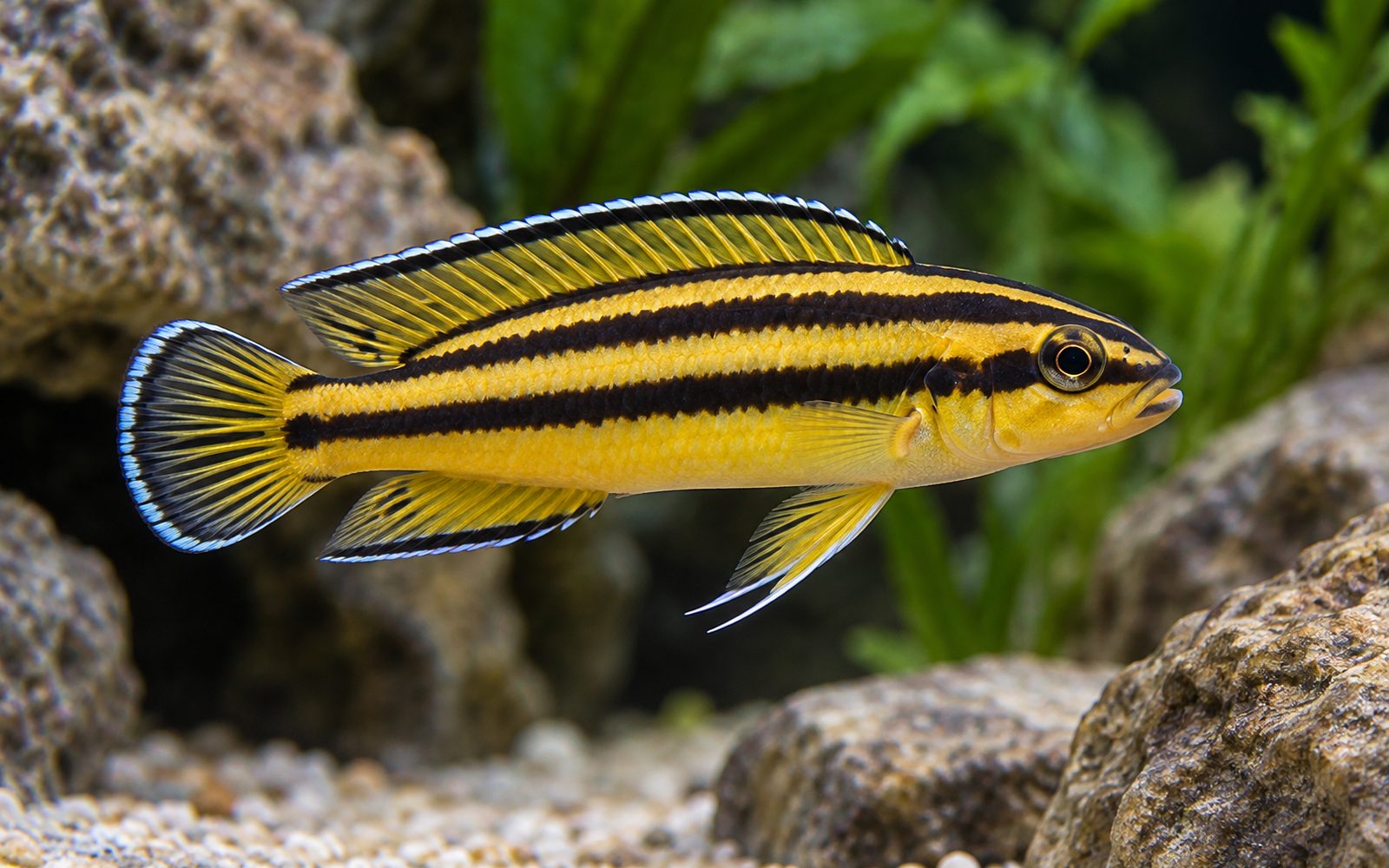
Julidochromis ornatus is one of the most colorful members of the genus, with three distinct black horizontal stripes running along its golden-yellow body. Its adult size is around 7–8 cm; because of this it does not need as much space as the large julies and is very well suited to small Tanganyika aquariums.
Like its relatives, it swims with its belly turned toward the rock surface and can hang upside down under rock overhangs. The pair bond is strong; the female is slightly larger than the male. In a properly set-up aquarium it breeds for years and several generations live together.
Natural Habitat
It lives along the lake's rocky shores, in narrow crevices among rock piles at shallow and medium depths. Each pair claims a small rock group and feeds by picking up small invertebrates inside the crevices. When in danger it immediately retreats into the nearest crevice; it rarely ventures into open water. The water is hard, alkaline and stable.
Tank Setup
- Volume: 60 liters for a pair; 100 liters or more with other species.
- Rockwork: sturdy rock piles with narrow crevices; a few small caves between flat stones.
- Water: pH 8–9, hard and stable; a 20–25% water change every week.
- Substrate: fine sand; if it will be kept with shell-dwelling cichlids, leave a sandy area.
Diet
Mainly carnivorous. A fine-grained cichlid granule or flake food should be the staple; vary it with frozen cyclops, brine shrimp and mysis. Give small amounts 1–2 times a day.
Behavior and Compatibility
It defends its own rock territory, but in keeping with its size this defense is moderate. When there are eggs and fry, it chases off fish that approach its territory.
Good companions: shell-dwelling cichlids (multifasciatus, similis, ocellatus), Cyprichromis, Paracyprichromis, small Neolamprologus species.
Avoid: other Julidochromis species (they hybridize), large carnivorous Tanganyika cichlids, shrimp, aggressive mbuna.
Group and Colony Structure
- Kept as a pair; 5–6 juveniles are grown up together and the pair that forms naturally is chosen.
- A compatible pair keeps its fry in its territory for a long time; several generations can be seen together in the aquarium.
- As the juveniles mature, the pair starts chasing them; at that point the extras are removed.
- There should be only one pair in a small aquarium.
Breeding
The pair lays a few dozen eggs inside a narrow crevice or small cave. The eggs hatch within a few days, the fry become free-swimming after about a week and stay among the rocks. They are fed newly hatched brine shrimp and powdered food.
Health and Common Problems
- Hardy; the main problems are soft water and low pH.
- In a small aquarium, overfeeding raises nitrate quickly.
- Fight wounds may be seen in incompatible pairs.
Sexing
Difficult from the outside. The female is usually slightly larger and plumper. A definite distinction is made by looking at the genital papilla.
Tank mates
This list is calculated automatically from the species profile and grows as new species are added to the catalog. Try it in the planner for a definite answer.
Usually compatible
 Yellow Regal Peacock
 Egyptian Mouthbrooder
 Yellow Tail Acei
Amazon Molly
Yellow Tail Acei
Amazon Molly
 Butterfly Goodeid
Anatolian Killifish
Eastern Happy
Red Shoulder Peacock
Butterfly Goodeid
Anatolian Killifish
Eastern Happy
Red Shoulder Peacock
 Fairy Cichlid
Blue Orchid Peacock
Fairy Cichlid
Blue Orchid Peacock
Should not be kept together





Hobbyist notes
Things you won't find in books, learned by trial and error. The most helpful ones are on top.
Change history and contributors
- Page created · October 16, 2026