
Water parameters
Overview
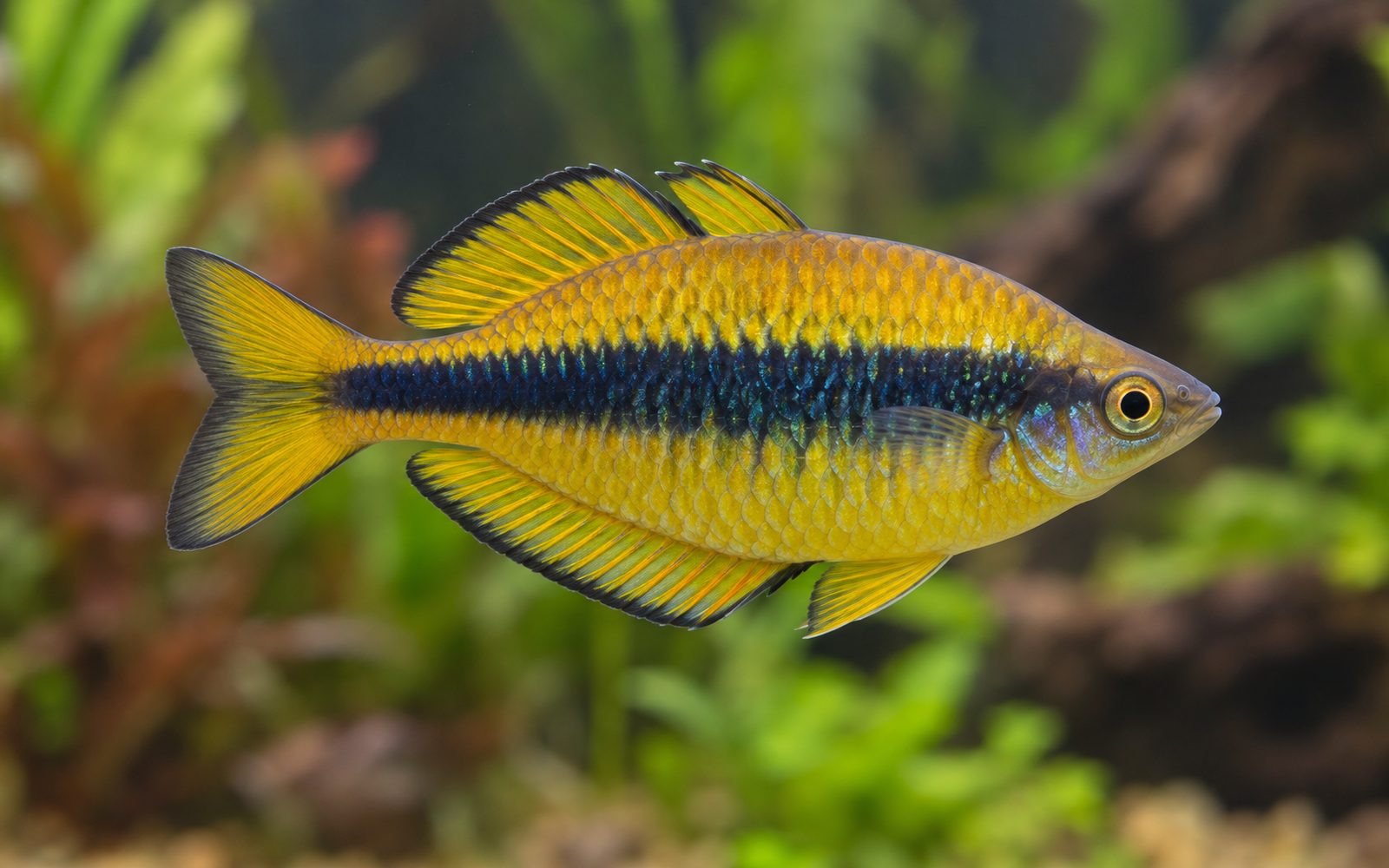
The Lake Tebera rainbowfish is easy to recognize by its body color, somewhere between lemon and golden yellow, and the dark blue-black stripe running from the gill cover to the base of the tail. It is endemic to the area around Lake Tebera in the interior of Papua New Guinea; fish in the aquarium trade are captive-bred.
It is a hardy, adaptable species that reaches 9–10 cm. Its yellow color makes a beautiful contrast when kept with blue- or red-toned rainbowfish; however, because these species can hybridize with each other, they should be kept apart if you plan to breed them.
Natural Habitat
It lives in Lake Tebera, the surrounding swamps and the small streams connected to them. Because the region lies at altitude, the water is somewhat cooler than lowland rivers; it is clear and moderately hard. The fish move along the planted shores and among sunken branches.
Tank Setup
- Volume: at least 160 liters and 120 cm of length for a school of 6–10.
- Water: 23–26°C, pH 7–8, moderately hard water. A 25–30% water change every week.
- Decor: Dense planting along the edges with a wide swimming area in the middle; roots and rocks provide shelter.
- Lighting: Good light makes the yellow shine; a dark substrate and background make the stripe stand out.
- Lid: It jumps; use a tight-fitting lid.
Diet
Omnivorous. Use quality flakes and granules as the staple and vary the diet with frozen brine shrimp, mysis, bloodworms and daphnia. Foods containing carotenoids and spirulina keep the yellow color vivid. Feed 2–3 times a day, only as much as is eaten quickly.
Behavior and Compatibility
A peaceful, active and social schooling fish. Males display to each other with spread fins; chases are brief and serious injuries are rare. Its hearty appetite means slow fish lose out at feeding time; it eats fry and small shrimp.
Good companions: Large rainbowfish from other genera, Congo tetras, corydoras, bristlenose plecos (Ancistrus), synodontis, large rasboras, loaches (botias).
Avoid: Neocaridina shrimp, aggressive cichlids, slow long-finned fish; other Melanotaenia species if you plan to breed.
Group and Colony Structure
At least 6, ideally 10 or more individuals. A female-heavy group (2 females per male) forms a balanced school. Having more than one male in the group intensifies the males' colors as they display; this behavior is only seen when the group is large enough.
Breeding
It lays its eggs over many days, a few each morning, on fine-leaved plants or a wool spawning mop. Since the eggs, which have sticky threads, can be eaten by the parents, move the mop to a separate container every few days. The fry hatch in 7–12 days; they are raised on infusoria and liquid fry food for the first week, then on newly hatched brine shrimp. The colors develop slowly over several months.
Hybridization: It hybridizes with other Melanotaenia species such as the turquoise rainbowfish and boesemani; the hybrid offspring are neither yellow nor show the pure species' pattern. Breed the species separately to keep a pure line.
Health and Common Problems
- White spot: Can appear after sudden temperature changes; quarantine new fish.
- Color fading: The first sign of poor water and a monotonous diet.
- Nitrate: Sensitive to accumulated nitrate; regular water changes are essential.
- In good conditions it is hardy and long-lived.
Sexing
Males are larger, deeper-bodied and more saturated yellow; their fins are also more colorful with dark edges. Females are smaller, slimmer and pale yellowish-silver, with a thinner midlateral stripe.
Tank mates
This list is calculated automatically from the species profile and grows as new species are added to the catalog. Try it in the planner for a definite answer.
Usually compatible
 Flame Tetra
Glass Tetra
Flame Tetra
Glass Tetra
 Blackfin Corydoras
 Polystictus Corydoras
 Emerald Betta
 Emerald Cory
 Emerald Dwarf Rasbora
 Porthole Catfish
 Keyhole Cichlid
 Cryptocoryne Parva
Should not be kept together







Hobbyist notes
Things you won't find in books, learned by trial and error. The most helpful ones are on top.
Change history and contributors
- Page created · October 16, 2026