
Water parameters
Overview
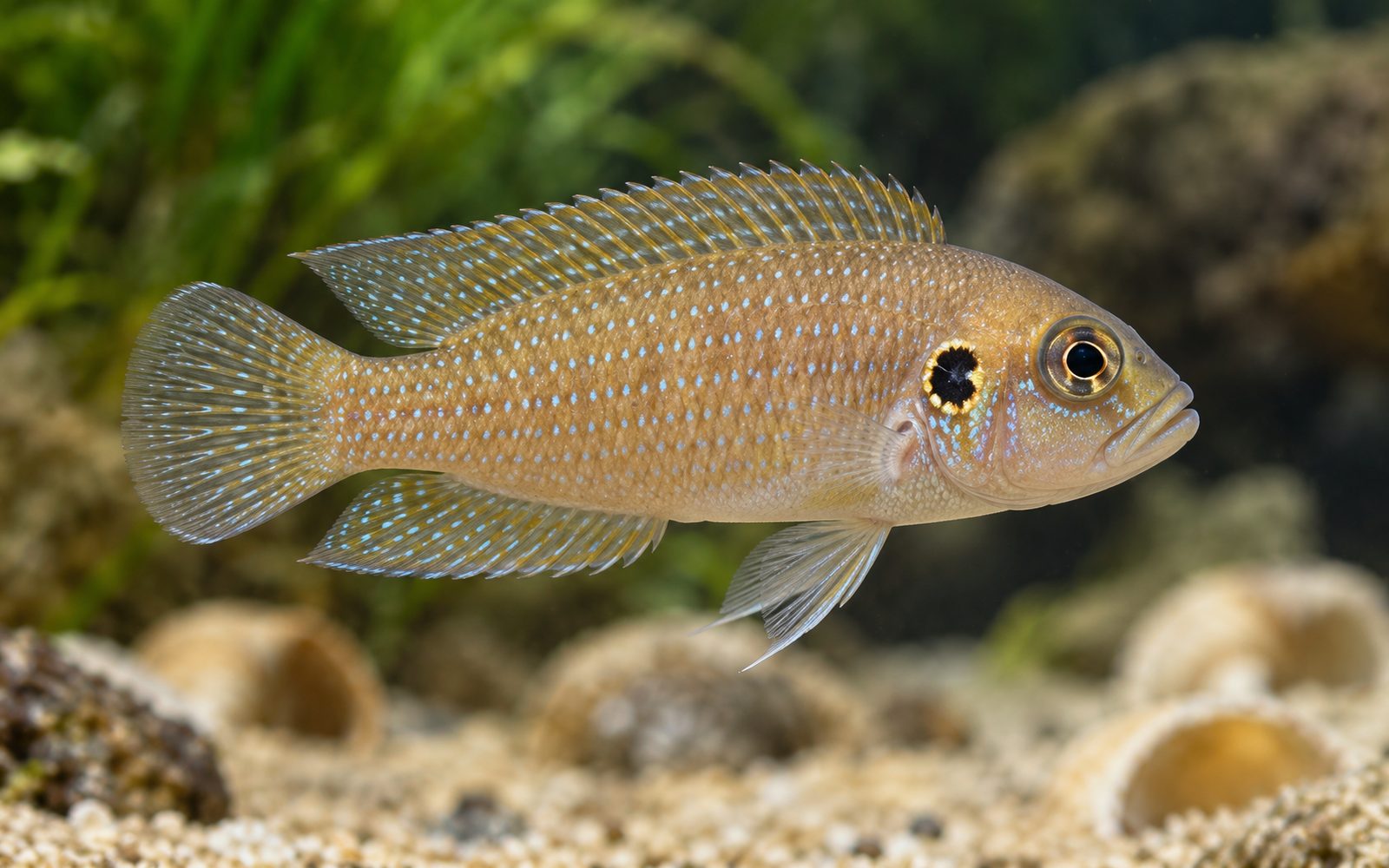
The ocellatus is a small shell-dwelling cichlid named after the dark eye-like spot (ocellus) on its gill cover. Males reach 5–6 cm and females around 4 cm. Its body ranges from light brown to golden yellow and is decorated with rows of small dots that shine like pearls; the "Gold" form often seen in the trade is a more yellow-toned local color form.
It is one of the shell dwellers with the most "personality": it stands guard at the entrance of its shell and attacks fish many times its size, and even a hand put into the aquarium. Burying its shell in the sand so that only the opening is exposed, and arranging its nest by carrying sand in its mouth, are behaviors that are a joy to watch.
Natural Habitat
It lives on the lake's sandy bottoms, in areas where empty Neothauma snail shells accumulate. Each individual takes a shell as its home and often buries it in the sand. Unlike the dense colonies of the multifasciatus, it lives in scattered small groups with more distance between individuals.
Tank Setup
- Volume: 54–60 liters for one male and 2–3 females; floor space matters. 100 liters or more for a larger harem or together with other species.
- Shells: at least 2 shells per individual; clean, unpainted snail shells with an opening of 2.5–3 cm. Scatter the shells; the fish buries them itself.
- Substrate: at least 5 cm of fine sand; it digs constantly.
- Water: pH 8–9, hard and stable; a 20–25% water change every week.
- Decor: a few small stones to separate territories; rooted plants may be dug up.
Diet
Carnivorous. A fine-grained cichlid granule should be the staple; vary it with frozen cyclops, brine shrimp and mysis. Feed small amounts 1–2 times a day; in a small volume, excess food quickly spoils the water.
Behavior and Compatibility
Extremely attached to its territory, it defends an area of 20–30 cm around its shell against every intruder. Males can be merciless toward each other; two males are not kept in a small aquarium.
Good companions: in 100 liters or more, Cyprichromis or Paracyprichromis living in the middle to upper water; Julidochromis ornatus or transcriptus in a rocky section.
Avoid: other shell-dwelling cichlids in a small aquarium, other bottom-dwelling cichlids, large and carnivorous fish, shrimp and calm community fish (the ocellatus constantly chases them out of its territory).
Group and Colony Structure
The ocellatus is a harem species:
- The most suitable setup is 1 male : 2–3 females; each female claims her own shell within the male's territory.
- It can also be kept as a pair, but a single female may be overwhelmed by the male's attention.
- Breaking lines of sight with stones and spreading the shells over a large area reduces fighting.
- The fry can stay with the parents for a few months; once mature they start being chased and need to be removed.
Breeding
The female lays her eggs inside the shell and the male fertilizes them at the shell's opening. The female guards the eggs and fry in the shell while the male defends the territory. The fry begin to appear at the opening of the shell after about a week to ten days and are fed newly hatched brine shrimp. During this period the female attacks anything that approaches her shell.
Health and Common Problems
- Hardy; the main risk is soft water and low pH.
- In a small aquarium, overfeeding quickly spoils water quality.
- Fight wounds appear when there are too many males or too few shells.
Sexing
Males are noticeably larger (5–6 cm) and more colorful; females stay at around 4 cm. Females are more attached to their shells, while the male patrols his territory.
Tank mates
This list is calculated automatically from the species profile and grows as new species are added to the catalog. Try it in the planner for a definite answer.
Usually compatible
 Yellow Regal Peacock
 Egyptian Mouthbrooder
 Yellow Tail Acei
Amazon Molly
Yellow Tail Acei
Amazon Molly
 Butterfly Goodeid
Anatolian Killifish
Eastern Happy
Red Shoulder Peacock
Butterfly Goodeid
Anatolian Killifish
Eastern Happy
Red Shoulder Peacock
 Fairy Cichlid
Blue Orchid Peacock
Fairy Cichlid
Blue Orchid Peacock
Should not be kept together






Hobbyist notes
Things you won't find in books, learned by trial and error. The most helpful ones are on top.
Change history and contributors
- Page created · October 16, 2026