
Water parameters
Overview
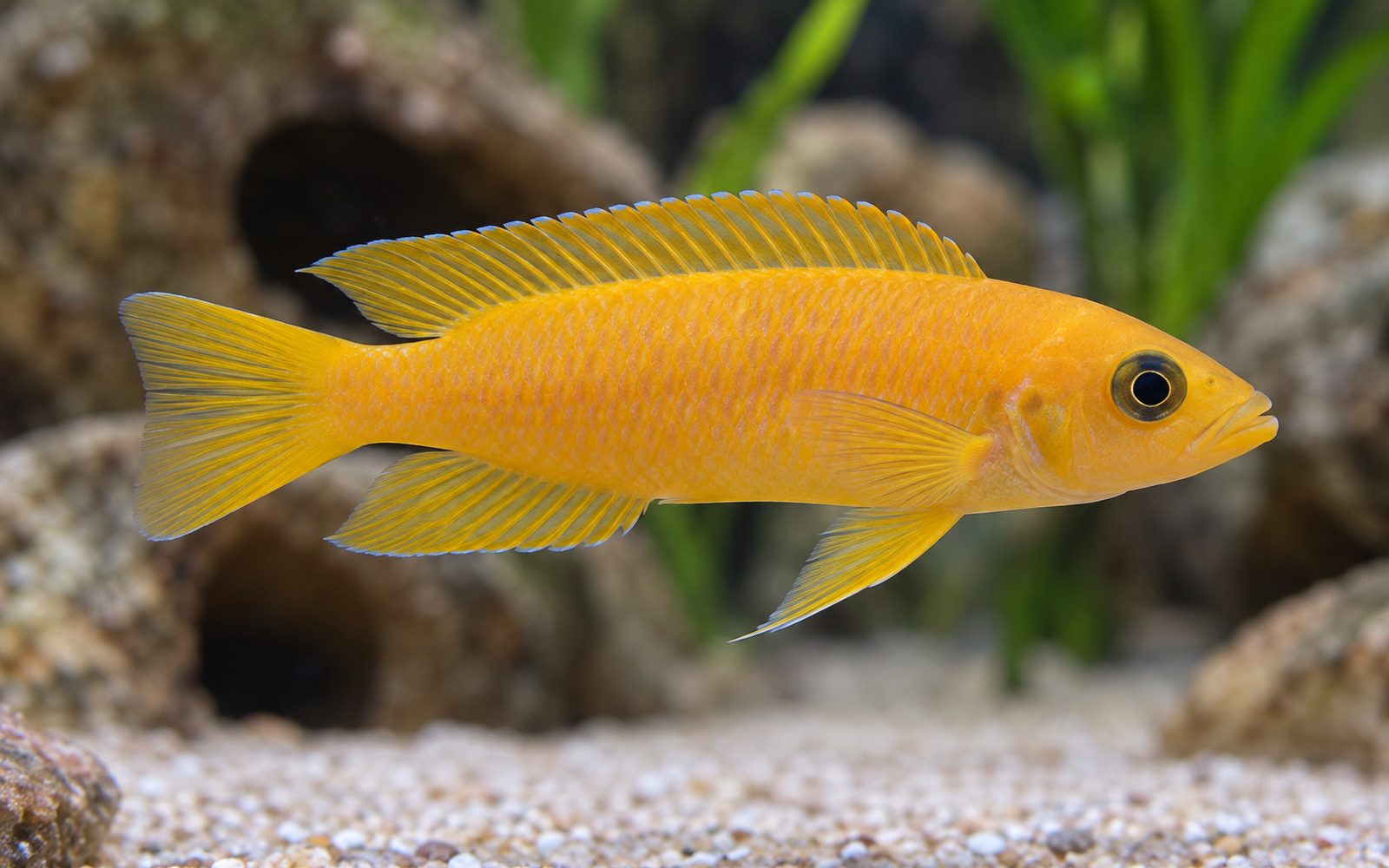
With its entirely yellow-orange body, the lemon cichlid becomes the focal point of an aquarium. It reaches 9–10 cm; with its slender, elongated body and active nature, constantly roaming among the rocks, it is one of the classics of rocky Tanganyika setups. The shade varies with the local form, from pale lemon yellow to deep orange.
Its color depends largely on diet: individuals not fed foods containing carotenoids gradually turn a pale, dirty yellow. It can be aggressive toward its own species; once a compatible pair forms, however, they live together for many years and regularly raise fry.
Natural Habitat
It is found along the lake's rocky shores, in areas rich in caves and crevices, from a few meters down to greater depths. It lives in narrow gaps between rocks and feeds by picking up small invertebrates in the crevices. It rarely ventures into open water.
Tank Setup
- Volume: 100 liters for a pair; 200 liters or more with other species.
- Rockwork: sturdily built rock piles with many caves and narrow crevices.
- Water: pH 8–9, hard and stable; a 25% water change every week.
- Substrate: fine sand; it enlarges caves by digging underneath them.
- Appearance: dark rock and a dark background bring out the yellow color.
Diet
Carnivorous. A small cichlid granule should be the staple; carotenoid-rich foods such as frozen cyclops, mysis and krill preserve its color. Color-enhancing foods containing astaxanthin are also beneficial. Bloodworms are given rarely and in small amounts.
Behavior and Compatibility
It defends its own cave territory; it can turn aggressive especially toward its own species and similarly shaped fish. It is generally indifferent to fish outside its territory.
Good companions: Cyprichromis, Paracyprichromis, Julidochromis species given enough space, shell-dwelling cichlids in a separate sandy area, Altolamprologus.
Avoid: a second lemon cichlid pair in a small aquarium, Neolamprologus species competing for the same caves, shrimp, aggressive mbuna.
Group and Colony Structure
- Kept as a pair. Putting an adult male and female together directly often ends in fighting.
- The healthiest way is to grow up 5–6 juveniles together, choose the pair that forms and remove the rest.
- If tension appears even in an established pair, a temporary divider can be placed in the aquarium to let the fish get used to each other side by side for a while.
- The fry can stay with the pair for a few months; once mature they are chased away and need to be removed.
Breeding
The pair lays a few dozen eggs on the ceiling or wall of a cave. The female tends the eggs while the male guards the surroundings of the cave. The eggs hatch in about 3 days; the fry become free-swimming in around a week and are fed newly hatched brine shrimp.
Health and Common Problems
- Loss of color: the result of an inadequate or monotonous diet; it is not a disease but an indicator of care.
- Bloat and bacterial infections: seen with poor water quality and overfeeding.
- Fight wounds: occur in incompatible pairs.
Sexing
Difficult from the outside. Males are usually slightly larger and may develop a slight bump on the forehead with age. A definite distinction is made by looking at the genital papilla.
Tank mates
This list is calculated automatically from the species profile and grows as new species are added to the catalog. Try it in the planner for a definite answer.
Usually compatible
 Yellow Regal Peacock
 Egyptian Mouthbrooder
 Yellow Tail Acei
 Butterfly Goodeid
Anatolian Killifish
Eastern Happy
Red Shoulder Peacock
Butterfly Goodeid
Anatolian Killifish
Eastern Happy
Red Shoulder Peacock
 Fairy Cichlid
Blue Orchid Peacock
Sulphur Head Peacock
Fairy Cichlid
Blue Orchid Peacock
Sulphur Head Peacock
Should not be kept together





Hobbyist notes
Things you won't find in books, learned by trial and error. The most helpful ones are on top.
Change history and contributors
- Page created · October 16, 2026