
Water parameters
Overview
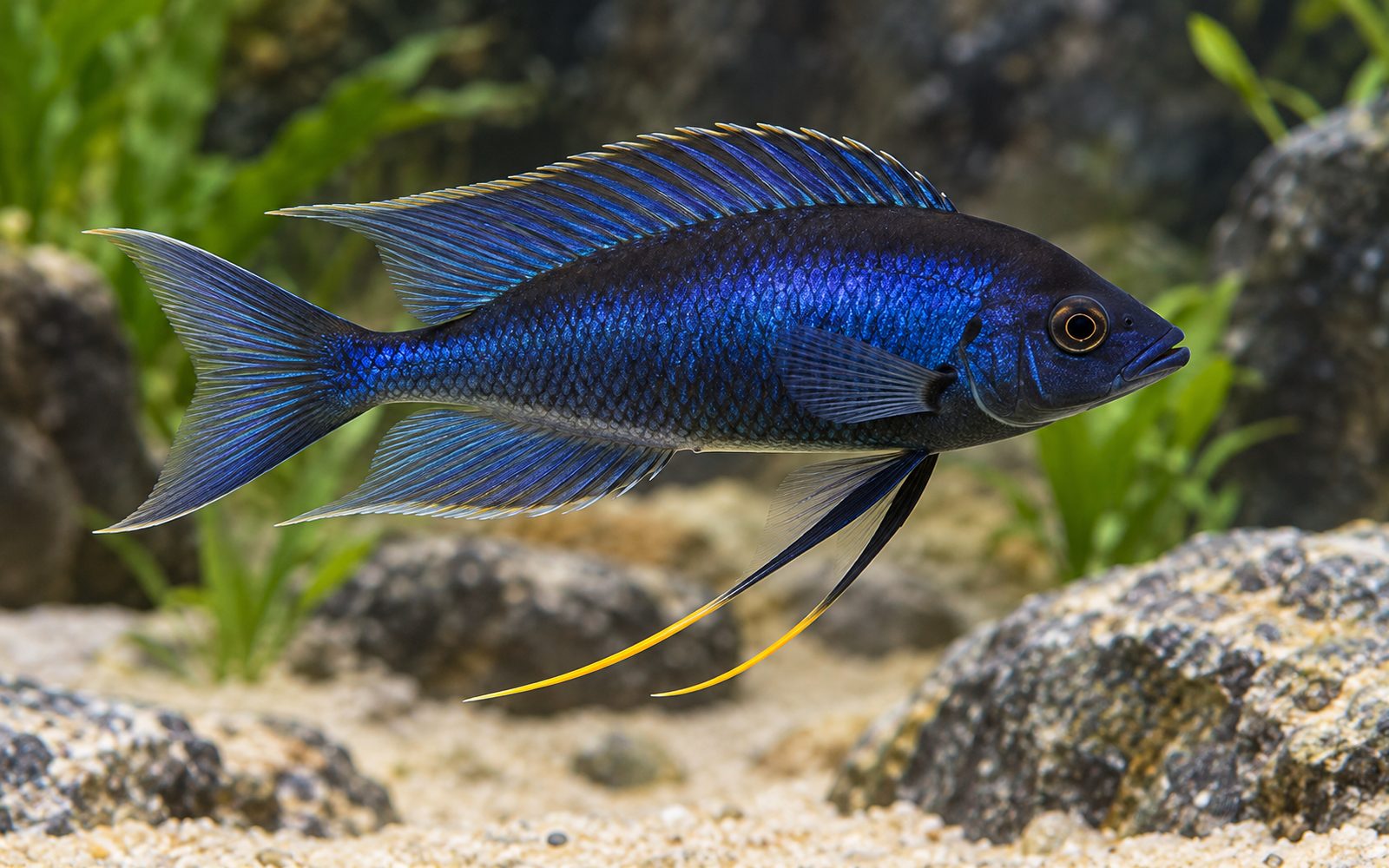
Ophthalmotilapia ventralis catches the eye immediately with the appearance of its males: in breeding season the male turns a dark, iridescent blue-black, and his pelvic fins extend almost to the tail as thin streamers carrying yellow-orange spots at their tips. These spots mimic eggs and play an important role in breeding. Females are a plain silvery gray.
It reaches around 15 cm and is an active species that needs plenty of space. In a properly set-up aquarium, the displays the males put on over their nests are among the most impressive scenes in Tanganyika aquariums.
Natural Habitat
It lives along the lake's rocky shores and where rock and sand mix. Males prepare small pit nests on the upper surfaces of rocks or in the sand between rocks and defend the surrounding area. In groups they pick algae and small organisms off rock surfaces and catch drifting plankton.
Tank Setup
- Volume: at least 300 liters and a length of 150 cm for one male and 3–4 females.
- Layout: rock groups with flat upper surfaces suitable for nests, sandy areas in between and a large open swimming area.
- Water: pH 8–9, hard and stable; a 25–30% water change every week.
- Oxygen: a strong filter and surface agitation.
Diet
Omnivorous; in the wild it feeds on plankton and the algae layer on rock surfaces. A flake or granule containing spirulina should be the staple; vary it with frozen cyclops, brine shrimp and mysis. Very high-protein foods and bloodworms should be given sparingly, as they can cause bloat.
Behavior and Compatibility
Males are territorial toward other males around their nests and generally restrained toward other species. The long pelvic fins can become a target for fin-nipping or aggressive fish.
Good companions: Cyprichromis, Paracyprichromis, Xenotilapia species, Julidochromis species, shell-dwelling cichlids (in a large aquarium).
Avoid: aggressive herbivores such as Tropheus and Petrochromis (in a small aquarium), fin-nipping fish, large fish-eating cichlids, Malawi mbuna, shrimp.
Group and Colony Structure
- Kept as a harem of 1 male : 3–4 females.
- More than one male can live together only in a very large aquarium where each is given its own nesting area.
- Juveniles can be bought together and the ratio adjusted as the males color up.
- In a single-female setup, the male's attention wears the female out; the number of females should not be kept low.
Breeding
The male displays to the female over the pit he has prepared. The female releases an egg and immediately takes it into her mouth; she then nudges the yellow spots at the tips of the male's pelvic fins with her mouth, mistaking them for eggs, and the eggs are fertilized in her mouth at this moment. Incubation lasts about 3 weeks. The fry are released ready to swim and are fed newly hatched brine shrimp.
Health and Common Problems
- Bloat: seen with overly high-protein food and poor water; a low-protein, plant-based diet is important.
- Fin damage: the long pelvic fins get torn with aggressive tankmates; they grow back in clean water.
- Transport stress: newly arrived individuals are shy and may refuse food in the first days.
Sexing
Easy in adults. Males are iridescent blue-black with long pelvic fins tipped with yellow spots. Females are silvery gray with short fins. It is difficult to tell juveniles apart.
Tank mates
This list is calculated automatically from the species profile and grows as new species are added to the catalog. Try it in the planner for a definite answer.
Usually compatible
 Yellow Regal Peacock
 Egyptian Mouthbrooder
 Yellow Tail Acei
Anatolian Killifish
Eastern Happy
Red Shoulder Peacock
Yellow Tail Acei
Anatolian Killifish
Eastern Happy
Red Shoulder Peacock
 Fairy Cichlid
Blue Orchid Peacock
Sulphur Head Peacock
Fairy Cichlid
Blue Orchid Peacock
Sulphur Head Peacock
 Peacock Cichlid
Should not be kept together






Hobbyist notes
Things you won't find in books, learned by trial and error. The most helpful ones are on top.
Change history and contributors
- Page created · October 16, 2026