
Water parameters
Overview
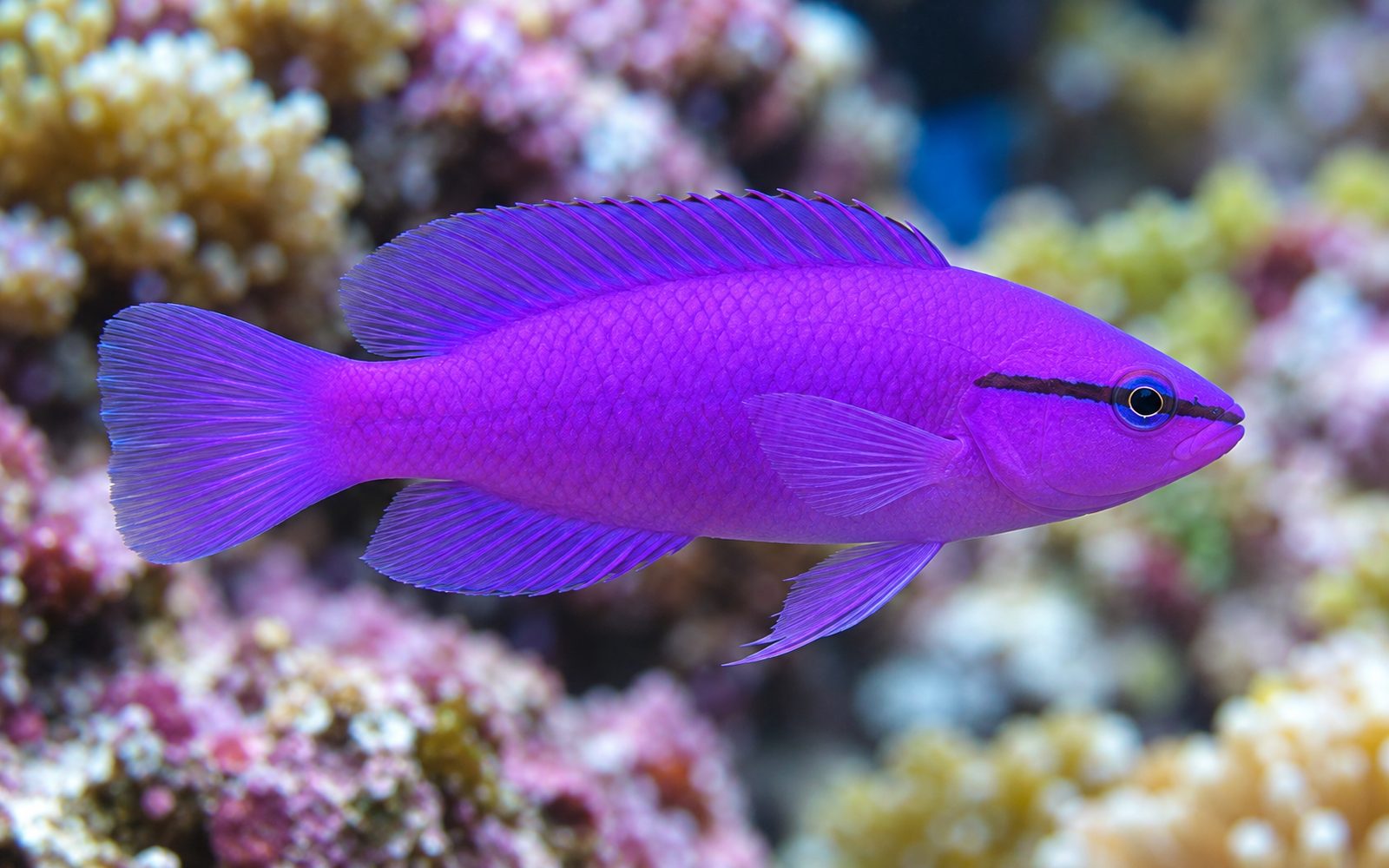
The orchid dottyback is a small dottyback, vivid purple-violet from head to tail, that lives only in the Red Sea. The thin dark line from the snout to the eye is its most distinctive marking. It was one of the first marine fish to be bred commercially on a regular basis, and most of those sold today are captive-bred; these fish are extremely hardy and adapt to dry food immediately.
It is considered one of the calmest dottybacks. Even so, it is territorial and may hunt small ornamental shrimp. Its hunting of bristleworms in the aquarium, on the other hand, is a plus for keepers.
Natural Habitat
It lives on reef slopes of the Red Sea, in cracks and holes in steep rock walls; it generally prefers the shaded, overhanging parts of the rocks. It stays near its den and hunts small crustaceans and worms among the crevices. It is adapted to the warm, salty waters of the Red Sea, but standard reef values are enough in the aquarium.
Tank Setup
- Volume: at least 75 liters.
- Water: salinity 1.023–1.026 specific gravity, pH 8.1–8.4, temperature 24–27°C.
- Reef compatibility: reef safe; it leaves corals alone. It may hunt small ornamental shrimp but usually leaves large cleaner shrimp alone.
- Layout: a rock structure full of cracks and holes; the fish chooses a den and lives around it.
- Order of introduction: adding it after more peaceful species reduces fighting.
Diet
Carnivorous. Offer frozen mysis, brine shrimp, krill and granules; captive-bred fish take dry food immediately. Twice a day. Bristleworms and small crustaceans in the aquarium also contribute to its diet.
Behavior and Compatibility
Calmer than other dottybacks, but it still defends its den. It is territorial toward similarly shaped fish and other dottybacks; it may harass very small, timid fish.
Good companions: clownfish, chromis, tangs, blennies, large gobies, cleaner shrimp.
Avoid: other dottybacks, royal gramma (in a small aquarium), small ornamental shrimp, large predators.
Group and Colony Structure
Kept as a single individual. A mated pair formed from captive-bred fish can live together in a large aquarium; two unfamiliar fish, however, will fight.
Breeding
The female lays her eggs as a ball inside a hole, and the male guards the egg ball. It is known to breed in the aquarium; the larvae are planktonic and can be raised on rotifers, but this requires expertise. Today's captive-bred fish are the result of this work.
Health and Common Problems
- Captive-bred fish are very hardy; in suitable water they rarely get sick.
- Marine white spot and velvet: quarantine new fish.
- Wild fish are more vulnerable to shipping stress and may be slow to accept food; for this reason, choose captive-bred fish whenever possible.
Sexing
There is no reliable external difference. Males are usually a little larger; a female carrying eggs has a fuller belly.
Tank mates
This list is calculated automatically from the species profile and grows as new species are added to the catalog. Try it in the planner for a definite answer.
Should not be kept together



Hobbyist notes
Things you won't find in books, learned by trial and error. The most helpful ones are on top.
Change history and contributors
- Page created · October 16, 2026