

Water parameters
Overview
The coral banded shrimp stands out for the red-and-white bands on its body and its long third pair of legs; the large claws at the tips of these legs resemble a boxer's fists. Its white antennae, as fine as a hair, reach several times the length of its body. It waits in front of its crevice and is also seen cleaning fish that come near.
It is hardy and easy to feed; the main thing to watch is its temperament. It fights to the death with members of its own species other than its mate, and it may hunt shrimp smaller than itself. Specimens on the market are wild-collected.
Natural Habitat
It lives in almost all tropical seas, from the Indo-Pacific to the Red Sea and the Caribbean, in reef crevices and beneath rock overhangs. In the wild it usually lives in mated pairs that use the same crevice for a long time and serves as a cleaning station.
Tank Setup
- Volume: At least 75 liters for a single specimen or a pair; live rock with plenty of crevices.
- Water: Salinity specific gravity 1.023–1.026, pH 8.1–8.4, temperature 24–27°C.
- Reef compatibility: Reef-safe with regard to corals; but dangerous for small shrimp and molting invertebrates.
- Acclimation and medication: Acclimate by the drip method for at least 1 hour. Copper-based medications and hyposalinity treatment are lethal.
- Shelter: An open-mouthed cave or overhang where it can hang during the day.
Diet
A mainly carnivorous scavenger. It readily takes frozen mysis, brine shrimp, chopped shrimp and mussels and sinking marine granules. Small morsels placed in front of its crevice with tweezers 3–4 times a week are enough; a hungry coral banded shrimp becomes more aggressive and turns on small organisms nearby.
Behavior and Compatibility
Generally peaceful towards fish; it defends its territory with its antennae and claws. It may catch small species such as the sexy shrimp and molting shrimp. It can be kept together with the cleaner shrimp only in large aquariums with plenty of crevices, and with care.
Good companions: Clownfish, tangs, dwarf angelfish, cardinalfish, damselfish; snails and corals.
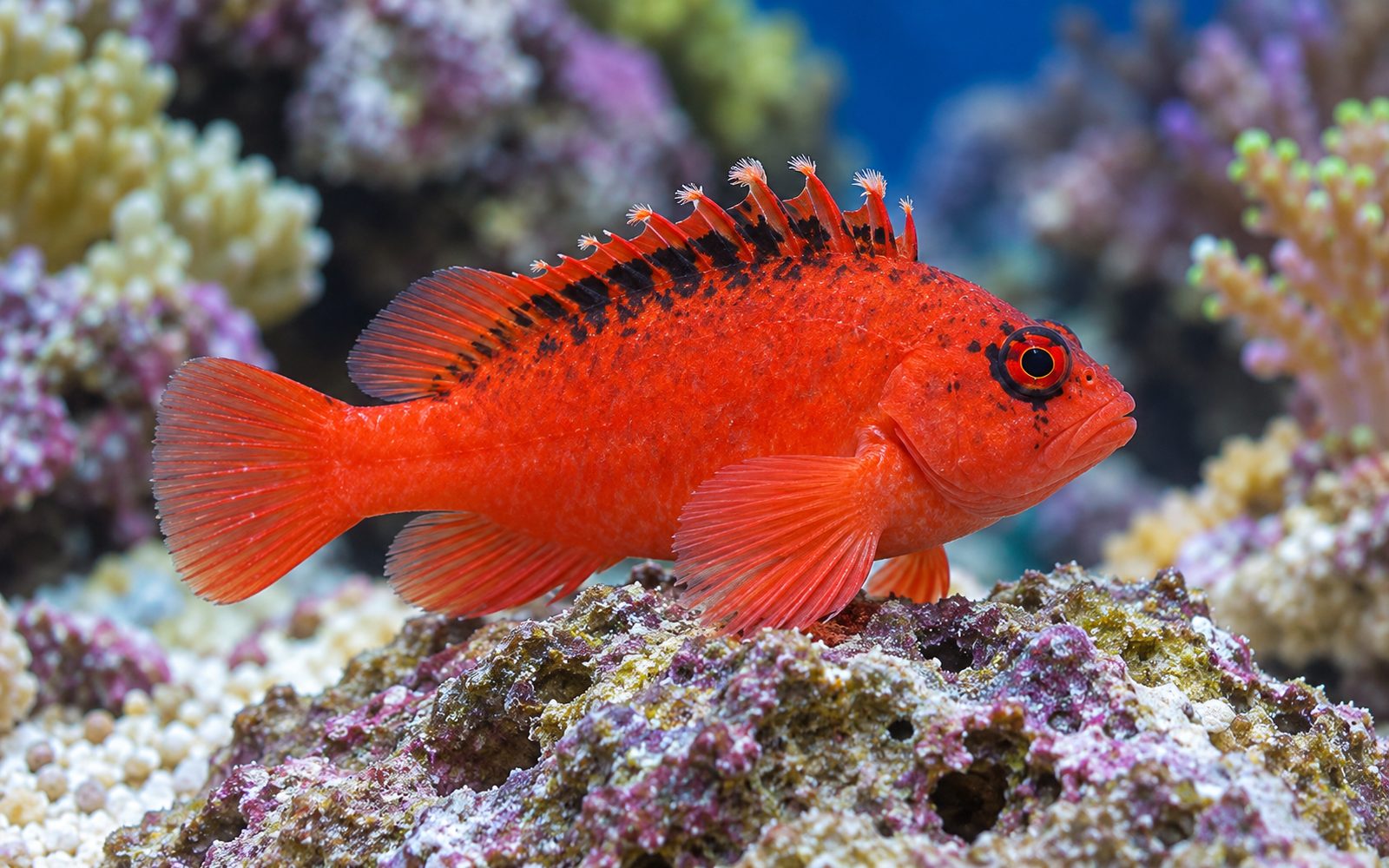
Avoid: A second coral banded shrimp that is not its mate, sexy shrimp and other small shrimp; hawkfish, triggerfish, lionfish, large wrasses.
Group and Colony Structure
Kept as a single specimen or a mated pair in one aquarium. Mated pairs are hard to find; pairs known to live together at the seller should be preferred. Putting two adults that do not know each other in the same aquarium usually ends in the death of one of them. If you want to form a pair, two young individuals can be added at the same time to a large aquarium, but success is not guaranteed.
Breeding
The sexes are separate; mated pairs stay together for a long time. The female mates after molting and carries her bluish-green eggs under her swimmerets. The larvae are planktonic and go through a long development period; they are not raised in a home aquarium.
Health and Common Problems
- Molting: Every few weeks; legs and claws lost in fights or during molting grow back in subsequent molts.
- Sudden deaths: Copper, rapid acclimation, low salinity.
- Failed molts: Fluctuating salinity and water parameters. Stable water and regular partial changes are the best protection.
Sexing
The female is usually slightly larger, and when mature her bluish-green ovary can be seen through the carapace. The male is smaller and slimmer. A definite external distinction is usually only possible by seeing a female carrying eggs.
Tank mates
This list is calculated automatically from the species profile and grows as new species are added to the catalog. Try it in the planner for a definite answer.
Should not be kept together


Hobbyist notes
Things you won't find in books, learned by trial and error. The most helpful ones are on top.
Change history and contributors
- Page created · October 16, 2026