
Water parameters
Overview
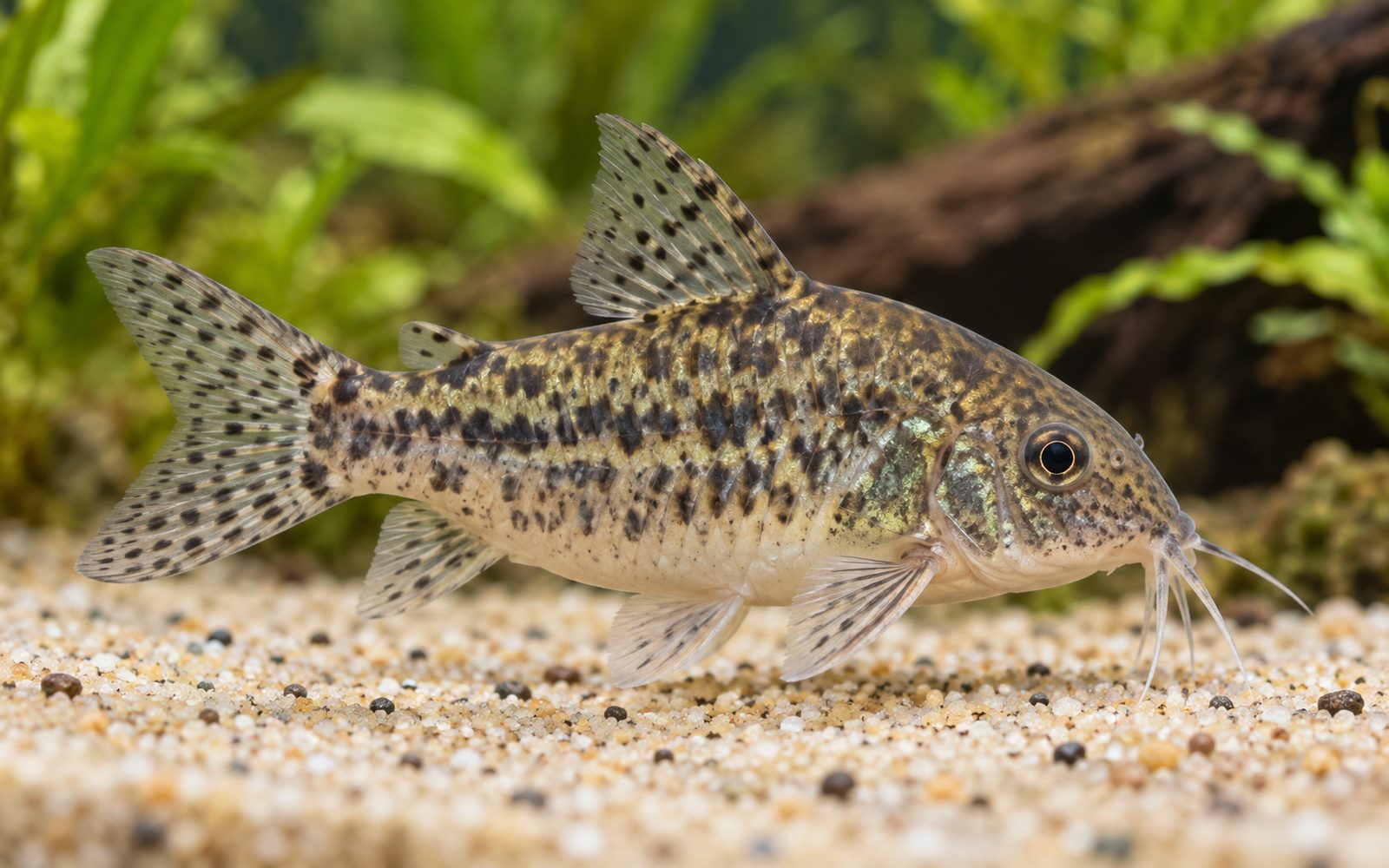
The peppered cory is one of the oldest and most widely bred corydoras in the hobby. Its olive-gray body has a faint greenish sheen and is covered with irregular dark blotches and speckles, as if sprinkled with pepper. The species was introduced to science from specimens collected by Charles Darwin during the voyage of the Beagle.
Its most important trait is that it suits cool water. Since it comes from the temperate regions of South America, it is at its best at 18–24°C; in water constantly above 26°C its lifespan is shortened. For this reason it is the bottom fish for cool community aquariums rather than for discus or ram aquariums that need warm water. Adults reach 6–7 cm.
Color and Fin Varieties
- Albino (Albino paleatus): pink-white body, red eyes; the pattern is faint or absent.
- Long-finned (Longfin paleatus): a cultivated form with elongated dorsal, pectoral and tail fins; it needs the same care and should not be kept with fin-nipping fish.
Natural Habitat
It lives in the slow-flowing stretches with sandy-muddy bottoms of the La Plata basin and coastal rivers in Argentina, Uruguay and southern Brazil. In these regions the water cools noticeably in the winter months; the species' tolerance of low temperatures comes from this.
Tank Setup
- Volume: at least 60 liters for a group of 6–10; a large footprint.
- Substrate: fine, rounded sand.
- Water: 18–24°C; flexible regarding pH and hardness. In homes where room temperature does not fall below 18°C it can also be kept in an unheated aquarium.
- Oxygen: It likes good aeration and gentle flow; cool water carries more oxygen anyway.
Diet
Sinking tablets and granules, frozen bloodworms, brine shrimp, daphnia and tubifex. It has a good appetite but should not be expected to live on leftovers alone; food should be given separately on the bottom every day.
Behavior and Compatibility
Extremely peaceful and hardy. In a group it forages on the bottom and often darts up to the surface to gulp air.
Good companions: peaceful species that like cool water: zebra danio, White Cloud Mountain minnow (Tanichthys albonubes), panda cory, platy, Endler's livebearer, Neocaridina shrimp.
Avoid: species that need warm water (discus, ram, sterbai cory), cichlids that claim the bottom, large predators.
Group and Colony Structure
At least 6, ideally 10 or more individuals. A large group is bolder and more active. Albino and long-finned individuals are the same species and join the group without problems.
Breeding
It is one of the easiest corydoras to breed. A large water change a few degrees cooler often starts spawning. The pair takes up the "T position"; the female sticks the fertilized eggs to the glass, plants and decor. Hundreds of eggs may be laid in one spawning period. Depending on temperature the eggs hatch in 4–6 days; the fry grow easily on microworms and freshly hatched brine shrimp.
Health and Common Problems
- At constantly high temperatures its immunity weakens; prevent the aquarium from overheating in the summer months.
- Barbel erosion: sharp or dirty substrate.
- It is sensitive to salt and copper-based medications.
Sexing
Females are larger and plumper. Males are smaller; their dorsal fins are longer and more pointed, and their body pattern is usually more distinct.
Tank mates
This list is calculated automatically from the species profile and grows as new species are added to the catalog. Try it in the planner for a definite answer.
Usually compatible
 Flame Tetra
 Blackfin Corydoras
 Polystictus Corydoras
 Emerald Cory
 Emerald Dwarf Rasbora
 Porthole Catfish
 Keyhole Cichlid
 Cryptocoryne Parva
 European Bitterling
 Adolfo's Cory
Should not be kept together






Hobbyist notes
Things you won't find in books, learned by trial and error. The most helpful ones are on top.
Change history and contributors
- Page created · October 16, 2026