
Water parameters
Overview
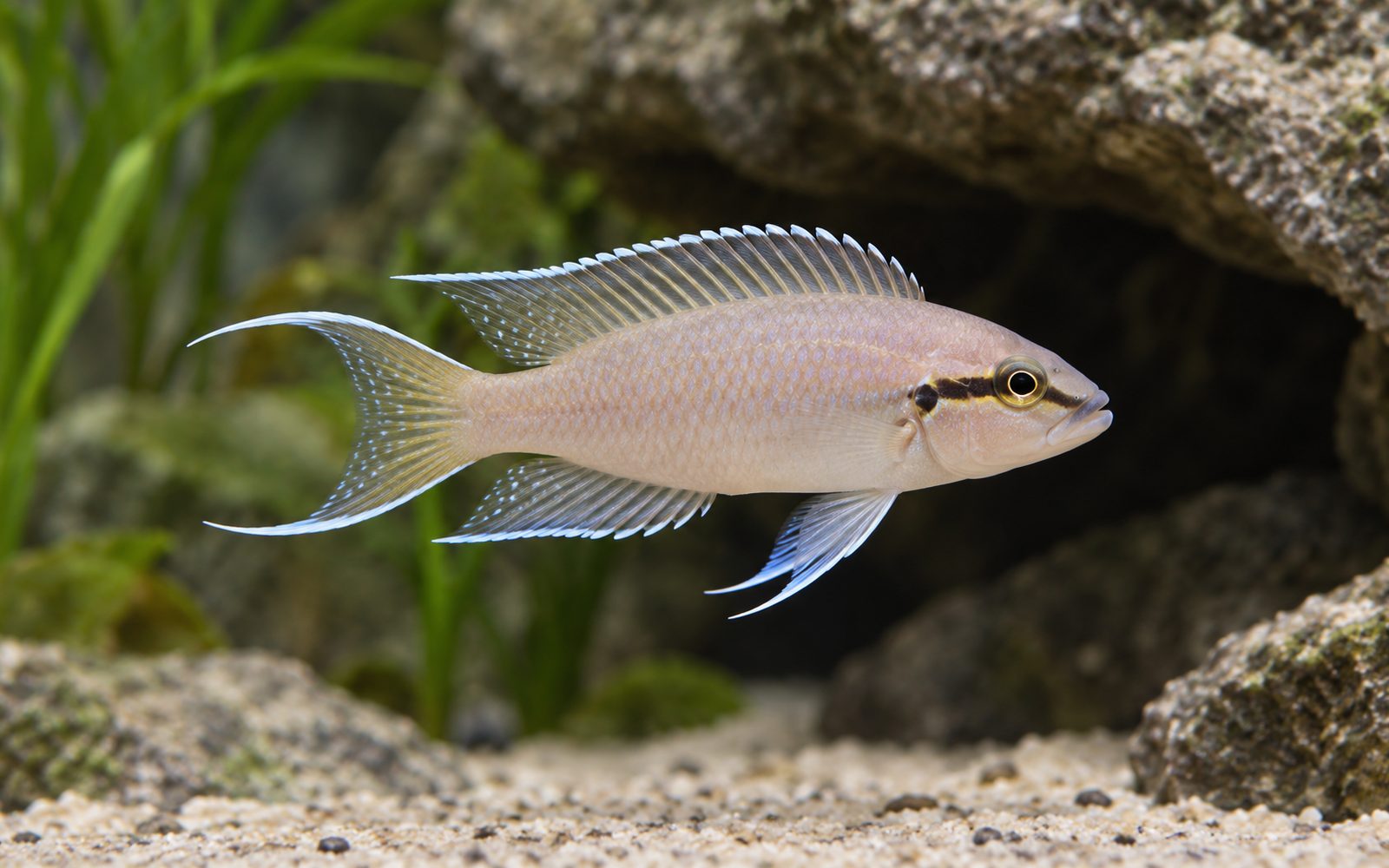
With its light beige–pink body, a black and yellow line running from the eye to the gill cover, a lyre-shaped tail with elongated tips and a white band along the fin edges, the Princess of Burundi is one of the most elegant cichlids of Lake Tanganyika.
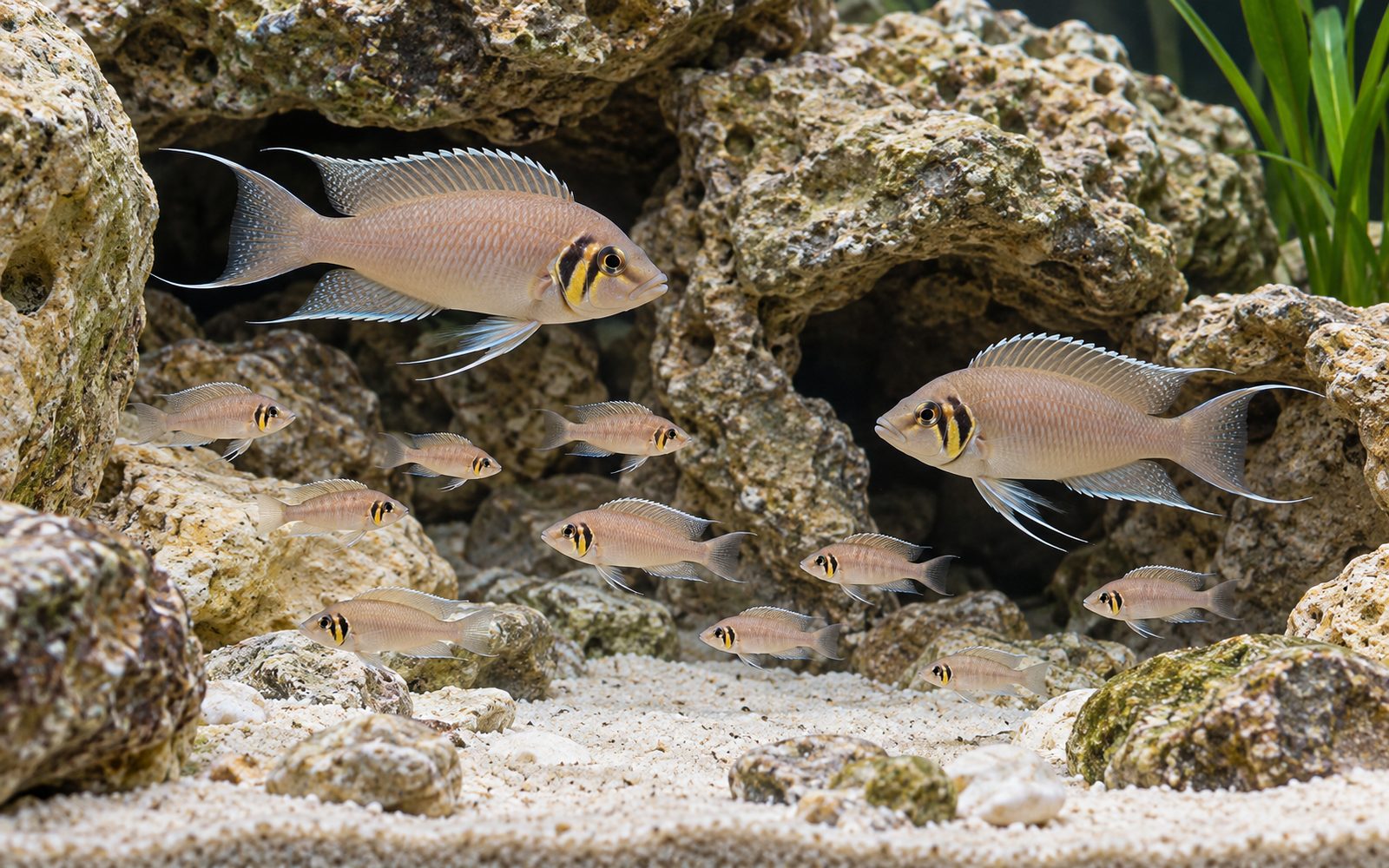
Its most notable feature is its social life: over time a pair builds a family colony made up of several generations, and older young from earlier generations help protect new eggs and their smaller siblings. This "cooperative breeding" behavior is one of the most interesting behaviors you can watch in an aquarium.
Natural Habitat
It lives along the rocky shores of northern Lake Tanganyika, at depths of 3–25 m, among rock piles and crevices. The lake water is very hard, alkaline (pH 8.5–9) and stable all year round. In the wild it forms colonies of hundreds of individuals, communities in which each family defends its own rock crevice.
Tank Setup
- Volume: 100 liters for a pair; 200 liters or more for a growing colony or together with other Tanganyika species. Floor space matters.
- Rockwork: many caves and crevices. The colony establishes its territory among the rocks; open water should also be left.
- Water: very hard and alkaline; pH 8–9. In soft water, coral sand, aragonite and Tanganyika/Malawi salt are used. Stable water matters more than the target value.
- Substrate: fine sand; the fish enlarge caves by digging underneath them.
Diet
Mainly carnivorous; in the wild it feeds on zooplankton and small invertebrates. A quality cichlid granule or flake food should be the staple; vary it with frozen mysis shrimp, brine shrimp and cyclops. Bloodworms should be given rarely. Small food particles ensure the colony's fry get fed too.
Behavior and Compatibility
Harmonious within its own colony, but it mounts a collective defense against other fish approaching its territory. As the colony grows, it claims a larger part of the aquarium.
Good companions: other Tanganyika species (Cyprichromis, Julidochromis, synodontis) with enough rock and space; fish that like the same water and can hold their own territory.
Avoid: community fish (it becomes aggressive while guarding its fry and hunts small ones), shrimp, aggressive Malawi mbuna, large cichlids that fill the aquarium.
Group and Colony Structure
The Princess of Burundi is the most typical example of the colony species on the site:
- Start with a pair. A pair is obtained by growing up 5–6 juveniles together and waiting for them to pair off naturally; all but the pair that forms are removed.
- The pair spawns regularly and fry from earlier generations stay in the aquarium. Older siblings clean new eggs and defend the little ones and the nest.
- Several generations live without problems in 100 liters; as the colony grows and becomes crowded, the largest juveniles are removed. Dozens of fry within a month is normal.
- Adult princesses from outside are not added to the colony; a stranger is targeted by the family.
- Two colonies in the same aquarium work only in a setup of 200 liters or more divided by rocks; each family should have a separate rock group.
Breeding
It lays 100–200 eggs on the ceiling or wall inside a cave. The eggs hatch in 2–3 days and the fry become free-swimming a few days later. The parents and older siblings protect the fry. The fry grow on newly hatched brine shrimp, cyclops and crushed food; older fry stay in the colony and become "helpers."
Health and Common Problems
- Malawi/Tanganyika bloat: overly high-protein food and poor water; loss of appetite and swelling.
- Falling pH: stress and disease in Tanganyika cichlids kept in soft water. Keep the KH high.
- Generally hardy; the main problems come from incorrect water parameters and territorial fights.
Sexing
Difficult to tell apart from the outside. Mature males are usually slightly larger and have longer fin extensions (especially the lyre tips of the tail and the dorsal fin). A definite distinction is made by looking at the papilla during spawning.
Tank mates
This list is calculated automatically from the species profile and grows as new species are added to the catalog. Try it in the planner for a definite answer.
Usually compatible
 Yellow Regal Peacock
 Egyptian Mouthbrooder
 Yellow Tail Acei
 Butterfly Goodeid
Anatolian Killifish
Eastern Happy
Red Shoulder Peacock
Butterfly Goodeid
Anatolian Killifish
Eastern Happy
Red Shoulder Peacock
 Fairy Cichlid
Blue Orchid Peacock
Sulphur Head Peacock
Fairy Cichlid
Blue Orchid Peacock
Sulphur Head Peacock
Should not be kept together





Hobbyist notes
Things you won't find in books, learned by trial and error. The most helpful ones are on top.
Change history and contributors
- Page created · October 16, 2026