
Water parameters
Overview
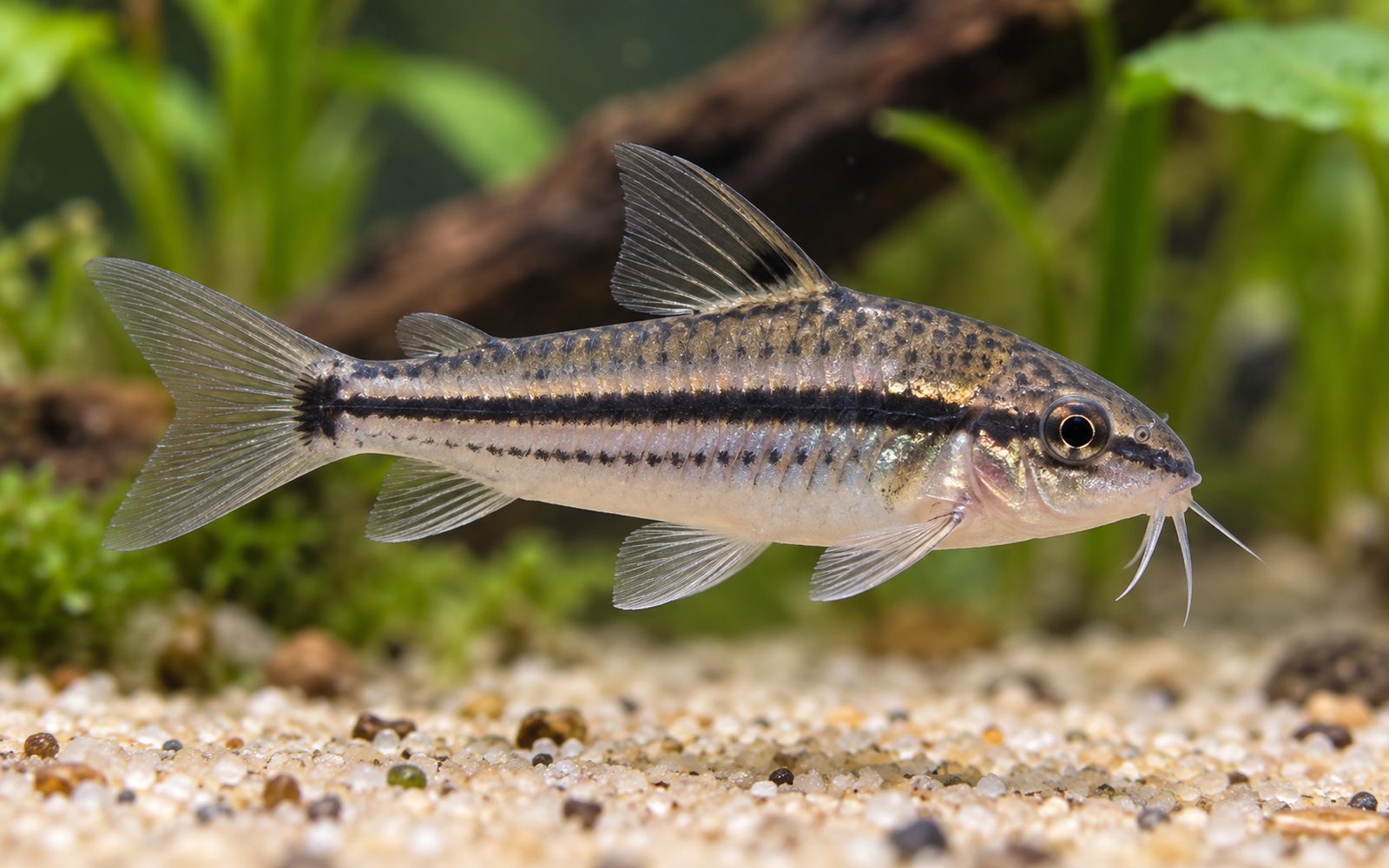
The pygmy cory is one of the smallest members of the genus: females reach 2.5–3 cm and males around 2 cm. Its silvery gray body has a distinct black stripe running from the snout to the base of the tail, with a thinner second line below it. Its most striking feature is its behavior: it spends most of its time not on the bottom but hovering in midwater as a small school or resting on top of broad leaves.
It has two dwarf relatives that are often confused with it. C. hastatus carries a large black spot ringed with pale color on the caudal peduncle and lacks the thick stripe starting at the snout. C. habrosus stays almost always on the bottom, and its body is covered with irregular dark blotches instead of a straight stripe.
Natural Habitat
It lives in the calm, clear waters among bank vegetation and roots hanging into the water in the Madeira River basin and neighboring Amazon tributaries. Here it stays in large schools in midwater just in front of the vegetation; when threatened it scatters among the plants.
Tank Setup
- Volume: at least 40 liters for a school of 10–15; a 60 cm aquarium shows the school's horizontal swimming better.
- Substrate: fine sand. Although it spends most of its time in midwater, it searches for food on the bottom.
- Plants: dense clumps of plants and broad-leaved plants (anubias, sword plants) are used as resting places.
- Water: 22–26°C, soft to moderately hard, a mature aquarium. It is more sensitive to ammonia and nitrite swings than larger corydoras.
- Filter: gentle flow is enough. Fitting a sponge in front of the filter intake protects these small fish.
Diet
Its mouth is very small; choose food accordingly. Fine granules, crushed flakes, crumbled sinking tablets, and frozen or live brine shrimp, daphnia and cyclops are eaten eagerly. Feed small amounts once or twice a day; it easily loses out in the competition around large tablets.
Behavior and Compatibility
Extremely peaceful; it harms neither fish nor shrimp. The safer it feels in a large school, the more it stays in the open; kept in small numbers it hides among the plants and is rarely seen.
Good companions: Boraras species, galaxy rasbora (celestial pearl danio), tiny tetras such as the ember tetra, otocinclus, Neocaridina and Caridina shrimp, other dwarf corydoras.
Avoid: medium to large fish that could fit it in their mouths (angelfish, large barbs, large gouramis), fast and greedy food competitors, cichlids that claim the bottom.
Group and Colony Structure
Its schooling bond is very strong; at least 10, ideally 15 or more individuals are recommended. In a large group the behavior of swimming together in midwater becomes pronounced. A mixed group with a few hastatus or salt and pepper corydoras can be formed, but each species behaves more naturally when there are enough of its own kind.
Breeding
It breeds on its own in a mature, heavily planted aquarium. A somewhat cooler water change can trigger spawning. Like other corydoras, the female carries the eggs between her pelvic fins and sticks them one by one to the glass and the undersides of leaves. The eggs hatch in 3–4 days; in the first days the fry are fed infusoria and microworms, then freshly hatched brine shrimp. Since adults may eat the eggs and fry, dense plants such as java moss provide hiding places.
Health and Common Problems
- Because of its small body it reacts quickly to sudden changes in water quality; avoid large, abrupt differences in parameters.
- Newly arrived fish may be hungry and weak; small, frequent meals in the first weeks speed up recovery.
- It is sensitive to salt and copper-containing medications; lower the dose when treating.
Sexing
Females are noticeably larger and plumper; viewed from above, their belly area is broader. Males are smaller and slimmer.
Tank mates
This list is calculated automatically from the species profile and grows as new species are added to the catalog. Try it in the planner for a definite answer.
Usually compatible
 Flame Tetra
 Blackfin Corydoras
 Polystictus Corydoras
 Emerald Cory
 Emerald Dwarf Rasbora
 Porthole Catfish
 Keyhole Cichlid
 Geophagus surinamensis
 Cryptocoryne Parva
 Gold Spot Pleco (L001)
Should not be kept together





Hobbyist notes
Things you won't find in books, learned by trial and error. The most helpful ones are on top.
Change history and contributors
- Page created · October 16, 2026