
Water parameters
Overview
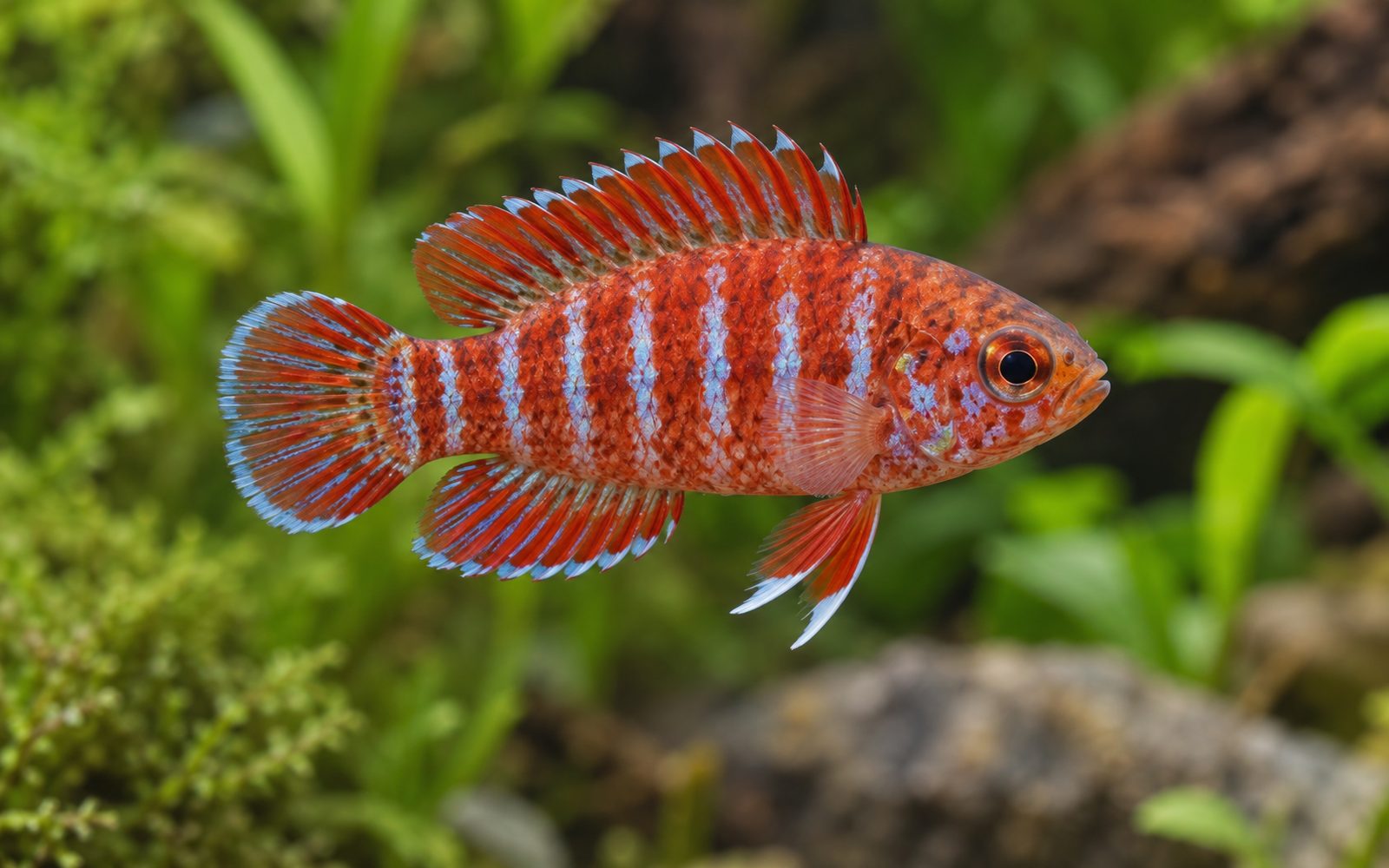
At no more than 2 cm, the scarlet badis is one of the smallest perch-like fish in the world. Males are eye-catching with bright red-orange bodies, up to seven bluish-white vertical bars and white-tipped pelvic fins; females are gray-beige and unremarkable.
It is one of the most beautiful choices for densely planted nano aquariums. However, it hardly ever takes dry food; it should not be bought unless you can regularly provide small live or frozen food.
Natural Habitat
It lives among dense aquatic plants in clear, shallow streams that flow into the Brahmaputra in northeastern India. Because of the region's subtropical climate, it also tolerates cool water.
Tank Setup
- Volume: at least 40 liters for 1 male and 2–3 females; more floor space for more than one male.
- Decor: very dense plants, moss and fine-leaved plants; visual barriers reduce fighting between males.
- Water: 22–25°C is ideal; it also adapts to hard water. Gentle flow.
- Choice of companions: a species-only tank or very calm, small species.
Diet
Carnivorous. Live or frozen cyclops, daphnia, brine shrimp (newly hatched brine shrimp is best), grindal worms and small bloodworms. Feed small amounts 1–2 times a day. It feeds slowly and goes hungry alongside fast fish.
Behavior and Compatibility
Males are territorial toward each other; they display by spreading their fins and coloring up, and serious injuries are rare. It is completely harmless to other species.
Good companions: dwarf shrimp (adult Neocaridina, Caridina), very small and calm fish such as Boraras, otocinclus, snails.
Avoid: fast-eating and large species, dominant fish such as dwarf gouramis, any species that might see it as food.
Group and Colony Structure
A harem setup: 1 male, 2–3 females. In a larger aquarium several males can live together, each claiming its own clump of plants.
Breeding
The male lures the female among the plants; the eggs are laid one by one among moss and fine leaves. The parents provide no care and may eat the eggs and fry. In an aquarium with dense moss some fry grow up on their own; the fry are fed infusoria and then newly hatched brine shrimp.
Health and Common Problems
- Starvation: the most common cause of death in fish not given suitable food.
- Internal parasites: in wild-caught fish; quarantine is recommended.
Sexing
Easy: males are red and barred; females are gray-beige, smaller and colorless. Because males are sold more often in the trade, females can be hard to find.
Tank mates
This list is calculated automatically from the species profile and grows as new species are added to the catalog. Try it in the planner for a definite answer.
Usually compatible
 Flame Tetra
Glass Tetra
Flame Tetra
Glass Tetra
 Blackfin Corydoras
 Polystictus Corydoras
 Emerald Betta
 Emerald Cory
 Emerald Dwarf Rasbora
 Porthole Catfish
 Keyhole Cichlid
 Buffalohead Cichlid
Should not be kept together





Hobbyist notes
Things you won't find in books, learned by trial and error. The most helpful ones are on top.
Change history and contributors
- Page created · October 16, 2026