
Water parameters
Overview
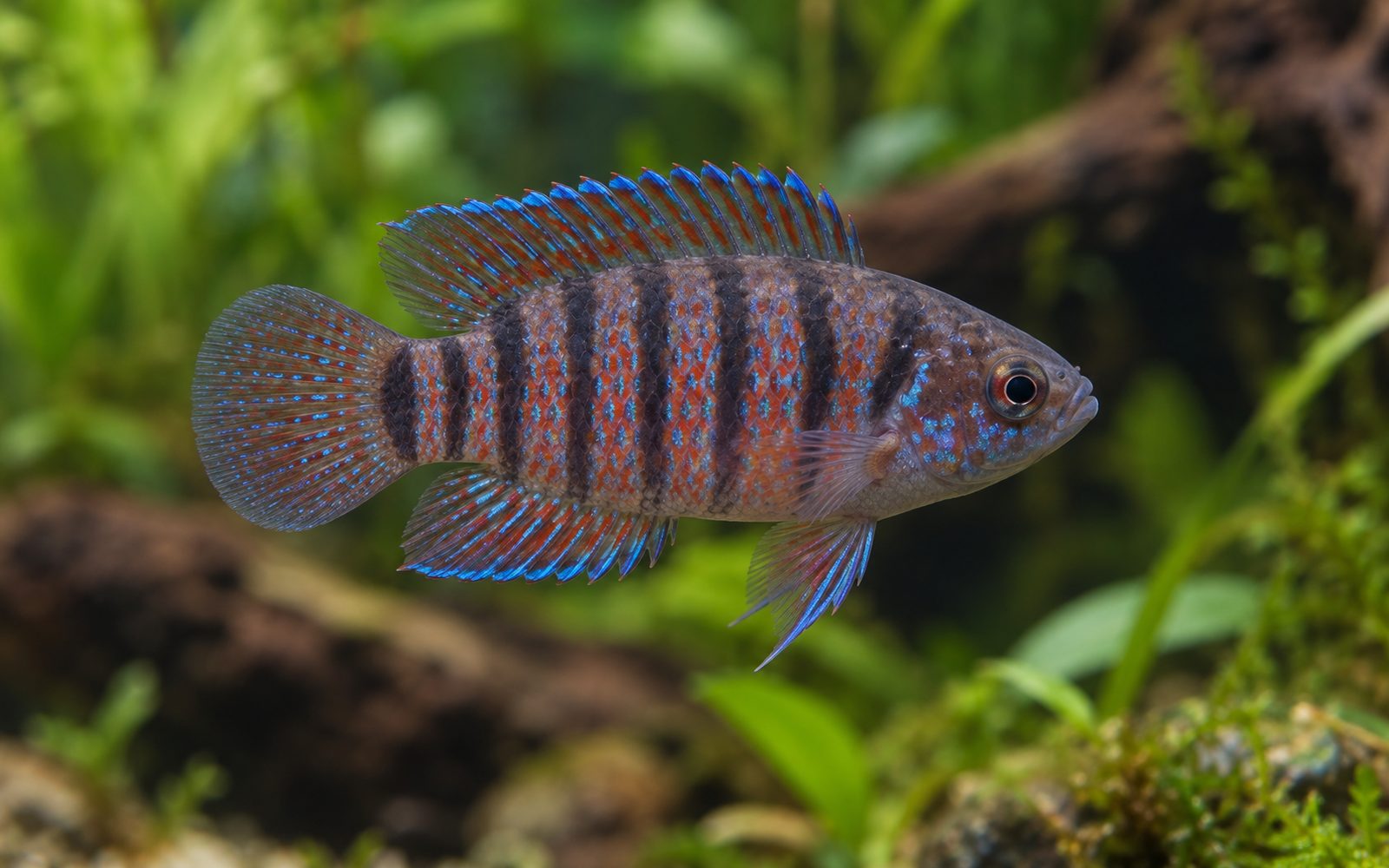
The badis is a small perch-like fish that can change color within minutes depending on its mood, the light and its surroundings; this is where the name "chameleon fish" comes from. Males show patterns of blue, purple, red and dark vertical bars; females are plainer, beige-brown.
It is a calm species with plenty of personality: it claims its cave, studies the aquarium with a fixed gaze and guards its fry. Its biggest challenge is feeding; most individuals refuse dry food.
Natural Habitat
It lives in slow-flowing streams, ponds and ditches of India, Bangladesh and Nepal, among dense plants and leaf litter. Because of the region's seasonal climate, it tolerates temperature changes well.
Tank Setup
- Volume: at least 60 liters for 1 male and 2–3 females.
- Caves: at least one cave per fish: coconut shells, clay pots, hollows in roots.
- Decor: dense plants, leaf litter, dim light.
- Water: 23–25°C, close to neutral; gentle flow.
Diet
Carnivorous. Frozen and live bloodworms, brine shrimp, daphnia, cyclops and small worms. It rarely takes flakes. Because it eats slowly, it can go hungry in the same aquarium as fast fish.
Behavior and Compatibility
Males are very territorial toward each other and fight in a small aquarium. It is usually calm toward other species.
Good companions: calm, small, mid-water species: rasboras, small tetras, pencilfish, small Corydoras. Adult dwarf shrimp are mostly safe; shrimplets may be eaten.
Avoid: fast and greedy species (tiger barbs, large danios), aggressive cichlids, bottom-dwellers that compete for caves.
Group and Colony Structure
A harem setup is recommended: 1 male, 2–3 females. More than one male can be kept in a large, heavily decorated aquarium; each needs its own cave and visual barriers.
Breeding
The male displays in front of his cave and lures the female inside. The eggs are laid on the ceiling of the cave; the male guards the eggs and the newly hatched fry. It is a good idea to remove the female after spawning. The fry are raised on infusoria and newly hatched brine shrimp.
Health and Common Problems
- Starvation and wasting: the most common problem in fish not given suitable food.
- Internal parasites: in wild-caught fish; quarantine is recommended.
Sexing
Males are larger, more colorful and have longer fins; mature males may have a concave belly. Females are smaller, round-bellied and pale.
Tank mates
This list is calculated automatically from the species profile and grows as new species are added to the catalog. Try it in the planner for a definite answer.
Usually compatible
 Emerald Betta
 Emerald Cory
 Porthole Catfish
 Keyhole Cichlid
 Firemouth Cichlid
 Buffalohead Cichlid
 Festivum
 Geophagus surinamensis
 Rainbow Cichlid
Should not be kept together





Hobbyist notes
Things you won't find in books, learned by trial and error. The most helpful ones are on top.
Change history and contributors
- Page created · October 16, 2026