
Water parameters
Overview
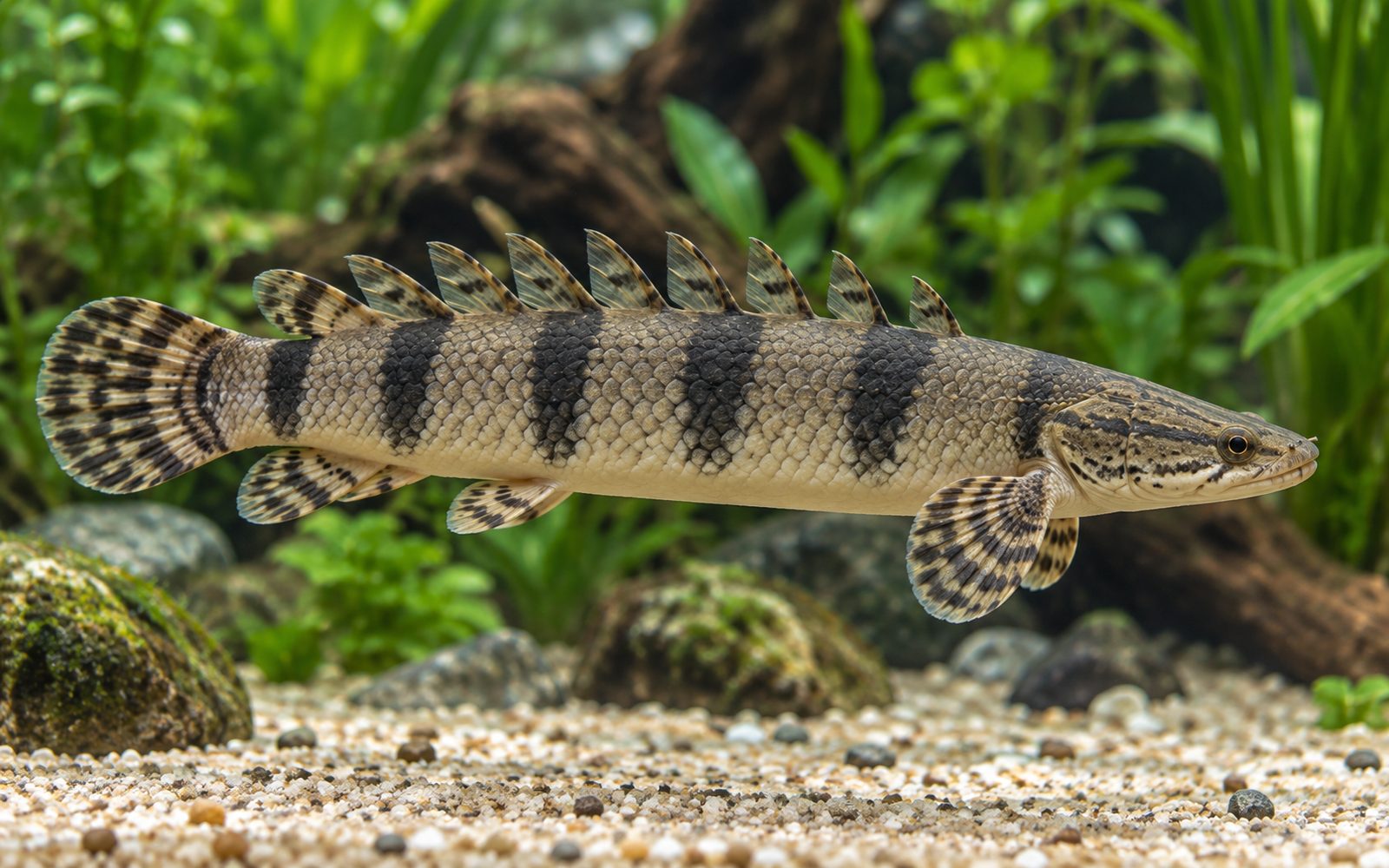
With dark vertical bars on its back and olive-gray, armor-like scales, the barred bichir is one of the most patterned and most popular bichirs. It has a row of finlets resembling small sails along its back, thick pectoral fins and tubular nostrils.
Like other bichirs it breathes air; it comes up to the surface to take a breath. It grows larger than the Senegal bichir (35–40 cm) and is a more active hunter at night. Its care is similar to that of the Senegal bichir, but it needs a larger aquarium.
Natural Habitat
It lives along slow-flowing, vegetated riverbanks and in floodplains of the Congo basin; during the day it rests among plants and roots. These waters are warm and oxygen levels sometimes drop very low; the bichirs' ability to breathe air is an adaptation to these conditions.
Its eyesight is poor; it finds its prey largely by smell through the tubular nostrils at the tip of its snout. For this reason it may take a little while to locate food in the aquarium.
Tank Setup
- Volume: at least 400 liters for an adult; a 150 × 60 cm footprint.
- Lid: a tight lid and sealed gaps for hoses; an air gap between the water surface and the lid.
- Decor: sand substrate, roots, large pipes and hollows. Dim corners.
- Water: clean and well-oxygenated; 25–30% water change weekly.
Diet
Carnivorous. Sinking pellets, shrimp, mussels, fish fillet, worms and bloodworms. Feed in the evening; it finds food by smell. Juveniles can be fed once a day, adults every other day. Do not accustom it to live feeder fish; they carry disease and cause it to refuse frozen foods.
Behavior and Compatibility
Calm during the day, active at night. It hunts fish and shrimp that fit in its mouth. It is peaceful with fish larger than itself.
Good companions: medium to large, calm species: large tetras, gouramis, angelfish, arowanas, large plecos, other bichirs.
Avoid: small fish, shrimp, aggressive cichlids that harass bichirs.
Group and Colony Structure
It can be kept alone; with enough floor space, several bichirs can live together.
Breeding
It rarely breeds in the aquarium. Breeding is as in other bichirs: the male gathers the eggs with his anal fin and scatters them among plants; there is no parental care.
Health and Common Problems
- Escape: getting out through gaps in the lid and drying out is the most common loss.
- Skin wounds: from sharp decor and coarse gravel.
- Water quality: it is hardy, but its appetite drops when nitrate is high.
Sexing
Males have a thicker, broader anal fin.
Tank mates
This list is calculated automatically from the species profile and grows as new species are added to the catalog. Try it in the planner for a definite answer.
Usually compatible
 Banded Jewel Cichlid
 Chocolate Cichlid
 Gymnogeophagus balzanii
 Pearl Cichlid
 Threadfin Acara
 Blood Parrot
 Redhead Cichlid
 Cryptocoryne Parva
Adonis Pleco
African Brown Knifefish
Cryptocoryne Parva
Adonis Pleco
African Brown Knifefish
Should not be kept together









Hobbyist notes
Things you won't find in books, learned by trial and error. The most helpful ones are on top.
Change history and contributors
- Page created · October 16, 2026