
Water parameters
Overview
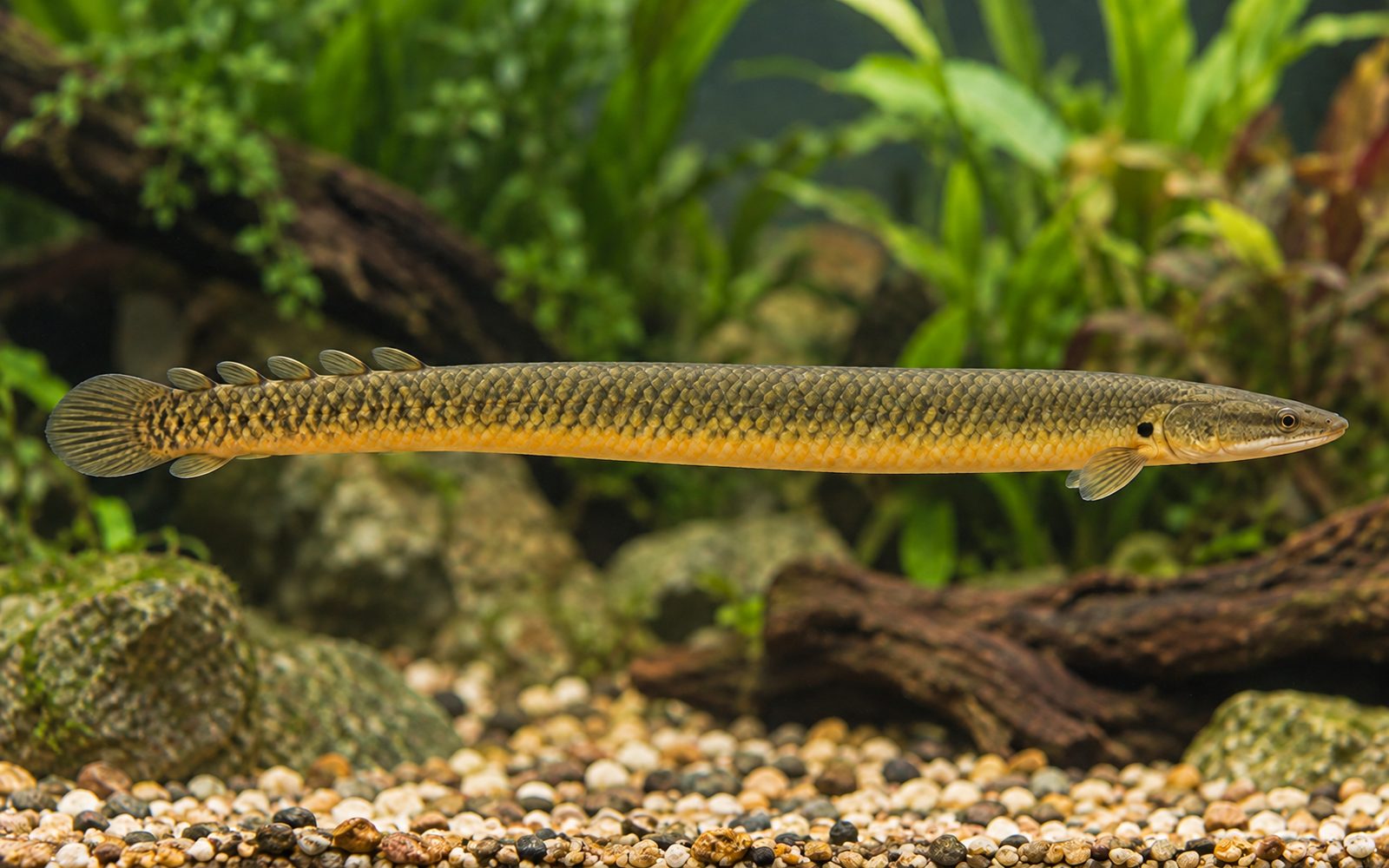
The ropefish belongs to the same family as the bichirs, but its body is as thin and long as a snake's, and it has no pelvic fins. Its olive-green back turns yellow-orange toward the belly, and there is a small black spot at the base of the pectoral fins.
It breathes air from the surface with a lung-like air bladder and tolerates oxygen-poor water. It is curious; it glides among roots and searches for food at night. In the aquarium it usually reaches 30–40 cm.
Its biggest problem is escaping: it slips out through cable holes, filter gaps and lid corners, and dries out and dies outside the aquarium.
Natural Habitat
It lives in the coastal lowlands of West-Central Africa, in reedy swamps and slow-flowing, vegetated river branches. These waters are warm and oxygen-poor, which is why the ropefish regularly comes to the surface to gulp air.
Tank Setup
- Volume: at least 200 liters and 120 cm length for several individuals.
- Lid: close every gap. Plug hose and cable openings with sponge or mesh; leave an air gap between the water surface and the lid.
- Decor: sand substrate, roots, pipes, dense plants. Dim corners.
- Water: clean, with stable values; gentle flow.
Diet
Carnivorous. Bloodworms, worms, pieces of shrimp, mysis and sinking pellets. It eats slowly; if there are fast bottom-dwellers, feed it in the evening near its hiding place so it does not go hungry.
Behavior and Compatibility
Peaceful and curious; it gets along well with its own kind. However, at night it eats small fish that fit in its mouth (neons, guppies) and dwarf shrimp.
Good companions: medium-sized, calm species: large tetras, gouramis, angelfish, Senegal bichirs, African butterflyfish, elephantnose fish.
Avoid: small schooling fish, shrimp, aggressive cichlids, fin-nipping species.
Group and Colony Structure
It is more comfortable in small groups with its own kind; 2–3 individuals roam together and share the same hiding place.
Breeding
It rarely breeds in the aquarium; the eggs are laid among plants and there is no parental care. Most of those sold are wild-caught.
Health and Common Problems
- Escape and drying out: the most common cause of loss.
- Starvation: fish that cannot get food in a competitive aquarium lose weight.
- Medication sensitivity: it is sensitive to some parasite medications; apply doses carefully.
- Blocked air breathing: if the water level rises up to the lid it cannot take air from the surface.
Sexing
Males have a broader, thicker anal fin; the female's is smaller.
Tank mates
This list is calculated automatically from the species profile and grows as new species are added to the catalog. Try it in the planner for a definite answer.
Usually compatible
 Chocolate Cichlid
 Geophagus altifrons
 Geophagus surinamensis
 Gymnogeophagus balzanii
 Pearl Cichlid
 Threadfin Acara
 Blood Parrot
 Redhead Cichlid
 Cryptocoryne Parva
 Gold Spot Pleco (L001)
Should not be kept together









Hobbyist notes
Things you won't find in books, learned by trial and error. The most helpful ones are on top.
Change history and contributors
- Page created · October 16, 2026