
Water parameters
Overview
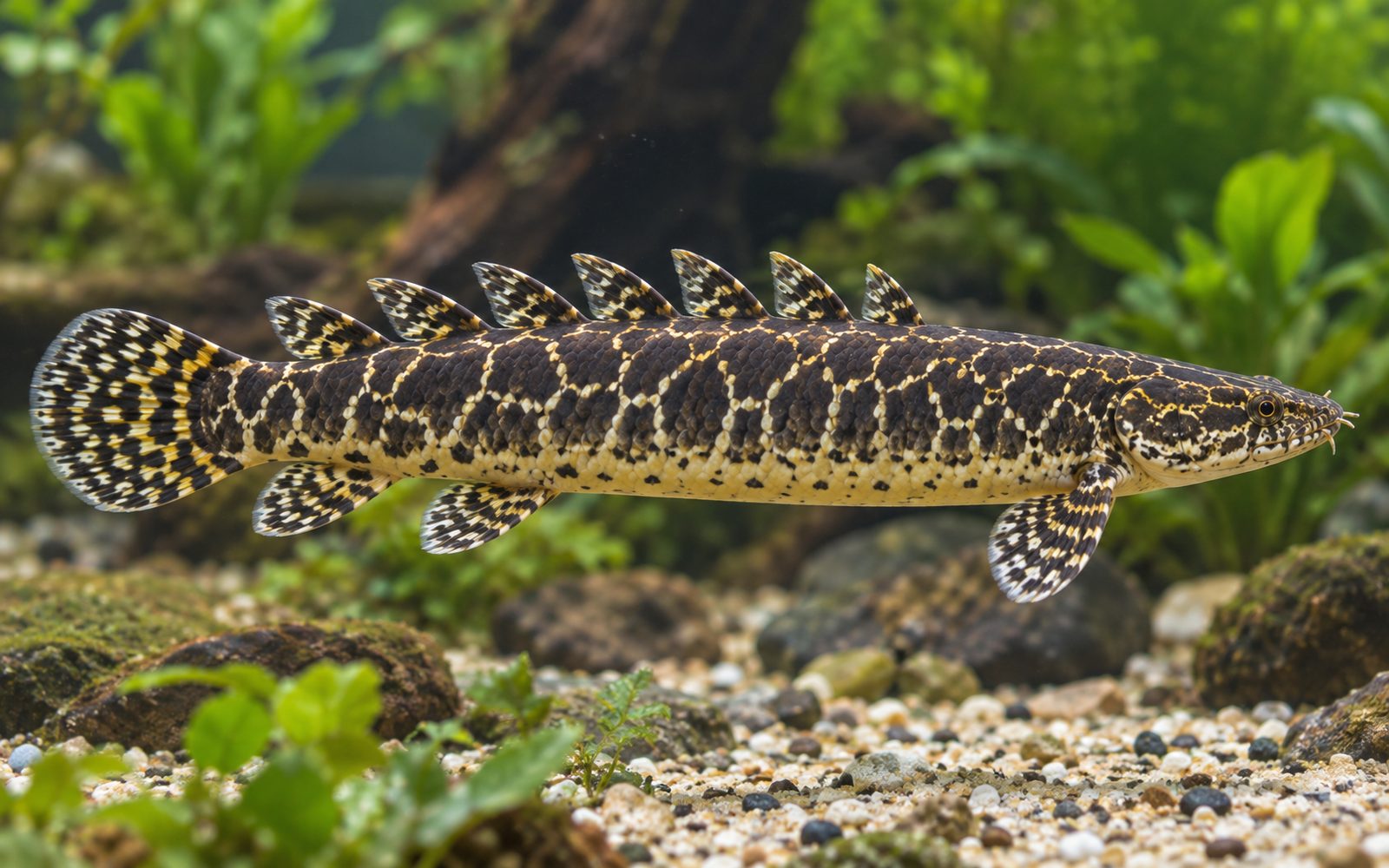
With the white and yellowish net pattern covering its dark brown-black body, the ornate bichir is the most striking bichir species; its fins are also spotted in black and white. With its thick scales, the row of sails on its back and the lung-like bladder it uses to breathe air, it is a typical member of this lineage known as "living fossils."
It reaches 50 cm in the aquarium and 60 cm in the wild. It is a stronger, bolder and hungrier predator than the Senegal and barred bichirs; its tankmates should be chosen accordingly.
Natural Habitat
It lives in the rivers and lakes of the Congo basin and the shoreline areas of Lake Tanganyika, in vegetated, shallow and dim areas. During the day it hides among plants and roots, and in the dark it hunts fish, crustaceans and insect larvae. In waters where oxygen drops, it survives by taking air from the surface.
Its eyesight is poor; it finds its prey by smell through the tubular nostrils on its snout. For this reason, in the aquarium it finds strong-smelling foods (shrimp, mussels) more easily.
Tank Setup
- Volume: at least 600 liters for an adult; a 180 × 60 cm footprint.
- Lid: a tight lid; gaps for hoses and cables must be closed, and an air gap must remain at the surface.
- Decor: sand substrate, large roots, caves and pipes. Dim places to hide during the day.
- Filter: strong filtration, 30% water change weekly.
Diet
Carnivorous. Shrimp, mussels, fish fillet, worms and large sinking pellets. It feeds in the evening. Live feeder fish become a habit and carry disease; accustom it to frozen foods.
Behavior and Compatibility
It mostly rests during the day and roams the aquarium at night. It easily swallows fish that fit in its mouth; it is also sometimes dominant over other bichirs.
Good companions: large, calm species too big for its mouth: arowanas, clown knifefish, large cichlids, tigerfish, large plecos.
Avoid: small and medium-sized fish, shrimp, fin-biting species.
Group and Colony Structure
Usually kept alone. In a large aquarium it can live with other bichir species, but the size difference should not be great.
Breeding
Aquarium breeding is rare; some of those sold are bred on farms in Asia. Its breeding behavior is similar to that of other bichirs.
Health and Common Problems
- Escape: it can get out through the smallest gap in the lid.
- Obesity: it is prone to overfeeding; adults should be fed every two to three days.
- Skin wounds: from hard and sharp decor.
Sexing
Males have a thicker, broader anal fin.
Tank mates
This list is calculated automatically from the species profile and grows as new species are added to the catalog. Try it in the planner for a definite answer.
Usually compatible
 Chocolate Cichlid
 Jack Dempsey
 Redhead Cichlid
 Red Devil Cichlid
 Cryptocoryne Parva
Adonis Pleco
African Brown Knifefish
Cryptocoryne Parva
Adonis Pleco
African Brown Knifefish
 Weeping Moss
 Flame Moss
 Alternanthera Reineckii 'Mini'
Should not be kept together









Hobbyist notes
Things you won't find in books, learned by trial and error. The most helpful ones are on top.
Change history and contributors
- Page created · October 16, 2026