
Water parameters
Overview
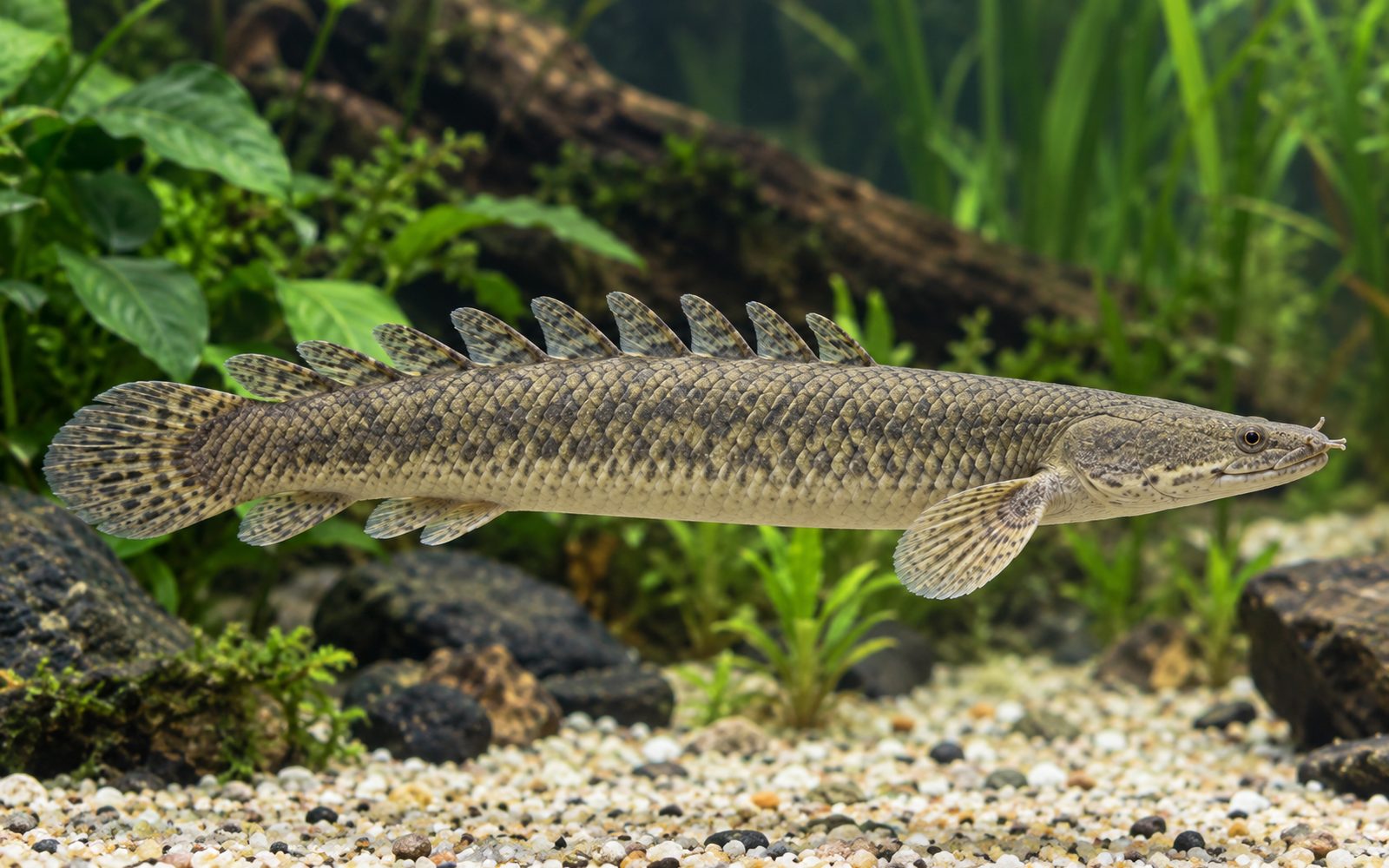
The Senegal bichir is one of the best-known and smallest members of a primitive lineage of fish whose origins go back hundreds of millions of years. Its long body is covered in thick, rhombus-shaped scales; along its back are 8–11 finlets, each resembling a small separate sail. It practically walks along the bottom on its fleshy pectoral fins.
It breathes air from the surface with a lung-like air bladder; it can drown if it cannot reach the surface. Its eyesight is poor, and it finds its prey largely by smell. It is the hardiest and best-selling bichir; in the aquarium it usually stays around 30 cm.
Color and Fin Varieties
- Albino: a form with a white-pink body and red eyes; its care is the same.
Natural Habitat
It lives in the rivers of West and Central Africa, the Nile basin, swamps and shallow, vegetated lake shores. It can survive in oxygen-poor water by breathing air.
Tank Setup
- Volume: at least 250 liters for an adult; a large floor area matters more than height (120 × 50 cm or more).
- Lid: a very tight lid is essential. It escapes by climbing through gaps for hoses and cables, and dries out and dies outside the aquarium. Leave an air gap between the water surface and the lid.
- Substrate and decor: sand or rounded gravel; roots, stone caves, pipes.
- Water: it adapts to a wide range of values; clean water and a 25–30% change weekly are enough.
Diet
Carnivorous. Sinking pellets and tablets, bloodworms, worms, shrimp, mussels and fish fillet. It feeds mostly in the evening and at night. Because it searches for food by smell, choose sinking food.
Behavior and Compatibility
Calm and slow-moving, but an opportunistic predator: at night it eats fish and shrimp that fit in its mouth. It usually has no problems with fish its own size or larger.
Good companions: medium to large species too big for its mouth: angelfish, large gouramis, silver dollars, African butterflyfish, medium-sized cichlids, large plecos.
Avoid: small fish such as neons and rasboras, shrimp, species that nip the bichir's fins.
Group and Colony Structure
It can be kept alone; with enough floor space and hiding places, several bichirs can also live together. It shows no marked aggression toward its own kind.
Breeding
It occasionally breeds in the aquarium: the male cups his anal fin like a scoop to collect the female's eggs, fertilizes them and scatters them among plants. The parents show no interest and may eat the eggs. The larvae carry external gills for a while.
Health and Common Problems
- Escape and drying out: the most common cause of death; close the gaps in the lid.
- Blocked air breathing: when the surface is completely covered or the water level touches the lid.
- Skin wounds: from hard and sharp decor.
Sexing
Males have a noticeably thicker and broader anal fin; the female's is narrower and thinner.
Tank mates
This list is calculated automatically from the species profile and grows as new species are added to the catalog. Try it in the planner for a definite answer.
Usually compatible
 Firemouth Cichlid
 Chocolate Cichlid
 Festivum
 Gymnogeophagus balzanii
 Pearl Cichlid
 Threadfin Acara
 Blood Parrot
 Redhead Cichlid
 Red Hump Eartheater
 Cryptocoryne Parva
Should not be kept together








Hobbyist notes
Things you won't find in books, learned by trial and error. The most helpful ones are on top.
Change history and contributors
- Page created · October 16, 2026