
Water parameters
Overview
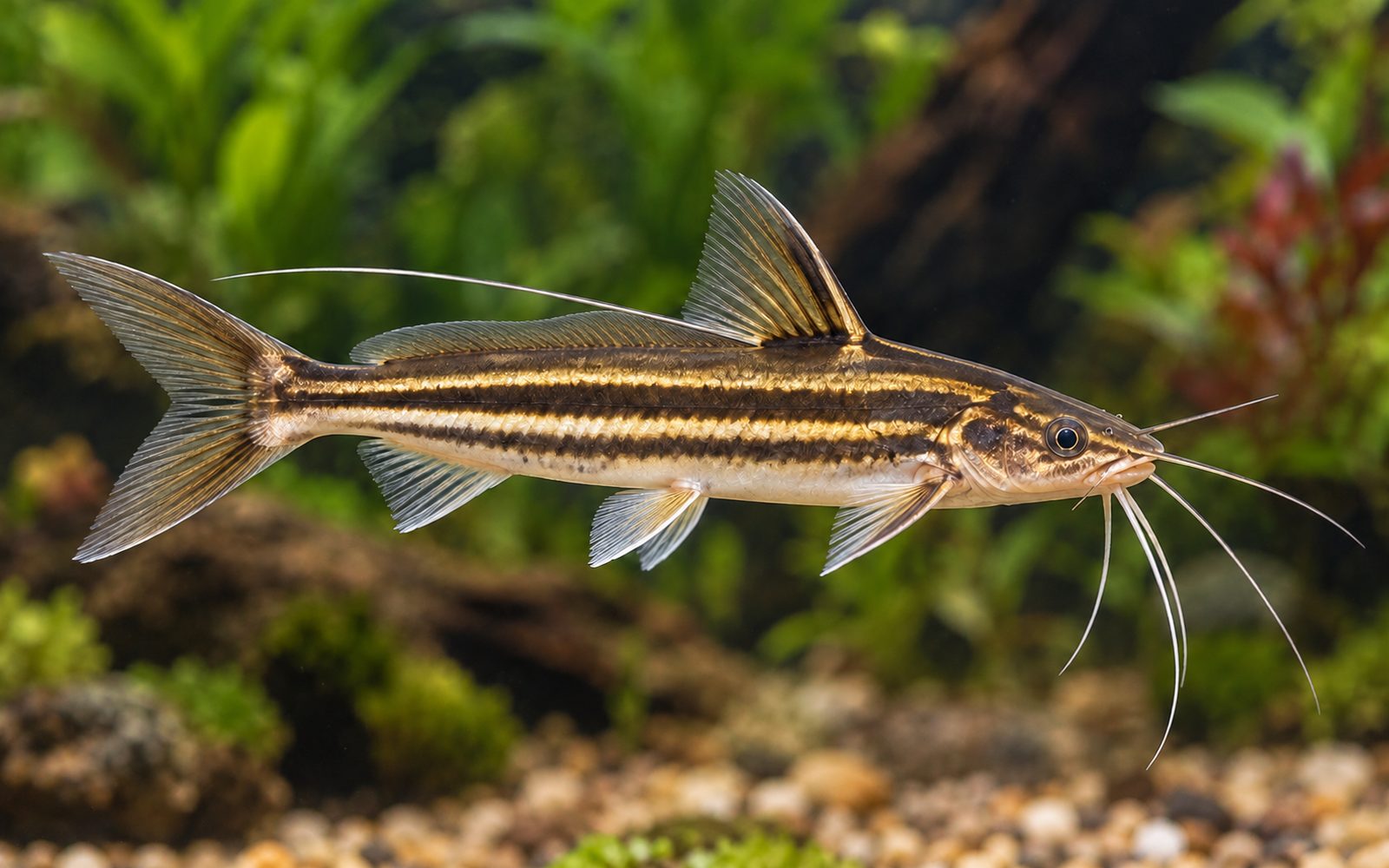
The striped dwarf catfish is a widespread South Asian member of the family Bagridae. Dark brown and pale golden stripes run along its slender body, and the barbels on the upper jaw reach back to the rear of the body. When disturbed it produces audible creaking sounds with its pectoral spines.
Adults usually reach 12–15 cm; large individuals can approach 20 cm. Unlike many catfish, it is quite active during the day as well. It is hardy, but because it hunts fish that fit in its mouth, choosing tankmates in a community aquarium is important.
Natural Habitat
It lives in the rivers, lakes, ponds, canals and rice paddies of South Asia. Thanks to its wide range, it adapts to varied water conditions. It prefers soft, muddy and planted bottoms. It moves about in groups, sweeping the bottom with its long barbels in search of insect larvae, small crustaceans and fish.
Tank Setup
- Volume: at least 200 liters and 120 cm of length for a group of 3–5.
- Substrate: fine sand; the barbels get injured on sharp gravel.
- Decor: roots, caves and sturdy plants along the edges; a hiding place for every individual.
- Water: 22–27°C, pH 6.5–7.8; it adapts to a wide range.
- Filter: good oxygenation and gentle to moderate flow.
Diet
Omnivorous but prefers animal-based food. Offer sinking granules and tablets, frozen bloodworms, mysis, brine shrimp and small worms. It is a hearty eater; make sure slow bottom dwellers can get their share. Feeding juveniles once or twice a day and adults once a day is enough.
Behavior and Compatibility
Active and semi-aggressive. It frequently spars with members of its own species over hiding places; fights increase when hiding spots are scarce. At night it hunts small fish that fit in its mouth.
Good companions: medium to large fish: large barbs, Congo tetras, rainbowfish, gouramis, medium-sized cichlids, large plecos.
Avoid: small tetras, rasboras, guppies, dwarf shrimp; very calm and timid species.
Group and Colony Structure
It lives in a loose group: at least 3, ideally 5 individuals. As the group grows, aggression is spread out instead of being focused on a single fish. A separate cave or hollow should be provided for each individual.
Breeding
It rarely breeds in the aquarium. In the wild it is known to breed during the rainy season, scattering its eggs among plants. Most of the fish sold are wild-caught.
Health and Common Problems
- It is hardy; poor water and sharp substrate lead to barbel injuries.
- Its scaleless skin is sensitive to copper-based medications.
- Its pectoral spines get caught in nets; catch it with a container.
- Quarantining new arrivals for two weeks prevents carrying diseases such as ich into the main tank.
Sexing
Males have a long, pointed genital papilla behind the vent; females have a fuller belly.
Tank mates
This list is calculated automatically from the species profile and grows as new species are added to the catalog. Try it in the planner for a definite answer.
Usually compatible
 Emerald Betta
 Festivum
 Firemouth Cichlid
 Buffalohead Cichlid
 Chocolate Cichlid
 Geophagus surinamensis
 Rainbow Cichlid
 Gymnogeophagus balzanii
 Pearl Cichlid
Should not be kept together






Hobbyist notes
Things you won't find in books, learned by trial and error. The most helpful ones are on top.
Change history and contributors
- Page created · October 16, 2026