
Water parameters
Overview
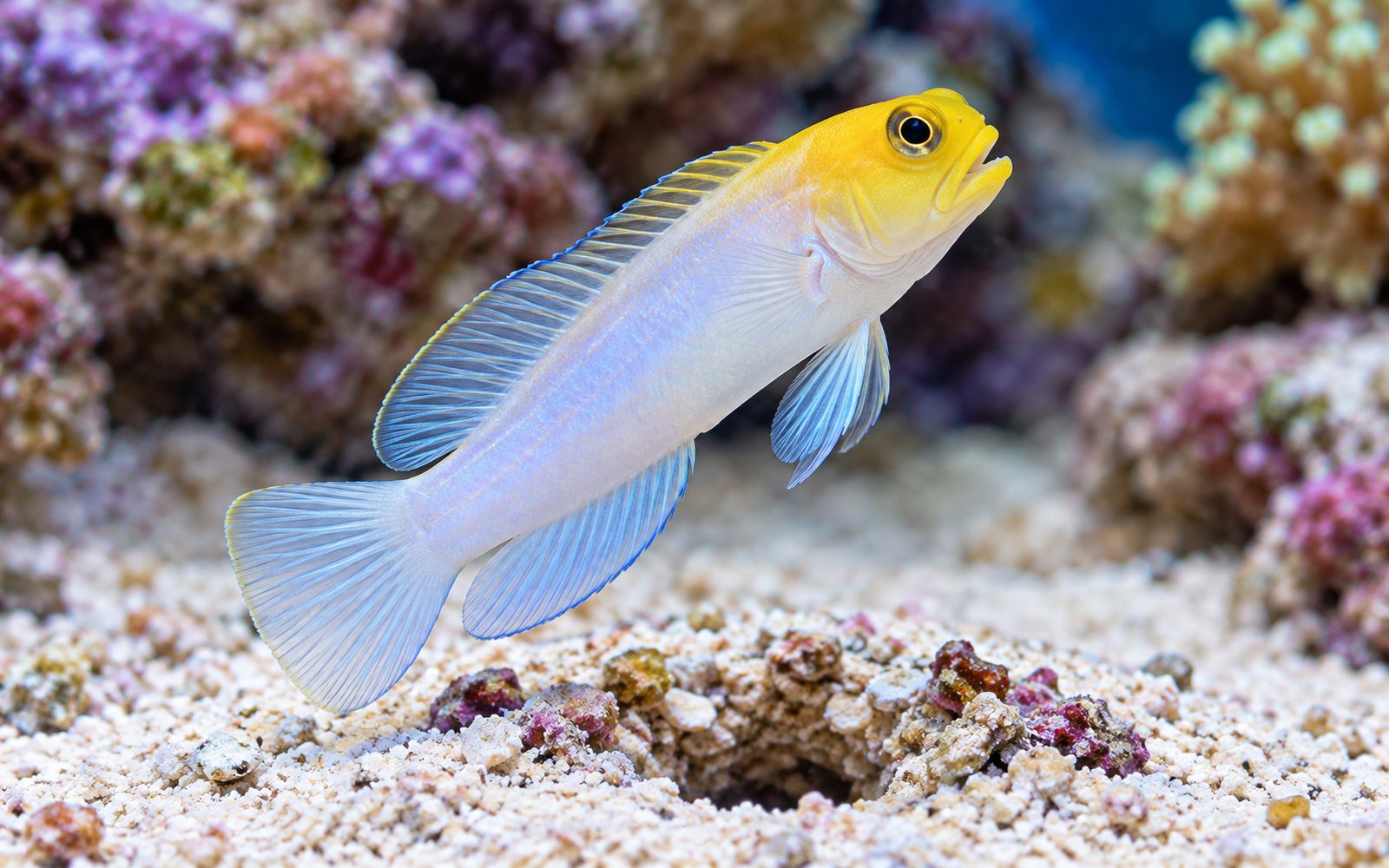
The yellowhead jawfish is a Caribbean bottom-dwelling fish recognized by its pearly white-bluish body and bright yellow head. It digs its own burrow from sand and small stones; it spends most of the day with its head poking out of the burrow entrance or hovering vertically just above it. When in danger it dives tail-first into its burrow.
It is a peaceful fish with personality, but it has two requirements: a deep, mixed substrate and a fully covered aquarium. It is one of the most skilled jumpers among marine fish; in an aquarium without a lid it is soon lost.
Natural Habitat
It lives on sand and rubble flats in the Western Atlantic, usually in colonies. Each individual digs its own vertical burrow and reinforces the burrow walls with coral fragments and shells. It picks plankton brought by the current while hovering above its burrow.
Tank Setup
- Volume: At least 110 liters; a wide footprint matters, not height.
- Water: Salinity specific gravity 1.023–1.026, pH 8.1–8.4, temperature 23–27°C. Avoid very warm water.
- Substrate: At least 8–10 cm deep, a mix of fine sand with small rubble and shell fragments. With fine sand alone the burrow collapses.
- Rock: Place rocks directly on the glass; the fish may dig underneath them.
- Lid: A fully closed or fine mesh lid is essential; it can escape even through small openings.
- Reef compatibility: Reef-safe; it leaves corals, shrimp and snails alone.
Diet
Carnivorous, picking plankton from the water column. Offer frozen mysis, brine shrimp, copepods and small sinking granules; get the food close to its burrow. Twice a day.
Behavior and Compatibility
Extremely peaceful. It does not attack its own kind apart from brief squabbles around the burrow. Aggressive or fast fish confine it to its burrow and prevent it from feeding.
Good companions: Clownfish, cardinalfish, firefish, blennies, chromis, cleaner shrimp.
Avoid: Aggressive damselfish, dottybacks, hawkfish, lionfish, large sand diggers that can wreck its burrow.
Group and Colony Structure
Kept singly or as a small colony. In an aquarium with a large footprint, 3 or more individuals can live together, each digging its own burrow; the individuals should be added at the same time. In a small aquarium a single specimen is best.
Breeding
The male is a mouthbrooder: he takes the egg mass laid by the female into his mouth and carries it for about a week; during this time he does not eat, and he may occasionally leave the eggs in the burrow and pick them up again. The fry are planktonic; raising them in the aquarium takes expertise.
Health and Common Problems
- Jumping: The most common cause of death.
- Burrow collapse: A fish whose burrow keeps collapsing in an unsuitable substrate becomes stressed.
- Marine white spot and velvet: Use quarantine.
Sexing
There is no reliable external difference. The individual brooding eggs is the male; its mouth looks noticeably swollen.
Tank mates
This list is calculated automatically from the species profile and grows as new species are added to the catalog. Try it in the planner for a definite answer.
Should not be kept together



Hobbyist notes
Things you won't find in books, learned by trial and error. The most helpful ones are on top.
Change history and contributors
- Page created · October 16, 2026