
Water parameters
Overview
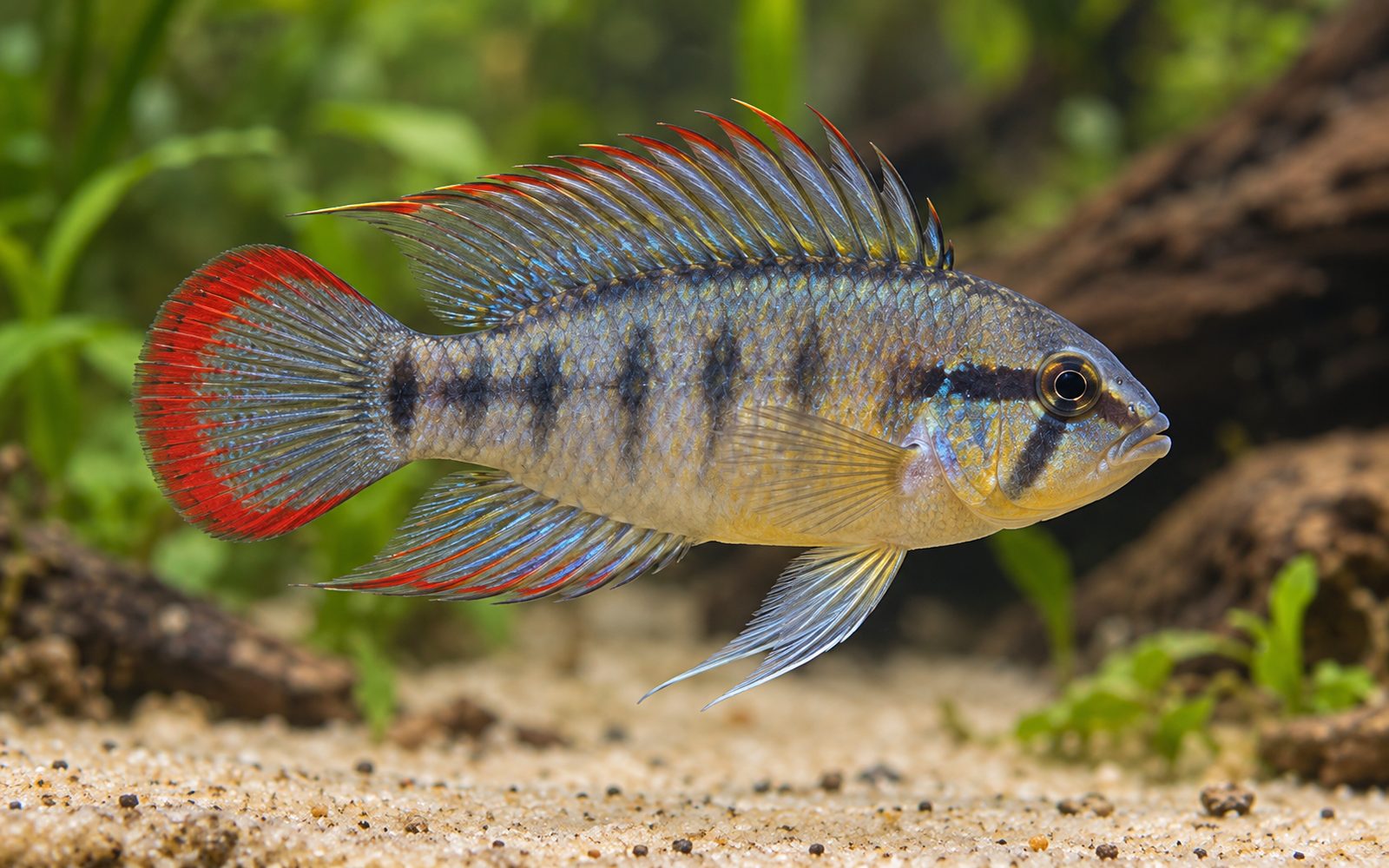
Apistogramma nijsseni is recognized by the striking color difference between the sexes. The male has a bluish–gray body with faint yellow reflections and a rounded tail with a broad, bright red band along its outer edge. The female turns lemon yellow, especially during the egg and fry periods; with the black band through her eye, the black spot on her flank and her black-edged fins, she resembles a panda.
Because it lives in very soft, acidic blackwater in the wild, it is choosy about water values. Farm-bred fish are somewhat more flexible, but soft water is needed for successful breeding.
Natural Habitat
It lives in slow-flowing forest streams that drain into the Ucayali River in the Loreto region of northern Peru. In these blackwaters the pH can drop as low as 4–5 and hardness is almost zero. The bottom is covered by a thick layer of leaves and branches.
Tank Setup
- Volume: at least 60 liters for one male and 1–2 females.
- Water: 25–27°C, pH 5–6.5, GH 1–5. If the tap water is hard, it should be mixed with reverse osmosis (RO) water. Peat or dried leaves soften the water and bring out the colors.
- Decor: caves, fine sand, roots, dried leaves; dim light and floating plants.
- Maintenance: a 20–25% change every week with water prepared to the same values; nitrate should be kept low.
Diet
Carnivorous. Make small frozen and live foods (brine shrimp, cyclops, daphnia, bloodworms) the staple. It accepts granules once accustomed to them; a varied diet strengthens the female's breeding colors.
Behavior and Compatibility
Males are more moderate than most Apistogramma, but the female becomes very aggressive while guarding fry. It gets along well with small, calm midwater fish; it hunts shrimp and shrimplets.
Good companions: cardinal tetras, pencilfish, hatchetfish, small rasboras, otocinclus (used to soft water).
Avoid: species that need hard water, large or aggressive cichlids, shrimp, crowds of bottom dwellers.
Group and Colony Structure
It is kept as a small harem of one male and 1–2 females, or as a single pair. Each female should have a separate cave. Because males are harsh toward each other, a single male per aquarium is recommended.
Breeding
The female lays eggs on the ceiling of the cave and takes on their care alone; during this time the panda pattern is at its most distinct. Very soft, acidic water is needed for the eggs to develop properly; in hard water the eggs usually spoil. The fry are fed newly hatched brine shrimp. In a small aquarium, if the female constantly chases the male, the male should be removed.
Health and Common Problems
In the wrong water values it quickly fades and falls ill. Bacterial infections and internal parasites are the most common problems; new fish should be quarantined.
Sexing
Males reach about 7 cm and are easily recognized by their red-edged tails. Females are noticeably smaller; the panda pattern of a yellow body with black markings is seen only in females.
Tank mates
This list is calculated automatically from the species profile and grows as new species are added to the catalog. Try it in the planner for a definite answer.
Usually compatible
 Emerald Betta
 Emerald Cory
 Porthole Catfish
 Keyhole Cichlid
 Cupid Cichlid
 Festivum
 Geophagus altifrons
 Geophagus surinamensis
 Threadfin Acara
Should not be kept together






Hobbyist notes
Things you won't find in books, learned by trial and error. The most helpful ones are on top.
Change history and contributors
- Page created · October 16, 2026