
Water parameters
Overview
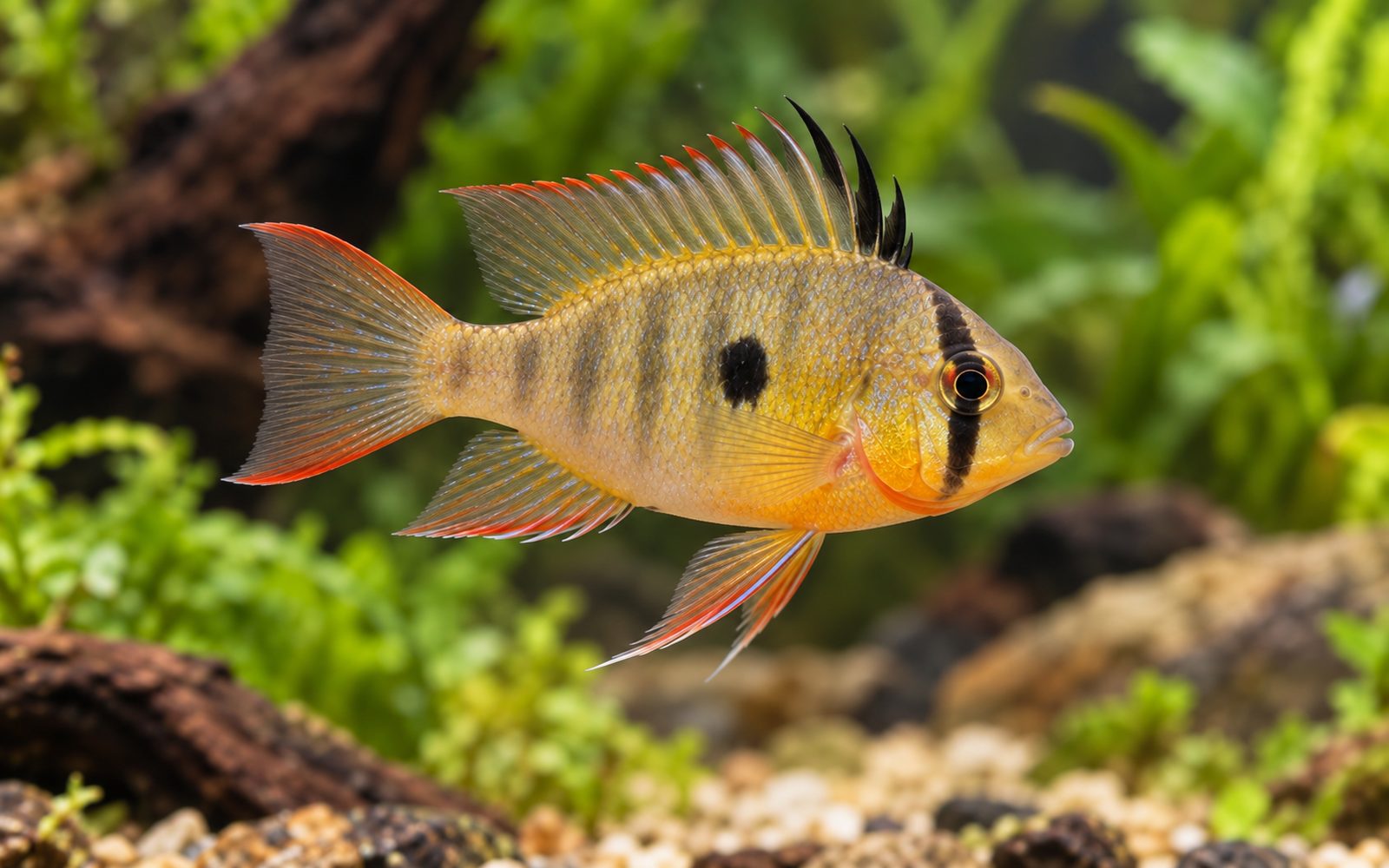
The Bolivian ram is one of the two species in the same genus as the ram (M. ramirezi). Compared with its cousin it is larger (up to 8 cm) and less brightly colored; instead of the ram's blue spots it has a golden-yellow body, a black spot in the middle, a red-tipped tail and long black front dorsal rays.
Its main advantage is its hardiness: it adapts to cooler and harder water and does not react as badly as the ram to small fluctuations in water values. Thanks to its peaceful nature, it is one of the species most often recommended to those who want to keep cichlids in a community aquarium.
Natural Habitat
It lives on the border of Bolivia and Brazil, in the Mamoré and Guaporé basins of the upper Madeira River. Sandy banks, floodplain lakes and slow-flowing side channels are its typical habitat. Water level and temperature change noticeably with the seasons.
Tank Setup
- Volume: at least 100 liters and 80 cm of length for a pair; 120 cm or more for a group.
- Substrate: fine sand is essential; it feeds by taking sand into its mouth and sifting it through its gills.
- Decor: flat stones (spawning surfaces), roots, plants along the edges, an open sand area in the middle.
- Water: 24–26°C; soft to moderately hard, pH 6–7.8. A 25–30% water change every week.
Diet
Omnivorous. It feeds on sinking granules and tablets, frozen bloodworms, brine shrimp, daphnia and mysis; it also takes plant-based foods. Because it searches for food on the bottom by sifting the sand, it is important that food reaches the bottom. It eats slowly, so it can fall behind fast, greedy fish in the race for food.
Behavior and Compatibility
Very peaceful; it guards its spawning site only during breeding. Males may square off in a confined space. It rarely attacks other fish but is weak in competition for food. It may eat shrimplets and adult dwarf shrimp.
Good companions: tetras, rasboras, Corydoras, otocinclus, bristlenose plecos, dwarf gouramis, pencilfish.
Avoid: aggressive and large cichlids, fast barbs that lunge for food, shrimp.
Group and Colony Structure
The easiest arrangement is a single pair. In an aquarium of 120 cm or more, a mixed group of 6–8 can be kept; over time pairs split off and each pair claims a small area. In the wild it has been observed to roam alone outside the breeding season; its group bond is not as strong as that of schooling fish.
Breeding
It is an open-substrate spawner: the pair clean a flat stone, root or broad leaf; the female lays rows of eggs and the male fertilizes them. The eggs hatch in 2–3 days; the larvae stay immobile for another 5–8 days, during which the parents move them between pits in the sand. The male and female share the care of the eggs and fry equally. Free-swimming fry are fed newly hatched brine shrimp.
Health and Common Problems
Hardy, but dirty substrate and high nitrate lead to bacterial infections. Food leftovers that collect in the sand should be siphoned regularly.
Sexing
Sexing is difficult. Males are larger, with slightly longer and more pointed dorsal and anal fins and more intense colors. Females are smaller and rounder; during spawning the ovipositor becomes visible. For a sure result, several juveniles are bought together and the pairs are left to form on their own.
Tank mates
This list is calculated automatically from the species profile and grows as new species are added to the catalog. Try it in the planner for a definite answer.
Usually compatible
 Flame Tetra
 Blackfin Corydoras
 Polystictus Corydoras
 Emerald Betta
 Emerald Cory
 Porthole Catfish
 Keyhole Cichlid
 Cupid Cichlid
 Geophagus surinamensis
 Cryptocoryne Parva
Should not be kept together







Hobbyist notes
Things you won't find in books, learned by trial and error. The most helpful ones are on top.
Change history and contributors
- Page created · October 16, 2026