
Water parameters
Overview
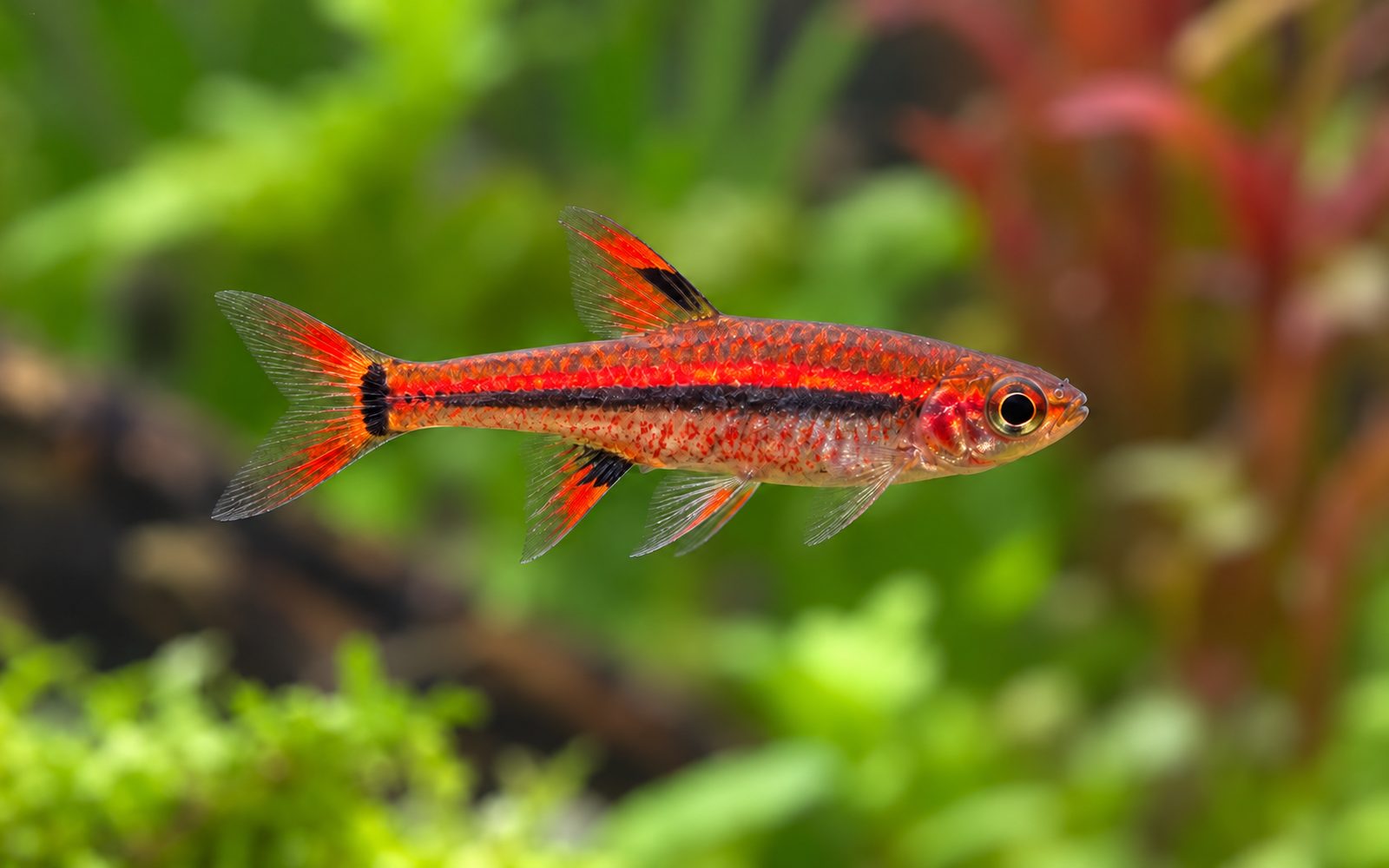
The chili rasbora is one of the smallest fish kept in aquariums: adults rarely exceed 1.5–2 cm. Males have a deep red or coral-colored body; above the thin black stripe running from behind the eye to the caudal peduncle there is a bright red line. The red and black markings on the leading edges of the dorsal and anal fins are the species' second identifying feature.
Its small size makes it very valuable for shrimp aquariums and planted nano setups of 20–40 liters. However, it struggles in newly set-up tanks or in water with fluctuating parameters; it must be added to a mature aquarium. In stores it is sometimes sold mixed with its close relative, the phoenix rasbora (Boraras merah).
Natural Habitat
It lives in the peat swamps of southwestern Borneo and in the slow-flowing channels that feed them. The water is tea-colored from the tannins released by decaying leaves, extremely poor in minerals and distinctly acidic. Dense vegetation and overhanging roots shade the surface.
Tank Setup
- Volume: at least 25 liters for a group of 10–15; a low nano tank with a wide footprint is better than a tall, narrow one.
- Water: 24–27°C, pH 5.5–7, soft water. Tannin-stained water and a dark substrate noticeably brighten the colors. Stable values matter more than hitting an exact number.
- Plants: mosses, fine-leaved stem plants and floating plants. Floating plants that soften the light make the fish bolder.
- Flow: should be weak; break up a strong filter outlet with a sponge or by redirecting it.
- Maturity: an aquarium that has been running for a few months, with biofilm on its glass and decor, should be preferred.
Diet
In the wild it is a micropredator feeding on small insect larvae, worms and zooplankton. In the aquarium it accepts flakes crushed fine enough to fit its mouth and micro granules; supplement these with newly hatched brine shrimp, frozen cyclops and microworms. Feed very small amounts two or three times a day; leftover food quickly fouls the water in a small volume.
Behavior and Compatibility
Extremely peaceful. It forms a loose group rather than a tight school: individuals spread out among the plants and regroup when they sense danger. Males put on brief displays among themselves by spreading their fins and darkening their colors; no one gets hurt in these encounters.
Good companions: Neocaridina and Caridina shrimp, otocinclus, dwarf corydoras species (C. pygmaeus, C. hastatus), galaxy rasboras, other Boraras species, nerite snails.
Avoid: Any fish whose mouth it fits into, active medium-sized species, bettas depending on the individual.
Group and Colony Structure
At least 10, ideally 15–20 or more individuals. Small groups are skittish and hide almost constantly; as numbers increase, the fish come out into the open and males show their best colors. The male-to-female ratio is not critical, but having slightly more females spreads out the displays between males.
Breeding
An egg scatterer that continuously lays small numbers of eggs. In a mature aquarium with plenty of moss, pairs release a few eggs among the plants throughout the day; there is no parental care and the eggs may be eaten. Clumps of moss and biofilm allow some fry to grow up unnoticed. For controlled breeding a small container filled with moss is used and the adults are removed after a few days. The fry are fed infusoria for the first days, then newly hatched brine shrimp.
Health and Common Problems
- New arrivals: sensitive to shipping stress; add them after a long, slow acclimation.
- Starvation: fish that cannot find food of the right size weaken quickly; a sunken belly is usually a sign of a feeding problem.
- Water quality: low tolerance for ammonia and nitrite; in a small volume make a 20–30% water change every week.
- White spot: can appear after sudden drops in temperature.
Sexing
Males are slimmer and intensely red; the red line above the black stripe is bright, and the markings on the dorsal and anal fins are prominent. Females are a pale orange-pink, have fuller bellies and are slightly larger.
Tank mates
This list is calculated automatically from the species profile and grows as new species are added to the catalog. Try it in the planner for a definite answer.
Usually compatible
 Flame Tetra
 Blackfin Corydoras
 Polystictus Corydoras
 Emerald Cory
 Porthole Catfish
 Keyhole Cichlid
 Cupid Cichlid
 Geophagus altifrons
 Geophagus surinamensis
 Cryptocoryne Parva
Should not be kept together





Hobbyist notes
Things you won't find in books, learned by trial and error. The most helpful ones are on top.
Change history and contributors
- Page created · October 16, 2026