
Water parameters
Overview
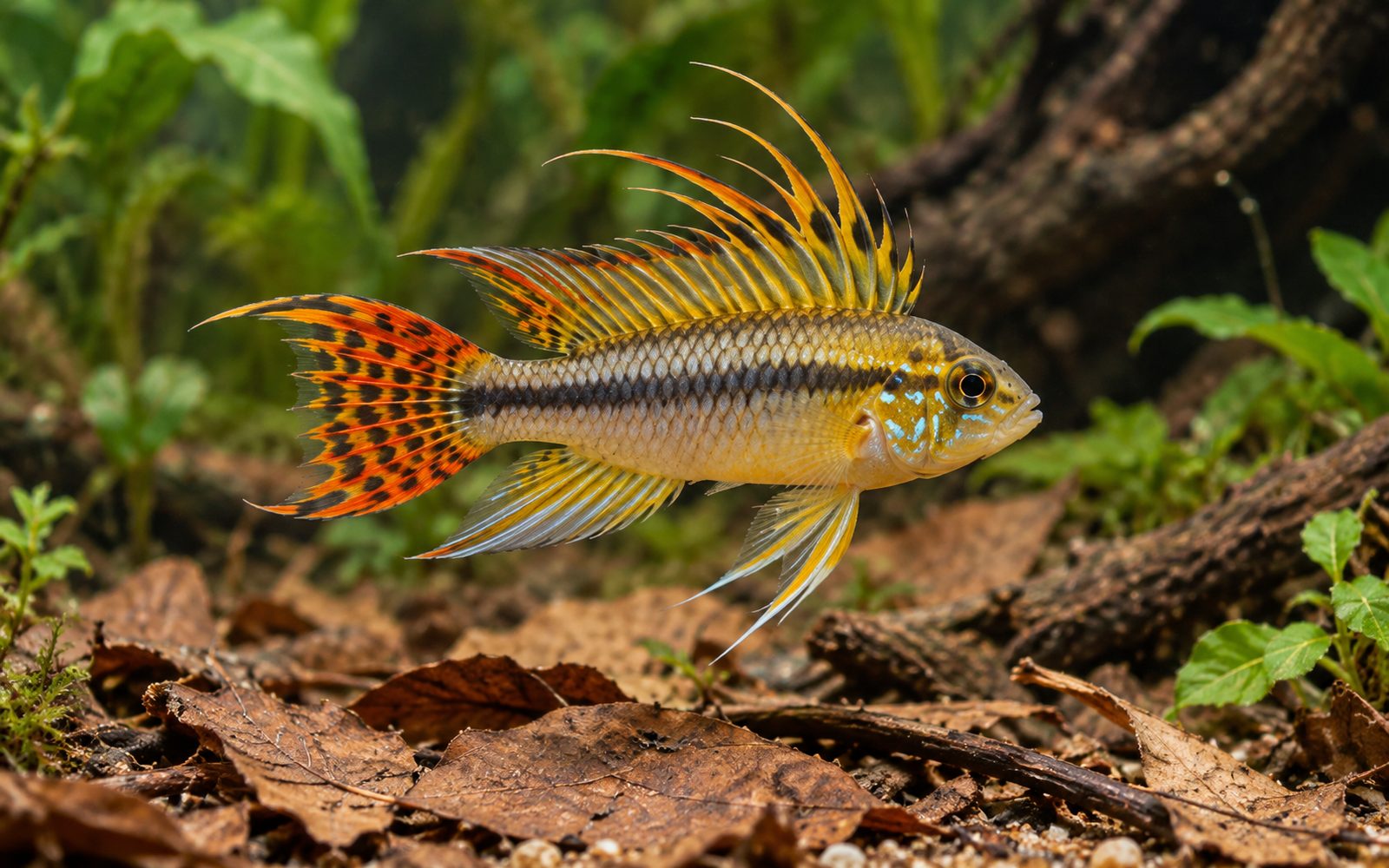
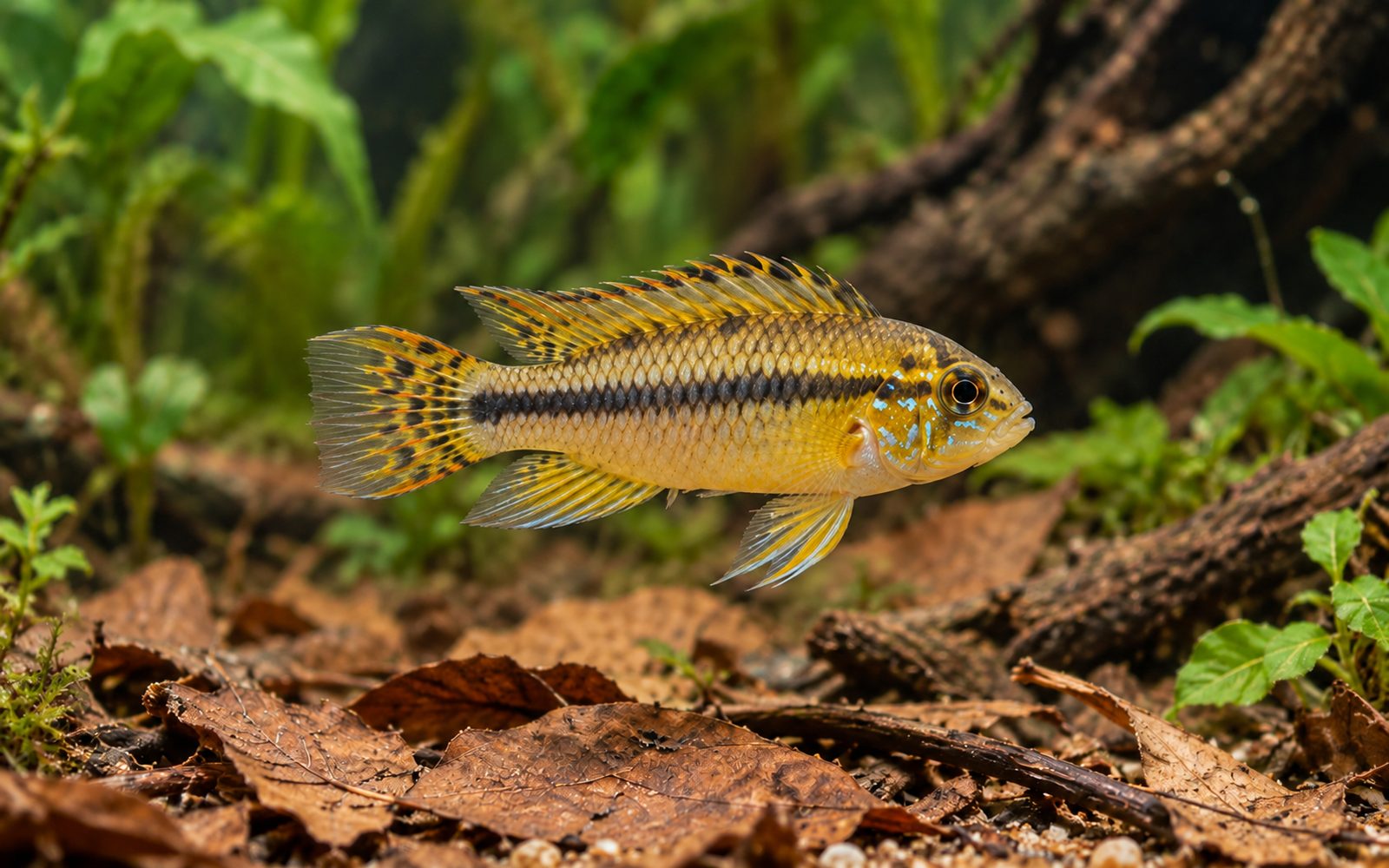
The cockatoo dwarf cichlid is the hardiest and most readily available of the Apistogramma. The front rays of the male's dorsal fin are elongated and stand up like a cockatoo's crest; the tail and fins have a red–orange pattern. There are color forms such as "double red" and "orange flash." Females are small, yellow and plain; when guarding fry they turn yellow and black.
Natural Habitat
It lives in the upper Amazon, in shallow streams and pools covered with leaf litter, in soft and slightly acidic water.
Tank Setup
- Volume: at least 60 liters for one male and 2–3 females; a length of 80 cm or more is more comfortable.
- Caves: a separate small cave for each female (coconut shell, small stone cave).
- Setting: fine sand, dried leaves, roots, dense planting; dim light.
- Water: 25–27°C; soft and slightly acidic is ideal, but it also adapts to moderate hardness.
Diet
Mainly carnivorous. Frozen bloodworms, brine shrimp, daphnia, cyclops; quality small granules. Live food boosts appetite and color.
Behavior and Compatibility
The male guards his territory and his females; the females also defend the area around their own caves. It usually leaves midwater fish alone but may chase bottom dwellers.
Good companions: small to medium tetras and rasboras (cardinal, rummy-nose, harlequin), otocinclus, kuhli loaches (with enough space).
Avoid: other Apistogramma males (in a small aquarium), fish that constantly roam the bottom such as corydoras (in a small aquarium), shrimp, large cichlids.
Group and Colony Structure
The cockatoo dwarf cichlid lives in a harem: 1 male and 2–3 females. Each female sets up her own small territory and cave; the male controls a large area that covers all of these territories. A single pair also works, but the female may be worn out by the male's attention. Two males can only be tried in a large aquarium well divided by decor.
Breeding
The female lays 50–100 eggs on the ceiling of the cave and guards the fry almost alone; during this time her color turns bright yellow. Once the fry start swimming, the female leads them around as a school. Temperature affects the sex ratio of the fry (at higher temperatures the proportion of males increases).
Health and Common Problems
Relatively hardy, but sensitive to nitrate buildup and poor water; regular water changes are essential. Internal parasites are common in imported fish.
Sexing
Sexing is easy: males are 7–8 cm, with a long-rayed, colorful dorsal fin and a patterned tail. Females are 4–5 cm, yellowish–gray and short-finned; they have a dark horizontal stripe on the body and turn bright yellow when guarding fry.
Tank mates
This list is calculated automatically from the species profile and grows as new species are added to the catalog. Try it in the planner for a definite answer.
Usually compatible
 Emerald Betta
 Emerald Cory
 Porthole Catfish
 Keyhole Cichlid
 Firemouth Cichlid
 Cupid Cichlid
 Buffalohead Cichlid
 Festivum
 Geophagus altifrons
Should not be kept together





Hobbyist notes
Things you won't find in books, learned by trial and error. The most helpful ones are on top.
Change history and contributors
- Page created · October 16, 2026