
Water parameters
Overview
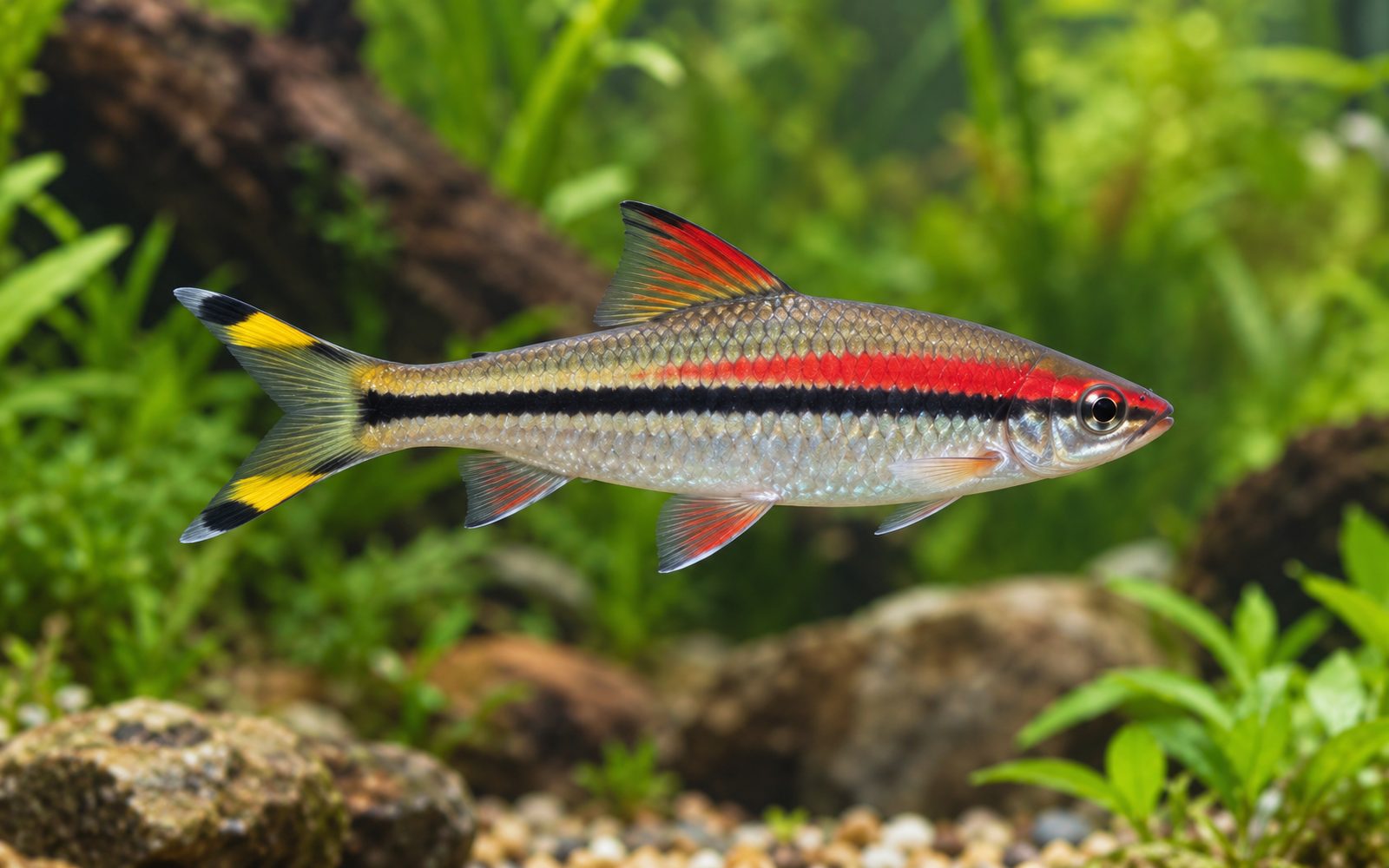
The Denison barb is endemic to the Western Ghats mountains of southwestern India. The black line running along its silver body, the bright red line above it and the yellow–black spots on the tail lobes make it one of the best-known barbs.
Excessive collection for the trade has seriously reduced its natural populations, and the species is classified as "endangered" on the IUCN list. Today farm-bred fish are also sold; choose captive-bred fish whenever possible. A gold-colored form is also available in the trade.
Natural Habitat
It lives in fast-flowing, clear, oxygen-rich streams and rivers in the mountainous regions of Kerala and Karnataka. The bottom is rocky and gravelly, and the banks are densely vegetated. During the monsoon the current becomes very strong; in the dry season the water cools and slows.
Tank Setup
- Volume: at least 300 liters and 150 cm of length for a group of 6. It swims fast and over long distances; tank length matters more than volume.
- Water: 20–24°C is ideal; it becomes stressed at temperatures above 25°C. High oxygen and powerful filtration are essential.
- Current: moderate to strong flow; well-aerated water with a rippling surface.
- Decor: a sand–gravel substrate, round stones and roots; a wide swimming area in the middle.
- Lid: it jumps when startled; a tight-fitting lid is required.
Diet
Omnivorous. Plant matter from quality flakes and granules, spirulina-based food and blanched vegetables; animal protein from frozen brine shrimp, bloodworms and mysis shrimp. It may eat dwarf shrimp and very small fry.
Behavior and Compatibility
Peaceful but active. It establishes a hierarchy within the group and engages in short chases. When kept alone or with 2–3 individuals it becomes shy, loses its color or gets grumpy toward its own kind.
Good companions: peaceful fish of similar size that like current and cool water: large danios and devarios, rainbowfish, large rasboras, current-loving loaches, Ancistrus.
Avoid: dwarf shrimp and very small fish, aggressive cichlids, slow species that like warm water (such as discus).
Group and Colony Structure
Kept in a group of at least 6, ideally 8 or more individuals. In a large group the fish swim the length of the aquarium following one another, and their colors become brighter. The sex ratio is of no particular importance.
Breeding
Breeding in the home aquarium is very rare. It is an egg scatterer; captive-bred fish sold in the trade are produced on farms with hormone support.
Health and Common Problems
Sensitive to water quality; high nitrate, low oxygen and warm water are the most common causes of problems. White spot and stress-related bacterial infections can appear. A 30–40% water change weekly is recommended. Keep newly arrived fish in quarantine.
Sexing
Hard to tell apart externally. Mature females are larger with a plumper belly, while males are slimmer; in some males the red line is more intense.
Tank mates
This list is calculated automatically from the species profile and grows as new species are added to the catalog. Try it in the planner for a definite answer.
Usually compatible
 Flame Tetra
Glass Tetra
Flame Tetra
Glass Tetra
 Blackfin Corydoras
 Polystictus Corydoras
 Emerald Cory
 Emerald Dwarf Rasbora
 Porthole Catfish
 Keyhole Cichlid
 Firemouth Cichlid
 Rainbow Cichlid
Should not be kept together






Hobbyist notes
Things you won't find in books, learned by trial and error. The most helpful ones are on top.
Change history and contributors
- Page created · October 16, 2026