
Water parameters
Overview
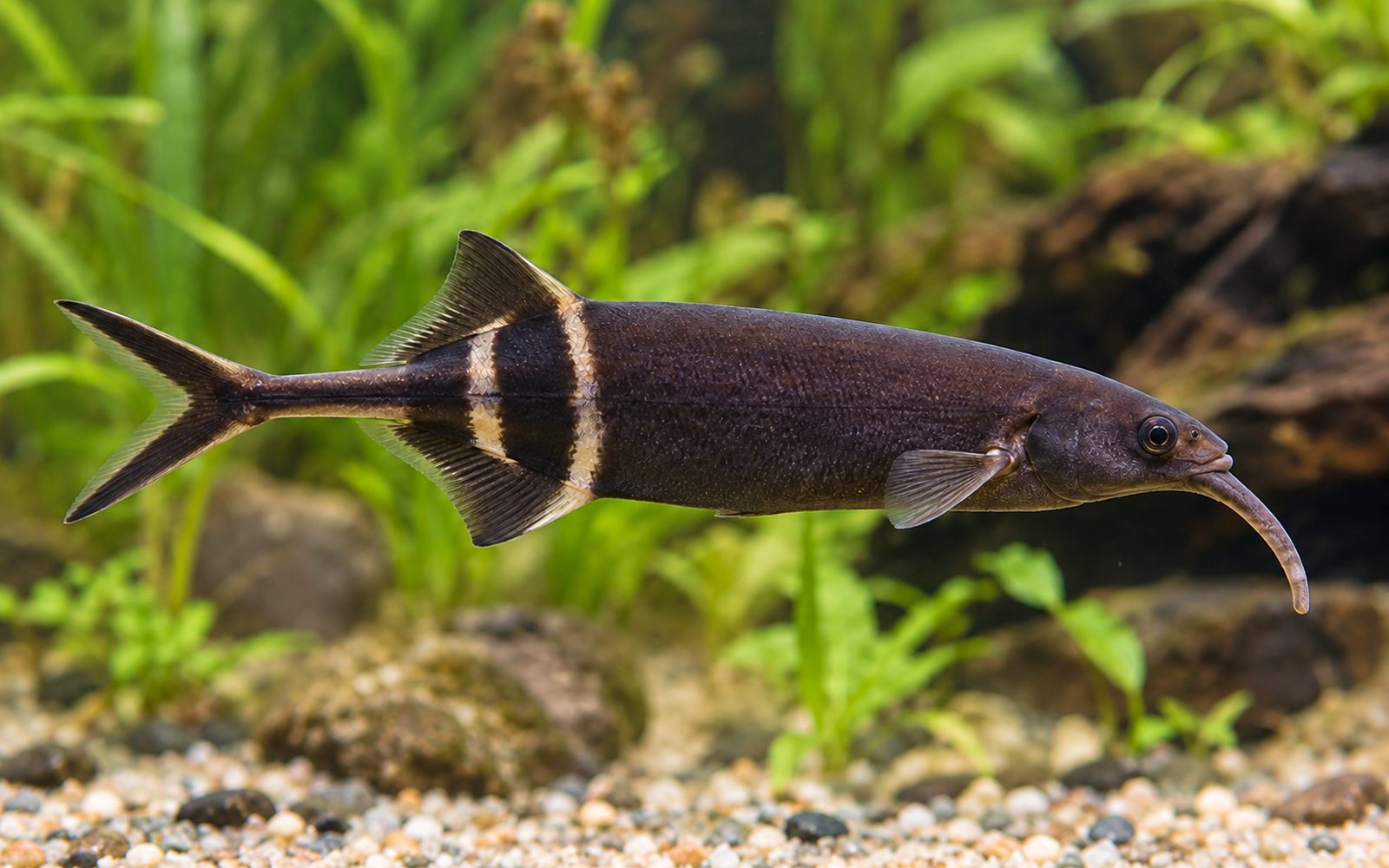
The elephantnose fish is recognized by the long, flexible extension on its chin. This extension is not actually a nose but a continuation of the lower jaw, and the sensory cells on it help it find worms in the sand. On the rear part of its dark brown-purple body there are two light-colored stripes connecting the dorsal and anal fins.
It produces weak electric signals with an organ in its tail base and uses these signals both to navigate and to communicate with conspecifics. It has a very large brain relative to its body and is known for playful-looking behavior. On the other hand, it is very sensitive to poor water, medications and competition for food.
Natural Habitat
It lives in murky, slow-flowing rivers and floodplains of West and Central Africa, over soft mud and sand bottoms. At night it digs through the substrate, feeding on insect larvae and worms.
Tank Setup
- Volume: at least 200 liters and 120 cm length for a single fish; 400 liters or more for a group.
- Substrate: fine, soft sand is essential; sharp gravel injures the chin extension.
- Light and cover: dim light, floating plants; hiding places made of pipes and roots.
- Water: flawless water quality, stable values; a mature aquarium. Use a lid; it can escape through small gaps.
Diet
Carnivorous. Frozen and live bloodworms, tubifex, small worms, brine shrimp and mysis. It searches for food slowly; if there are fast-eating tankmates it goes hungry. Feed after the lights go out, close to where it hides.
Behavior and Compatibility
Peaceful toward other species but territorial toward its own kind. Shy during the day, active in the evening and at night. It may eat dwarf shrimp.
Good companions: calm mid-water species: large tetras (Congo tetras), calm gouramis, angelfish, African butterflyfish.
Avoid: fast and greedy bottom-dwellers, aggressive cichlids, large predators, dwarf shrimp.
Group and Colony Structure
Alone, or 5 or more in a large aquarium. In groups of two or three, the strongest constantly chases the others.
Breeding
Aquarium breeding is almost unknown; the fish sold are wild-caught.
Health and Common Problems
- Medication sensitivity: copper and many parasite medications can be fatal; always research before using any medication.
- Starvation and wasting: common in fish that cannot get food because of competition; the belly becomes sunken.
- Injuries to the chin extension: from hard substrate and sharp decor.
Sexing
The sexes are hard to tell apart externally. Males are reported to have a more curved anal fin base, but this is not a reliable method.
Tank mates
This list is calculated automatically from the species profile and grows as new species are added to the catalog. Try it in the planner for a definite answer.
Usually compatible
 Flame Tetra
Glass Tetra
Flame Tetra
Glass Tetra
 Blackfin Corydoras
 Polystictus Corydoras
 Emerald Betta
 Emerald Cory
 Porthole Catfish
 Keyhole Cichlid
 Firemouth Cichlid
 Cupid Cichlid
Should not be kept together




Hobbyist notes
Things you won't find in books, learned by trial and error. The most helpful ones are on top.
Change history and contributors
- Page created · October 16, 2026