
Water parameters
Overview
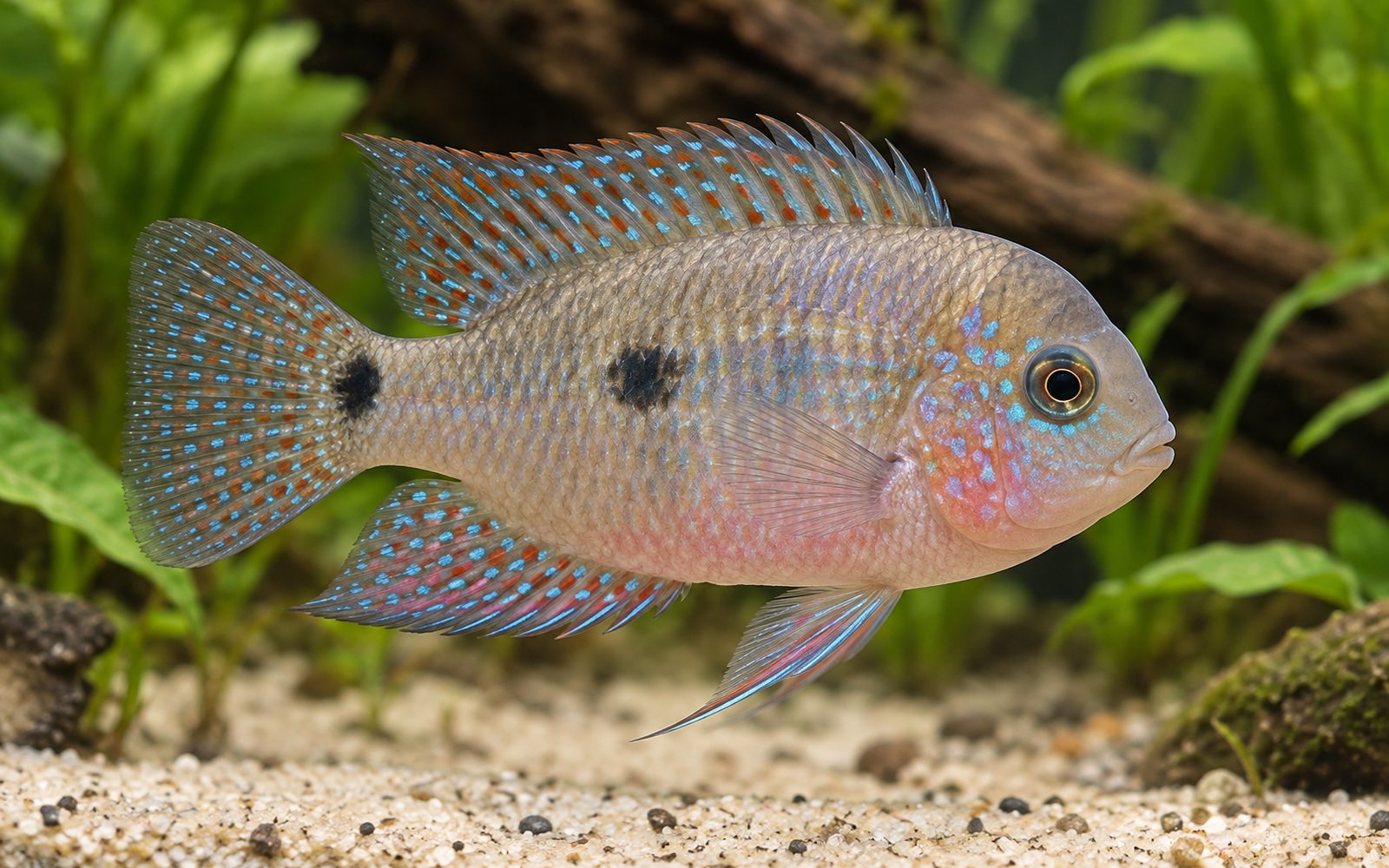
The flag acara is a small representative of the cichlids known as acaras. Curviceps ("curved head") in its scientific name refers to its steep, rounded forehead profile. Its silvery–beige body shines with blue and pink reflections; there is a dark spot in the middle of the flank and another at the tail base, and rows of blue and reddish dots on its fins.
Its peaceful, calm nature combined with its tolerance of a range of water values makes it one of the easiest South American dwarf cichlids after the Apistogramma. The proportion of red and blue in its coloring varies from locality to locality.
Natural Habitat
It lives in Brazil in the lower Amazon, around the Tapajós and Arapiuns rivers. It prefers clear, slow-flowing small side channels, old riverbeds and lake shores; the bottom is usually covered with leaf litter.
Tank Setup
- Volume: at least 80 liters for a pair.
- Decor: flat stones and broad-leaved plants (spawning surfaces), roots, dense plants along the edges.
- Substrate: fine sand; the parents dig pits in the sand during the fry period.
- Water: 24–27°C; soft to moderately hard, pH 6–7.5. A 25% water change every week.
Diet
In the wild it feeds on algae, organic detritus, insect larvae, worms and small crustaceans. In the aquarium, give frozen bloodworms, brine shrimp and daphnia along with a plant-based granule or flake food.
Behavior and Compatibility
Peaceful and shy; it defends its territory only during the egg and fry period, and even this defense is usually moderate. It does not damage plants. It may eat shrimplets and adult dwarf shrimp.
Good companions: tetras, pencilfish, hatchetfish, Corydoras, otocinclus, dwarf gouramis.
Avoid: aggressive and large cichlids, fast and greedy barbs, shrimp.
Group and Colony Structure
Kept as a pair. To get a pair, 4–6 juveniles are grown up together; all except the bonded pair are moved to another aquarium. In 150 liters or more, two pairs can be housed if separate territories are created.
Breeding
It is an open-substrate spawner. The pair clean a flat stone or a broad leaf and lay the eggs there. The male and female care for the eggs and fry together. The eggs hatch in 2–3 days; the larvae may be moved to pits in the sand and become free-swimming a few days later. The fry are fed newly hatched brine shrimp and microworms.
Health and Common Problems
Hardy. Dirty water and high nitrate can lead to bacterial infections; with regular water changes, problems are rare. New fish should be observed in quarantine.
Sexing
Sexing is difficult. Males are slightly larger, with longer and more pointed dorsal and anal fins. Females are rounder; during spawning the ovipositor is visible. The dark spot on the dorsal fin is not present in every male, so it is not a reliable distinguishing feature.
Tank mates
This list is calculated automatically from the species profile and grows as new species are added to the catalog. Try it in the planner for a definite answer.
Usually compatible
 Flame Tetra
 Blackfin Corydoras
 Polystictus Corydoras
 Emerald Betta
 Emerald Cory
 Porthole Catfish
 Keyhole Cichlid
 Cupid Cichlid
 Geophagus altifrons
 Geophagus surinamensis
Should not be kept together






Hobbyist notes
Things you won't find in books, learned by trial and error. The most helpful ones are on top.
Change history and contributors
- Page created · October 16, 2026