
Water parameters
Overview
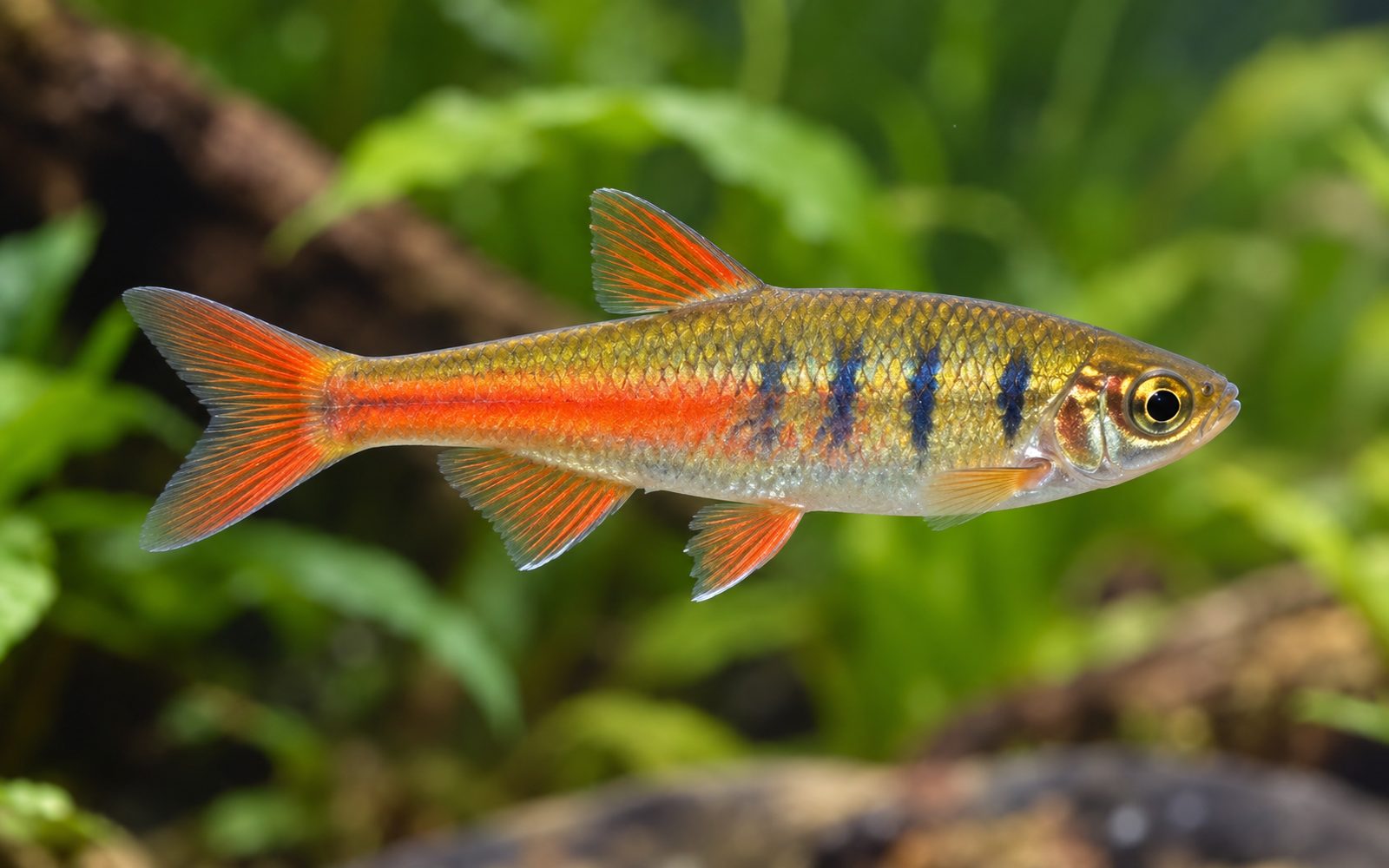
The glowlight danio is one of the most colorful of the small danios. Its body, about 3 cm long, is golden olive; the front half has short, dark blue vertical bars, while the rear half has an orange-red band that glows as it catches the light. Its fins are also orange-red.
It is as hardy and easy to feed as the zebra danio, but smaller and more colorful. Thanks to its tolerance of cool water, it also does well in planted aquariums without a heater or kept at low temperatures. Its active, curious nature livens up the upper layer of the aquarium.
Natural Habitat
It lives in the Kachin region of northern Myanmar, in hill streams that form the upper tributaries of the Irrawaddy River. These waters are clear, flowing and rich in oxygen; the bottom is gravel and stone, with plants and roots along the banks. The temperature varies markedly with the seasons.
Tank Setup
- Volume: at least 54 liters and 60 cm in length for a school of 8–10.
- Water: 20–24°C, pH 6.5–7.5, moderately hard water. High temperatures shorten its lifespan.
- Flow: gentle to moderate current and high oxygen.
- Layout: gravel or sand substrate, stones, plants along the sides and open swimming space.
- Lid: it jumps; use a lid.
Diet
Omnivorous. It readily accepts small granules and flakes; frozen brine shrimp, daphnia, cyclops and mosquito larvae bring out its colors. It takes food mostly from the surface and midwater.
Behavior and Compatibility
Peaceful but active. As a school it moves through the upper and middle layers; males display to each other by flaring their fins and chase the females. Because of its speed it can bother very slow species with flowing fins.
Good companions: other small danios, kubotai and other rasboras, White Cloud Mountain minnows, corydoras, kuhli loaches, otocinclus, Neocaridina shrimp.
Avoid: large and predatory species, fish that need warm water (such as discus), bettas and slow, long-finned species.
Group and Colony Structure
At least 8, ideally 12 or more individuals. In a large school the males' displays and chasing are spread out; the fish become bolder and more colorful. Kept in small numbers, a dominant male can wear out the others. The male-to-female ratio is not critical.
Breeding
It scatters its eggs among plants and gravel; there is no parental care and the eggs are eaten. For breeding, a well-fed group is kept in a separate aquarium with the bottom covered in moss or an egg grid; it usually spawns in the morning. After the adults are removed, the fry become free-swimming within a few days; they are fed infusoria and then newly hatched brine shrimp.
Health and Common Problems
Hardy. Constantly high temperatures and low oxygen are the biggest risks. Losses from jumping occur in tanks without a lid. A 25% weekly water change is sufficient.
Sexing
Males are slimmer and more colorful; their orange-red band and fin colors are brighter. Females have a fuller belly and slightly paler colors.
Tank mates
This list is calculated automatically from the species profile and grows as new species are added to the catalog. Try it in the planner for a definite answer.
Usually compatible
 Flame Tetra
 Blackfin Corydoras
 Polystictus Corydoras
 Emerald Cory
 Emerald Dwarf Rasbora
 Porthole Catfish
 Keyhole Cichlid
 Cryptocoryne Parva
 European Bitterling
 Adolfo's Cory
Should not be kept together






Hobbyist notes
Things you won't find in books, learned by trial and error. The most helpful ones are on top.
Change history and contributors
- Page created · October 16, 2026