
Water parameters
Overview
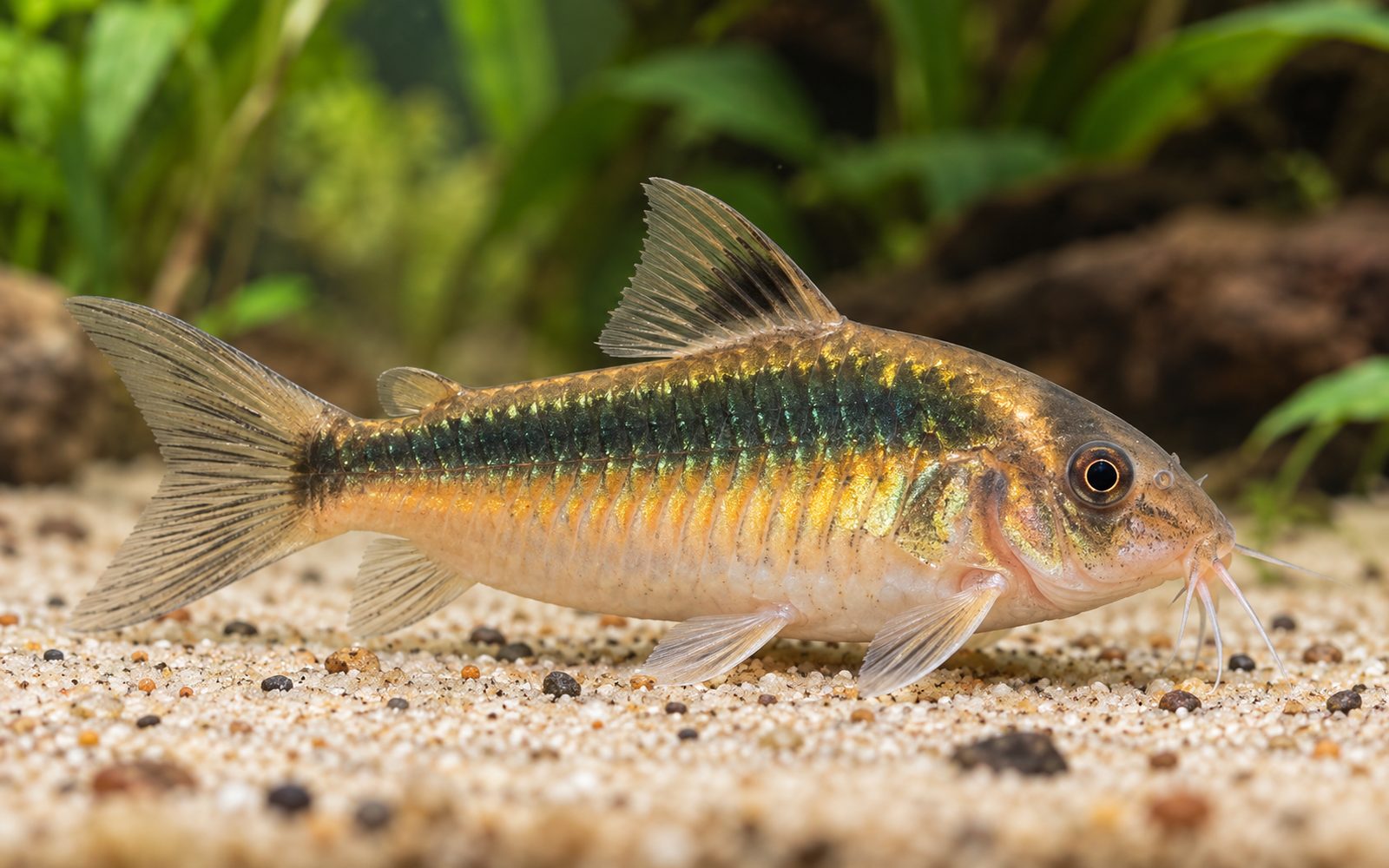
The green gold corydoras is recognized by its golden–orange flanks and the dark, greenish metallic band running from head to tail along the upper body near the back; its scientific name means "black band," and in English it is called the "green gold cory." It belongs to the same group as the bronze corydoras and has a similar body shape. Adults are around 6 cm. It comes from the Meta basin of Colombia and adapts to a wide range of water values, which makes it a suitable species for beginners as well.
Tank Setup
- At least 60 liters for a group of 6–10.
- Fine, rounded sand substrate; an open sand area at the front.
- 22–26°C, soft to moderately hard, clean and well-oxygenated water.
- Keep nitrate low with regular water changes.
Diet
Sinking tablets and granules, frozen bloodworms, brine shrimp and tubifex. It has a hearty appetite; make sure food reaches the bottom and is not snatched by other fish.
Behavior and Compatibility
Peaceful, active and social. It sifts the bottom in a group and now and then darts to the surface to gulp air. It does not harm fish or shrimp.
Good companions: tetras, rasboras, peaceful barbs, platies, gouramis, angelfish, other corydoras.
Avoid: aggressive cichlids that claim the bottom, large predatory fish.
A short profile for this species
The Green Gold Corydoras page has the basics, but the sections below have not been written yet. If you keep this species, write a section from your own experience; it will be published under your name after editor approval.
Tank mates
This list is calculated automatically from the species profile and grows as new species are added to the catalog. Try it in the planner for a definite answer.
Usually compatible
 Flame Tetra
 Blackfin Corydoras
 Polystictus Corydoras
 Emerald Cory
 Emerald Dwarf Rasbora
 Porthole Catfish
 Keyhole Cichlid
 Geophagus surinamensis
 Cryptocoryne Parva
 Gold Spot Pleco (L001)
Should not be kept together






Hobbyist notes
Things you won't find in books, learned by trial and error. The most helpful ones are on top.
Change history and contributors
- Page created · October 16, 2026