
Water parameters
Overview
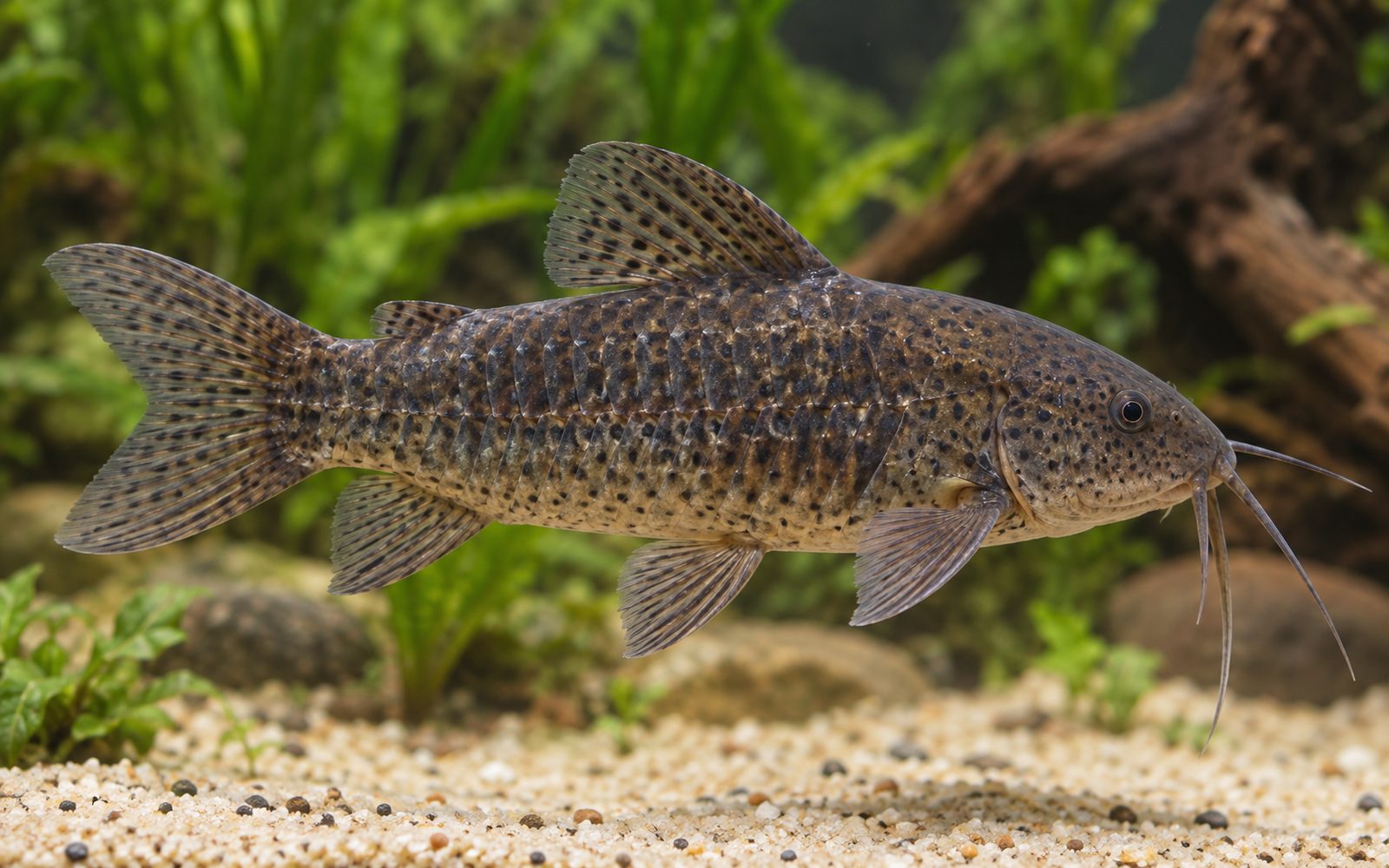
The hoplo is one of the large members of the family Callichthyidae: adults reach 18–20 cm in the aquarium and grow even larger in the wild. Its body is armored on each side with two rows of overlapping bony plates; its color ranges from brown to gray and it is covered with small dark spots. There are two pairs of long barbels around its mouth. The tail fin is slightly forked; this helps distinguish it from the similar Megalechis thoracata, which has a rounded tail.
It is very hardy: because it can take oxygen from the air through its intestine, in the wild it lives even in oxygen-poor swamps. In the aquarium it is peaceful, but because of its size it needs a large aquarium. In its native range it is a common food fish.
Natural Habitat
It lives across most of South America east of the Andes, in swamps, floodplains, canals and still pools. These waters are warm, vegetated and often low in oxygen. In dry periods it survives in shallow water by gulping air.
Tank Setup
- Volume: at least 200 liters for a group of 3–5; a base length of 120 cm or more.
- Substrate: sand or fine, rounded gravel; it can stir up cloudiness while foraging on the bottom.
- Filter: strong filtration is essential; it is a large, greedy fish that produces a lot of waste.
- Lid: it dashes up to the surface to gulp air; a covered aquarium and space at the surface are recommended.
- Floating plants: support the bubble nest during the breeding season.
Diet
Omnivorous and greedy. It accepts large sinking tablets and granules, frozen bloodworms, mosquito larvae, shrimp and pieces of vegetables. It should not be fed on leftovers alone; give food separately on the bottom every day.
Behavior and Compatibility
Peaceful; most of the time it calmly roams the bottom. In the breeding season the male determinedly guards the area around his nest and may chase away approaching fish. Because of its size, dwarf shrimp and very small fish are not safe with it.
Good companions: medium to large peaceful fish: angelfish, large tetras, silver dollars, gentle cichlids such as the blue acara, plecos, large gouramis.
Avoid: dwarf shrimp, small fish that could fit in its mouth, very aggressive large cichlids that claim the bottom.
Group and Colony Structure
It is a social species; at least 3, ideally 5 individuals are recommended. It is usually compatible within the group. In the breeding season, males may jostle over nest sites; so if there is more than one male in the aquarium, there should be enough space and floating plants.
Breeding
Unlike corydoras, it builds a bubble nest. The male makes a large bubble nest at the surface under floating plants or a leaf; the female lays her sticky eggs inside this nest. The male guards the nest and eggs and repairs the nest when necessary. The eggs hatch in a few days; the fry grow quickly and are fed freshly hatched brine shrimp, then crumbled sinking food. During this period, because of the male's protective behavior, there should be an area where other fish can stay away from the nest.
Health and Common Problems
- It is very hardy; most problems stem from inadequate filtration and nitrate buildup.
- Sharp substrate damages its barbels.
- Be careful with salt and copper-based medications.
Sexing
In mature males the first ray (spine) of the pectoral fin is clearly thicker and longer than in females; in the breeding season it takes on an orangish color. Females have plumper bodies.
Tank mates
This list is calculated automatically from the species profile and grows as new species are added to the catalog. Try it in the planner for a definite answer.
Usually compatible
 Flame Tetra
 Yellow Regal Peacock
Glass Tetra
Yellow Regal Peacock
Glass Tetra
 Blackfin Corydoras
 Polystictus Corydoras
 Emerald Betta
 Emerald Cory
 Emerald Dwarf Rasbora
 Porthole Catfish
 Keyhole Cichlid
Should not be kept together






Hobbyist notes
Things you won't find in books, learned by trial and error. The most helpful ones are on top.
Change history and contributors
- Page created · October 16, 2026