
Water parameters
Overview
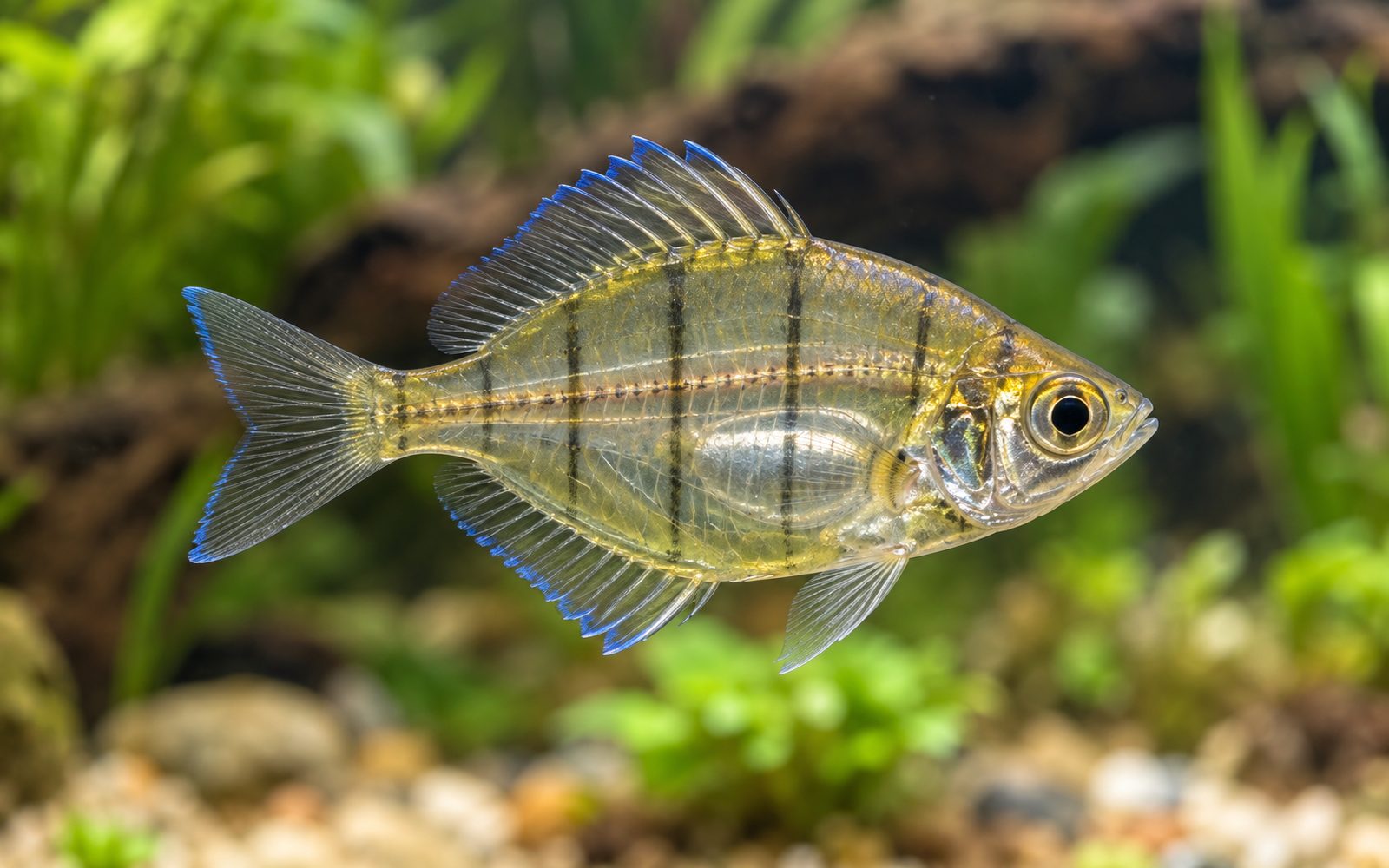
The Indian glassfish is so transparent that its spine, bones and silvery swim bladder can be seen through its body. It has a slight yellowish sheen; the edges of the males' dorsal and anal fins are bright blue. It is a calm, somewhat shy schooling fish.
Ethical warning: The trade sometimes sells glassfish that have had colored dye injected under the skin or have been dyed ("disco," "painted glassfish"). This procedure harms the fish and shortens its life; the dye fades over time. Do not buy these fish; choose naturally colored ones.
Natural Habitat
It lives in the still and slow-flowing waters, ponds, floodplains and vegetated banks of South and Southeast Asia. Some populations move down into slightly brackish waters near the coast.
Tank Setup
- Volume: at least 80 liters and 80 cm length for a group of 6–10.
- Water: moderately hard to hard, slightly alkaline water; it does well in fresh water. A little salt is not essential, but it likes hard water.
- Decor: densely planted edges and roots; the fish is bolder when it has places to hide.
- Flow: gentle to moderate.
Diet
Carnivorous. Frozen bloodworms, brine shrimp, daphnia, cyclops and mysis. Most individuals eventually accept small granules and flakes as well, but on dry food alone their color and health decline.
Behavior and Compatibility
Peaceful, shy and attached to its school. Males form small territories among themselves; they display with spread fins but do no harm. It may lose out to fast fish at feeding time.
Good companions: calm species of similar size: rasboras, calm barbs, rainbowfish, mollies, Corydoras, otocinclus.
Avoid: aggressive and fast-eating species, fin-nipping barbs, large predators.
Group and Colony Structure
A school of at least 6, ideally 10. When kept in small numbers it becomes timid and hides constantly.
Breeding
It spawns among fine-leaved plants or moss in the morning hours. The parents provide no care. The fry are very small and in the first days take only moving, tiny live food (infusoria, rotifers), which makes raising them difficult.
Health and Common Problems
- White spot and bacterial infections: common when stressed.
- Short lifespan in dyed fish: injection wounds are prone to infection.
- Starvation: in competitive aquariums.
Sexing
Males have bright blue edges on the dorsal and anal fins and a more yellowish body. Females are silvery, without blue edges. Held against the light, the rear end of the female's swim bladder can be seen to be more rounded.
Tank mates
This list is calculated automatically from the species profile and grows as new species are added to the catalog. Try it in the planner for a definite answer.
Usually compatible
 Flame Tetra
 Blackfin Corydoras
 Polystictus Corydoras
 Emerald Betta
 Emerald Cory
 Emerald Dwarf Rasbora
 Porthole Catfish
 Keyhole Cichlid
 Cryptocoryne Parva
 Gold Spot Pleco (L001)
Should not be kept together






Hobbyist notes
Things you won't find in books, learned by trial and error. The most helpful ones are on top.
Change history and contributors
- Page created · October 16, 2026