
Water parameters
Overview
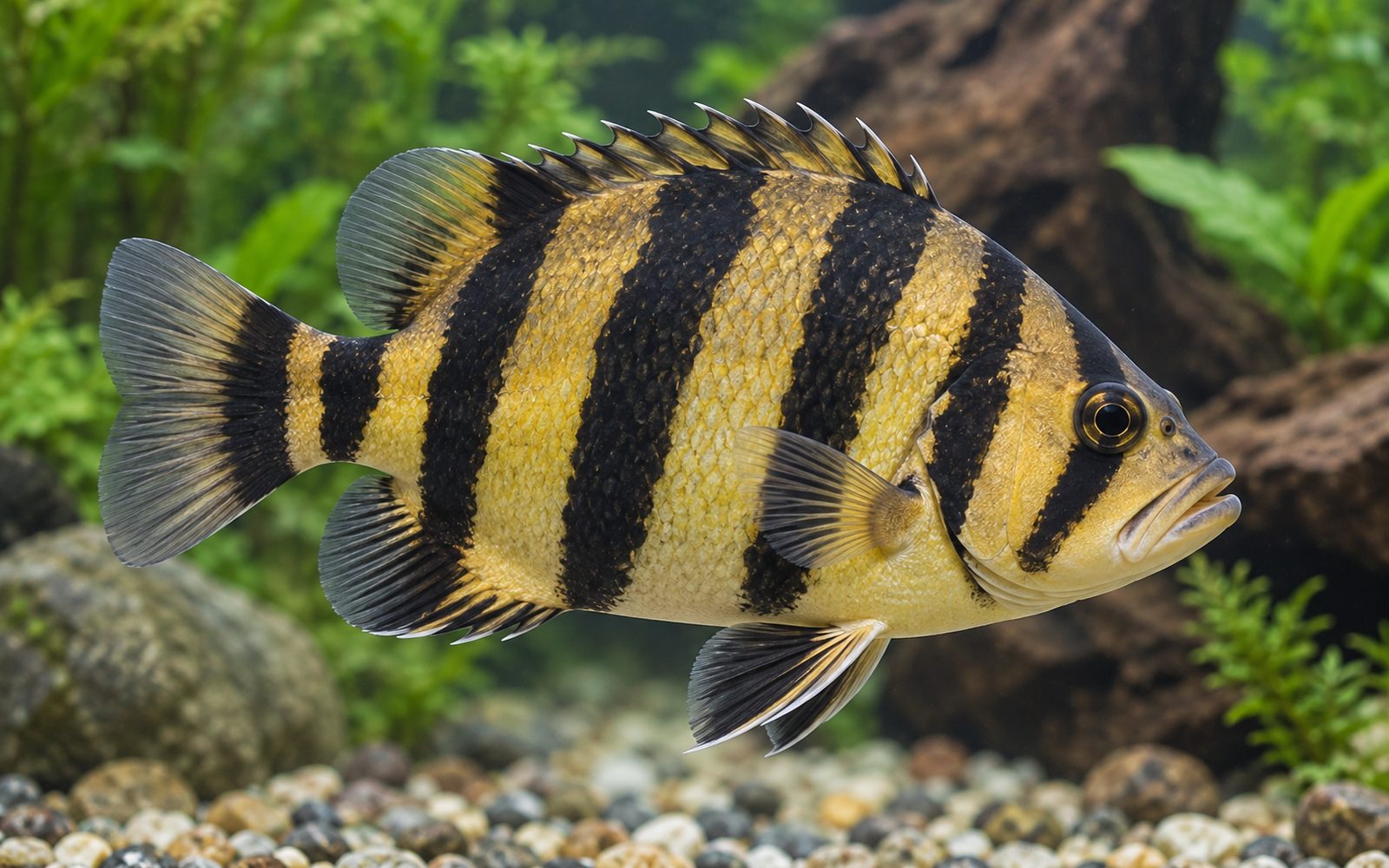
With thick black bands crossing its golden-yellow body, the Indonesian tigerfish resembles a tiger. It is a deep-bodied, large-mouthed perch-like fish and an ambush predator that swallows any fish fitting in its mouth in an instant. It reaches 40 cm in the aquarium.
Despite its appearance it is a shy fish; bright light and a busy setting stress it, and its colors fade or darken. In a calm, dim aquarium it eventually recognizes its owner and takes food from the hand. It is the best-known companion in arowana aquariums.
Natural Habitat
It lives in the large rivers, lakes and flooded forests of Sumatra and Borneo, in areas with plenty of sunken trees and roots. The bands on its body camouflage it in the light filtering through the branches; it waits for its prey in these shadows.
It is often confused with similar-looking relatives: the Siamese tigerfish (Datnioides pulcher) has become very rare in the wild, and some tigerfish species live in brackish water. Ask for the species name and origin when buying.
Tank Setup
- Volume: at least 600 liters for an adult; a 180 × 70 cm footprint.
- Light and decor: dim light, a dark background, large roots and branches; a fish with places to hide becomes bolder.
- Water: clean and stable; strong filtration and a 30% water change weekly. No salt is needed.
Diet
Carnivorous. Shrimp, fish fillet, mussels, worms; over time, large sinking pellets. Wild-caught fish may at first accept only live food; wean them gradually onto frozen foods. Live feeder fish carry a risk of disease.
Behavior and Compatibility
It eats any fish that fits in its mouth. It is territorial toward its own kind; if two are kept, the dominant one wears down the other.
Good companions: large, calm species too big for its mouth: arowanas, bichirs, clown knifefish, large plecos and catfish, large gouramis.
Avoid: small and medium-sized fish, shrimp, very active and aggressive large cichlids.
Group and Colony Structure
Alone, or 3 or more in a large aquarium. When kept as a group, aggression is spread out; two individuals are not recommended.
Breeding
Aquarium breeding is unknown; those sold are wild-caught.
Health and Common Problems
- Stress and color loss: in bright light, without hiding places and in a busy setting.
- Skin and fin infections: with poor water quality.
- Diseases from live food: feeder fish carry parasites.
Sexing
There is no reliable external way to tell the sexes apart.
Tank mates
This list is calculated automatically from the species profile and grows as new species are added to the catalog. Try it in the planner for a definite answer.
Usually compatible
 Banded Jewel Cichlid
 Chocolate Cichlid
 Gymnogeophagus balzanii
 Pearl Cichlid
 Threadfin Acara
 Blood Parrot
 Redhead Cichlid
 Cryptocoryne Parva
Adonis Pleco
African Brown Knifefish
Cryptocoryne Parva
Adonis Pleco
African Brown Knifefish
Should not be kept together









Hobbyist notes
Things you won't find in books, learned by trial and error. The most helpful ones are on top.
Change history and contributors
- Page created · October 16, 2026