
Water parameters
Overview
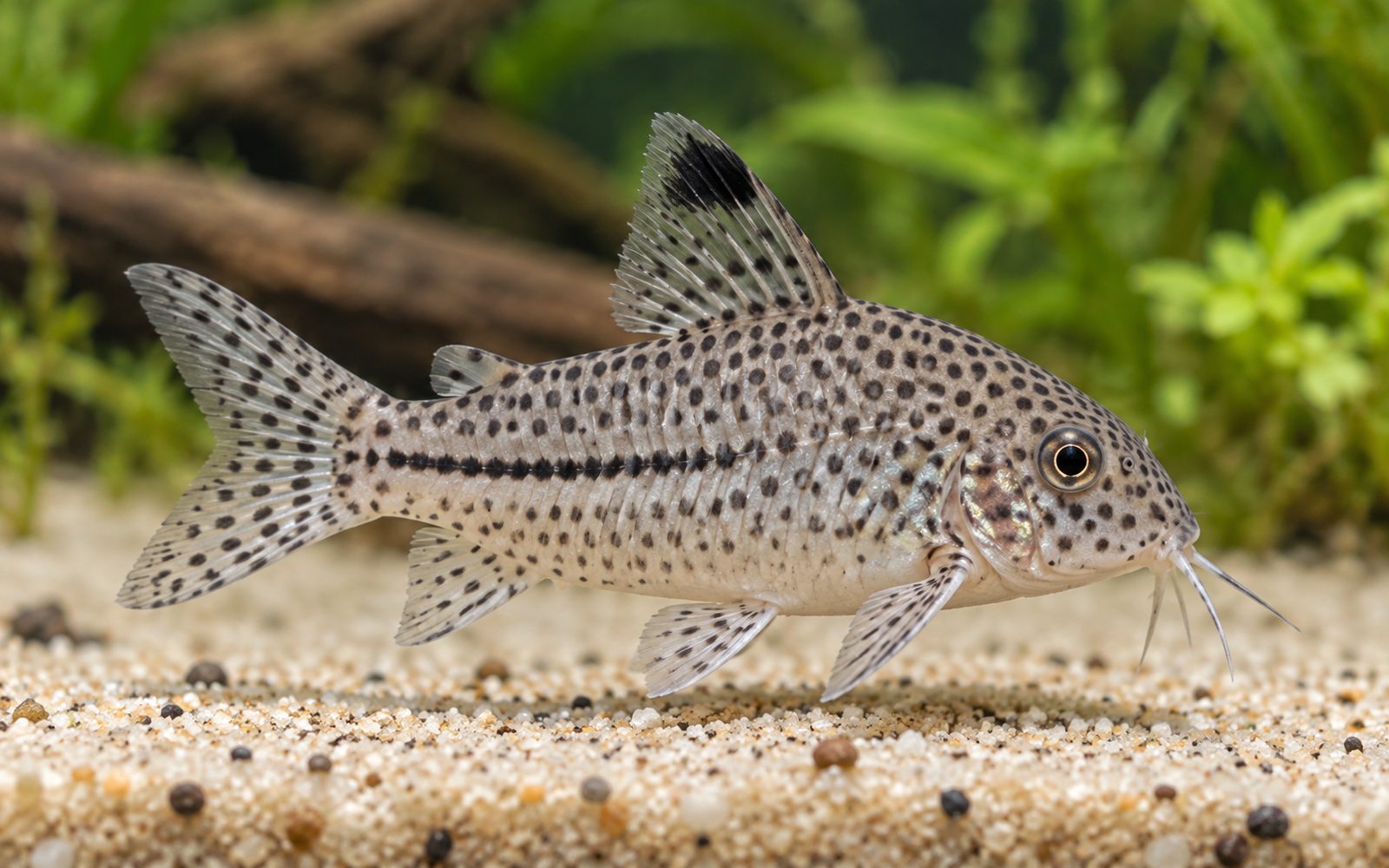
The julii cory is a corydoras with a "leopard" look, thanks to the small black spots sprinkled over its pale gray background. There is a black blotch at the tip of the dorsal fin, and the tail fin is spotted in rows. On the rear half of the body, a thin, faint dark line can be seen along the lateral line.
It is the most frequently confused pair of corydoras in the hobby. The true julii is rarely exported; most fish sold with the "julii" label are C. trilineatus. The most reliable way to tell them apart is to look at the head:
- C. julii: the head is covered with separate round spots, like the body; the dark line along the lateral line is thin and short.
- C. trilineatus: the head has wavy, maze-like lines rather than spots; a thick, unbroken black stripe runs along the lateral line.
Care requirements are almost identical for the two species.
Natural Habitat
It lives in clear, slow-flowing waters with sandy bottoms in the tributaries of the lower Amazon in northeastern Brazil and in the coastal rivers of the region.
Tank Setup
- Volume: at least 60 liters for a group of 6–10; a large footprint.
- Substrate: fine, rounded sand. Sharp gravel damages the barbels.
- Water: 22–26°C; soft to moderately hard, well-oxygenated and clean water. It is sensitive to nitrate buildup; a 25–30% water change weekly is recommended.
- Decor: shaded areas with roots, leaves and plants; a strip of open sand at the front.
Diet
Make sinking tablets and granules the staple; vary with frozen bloodworms, brine shrimp, daphnia and tubifex. Food given just before or after the lights go out lets bottom fish feed in peace. It cannot live on leftovers alone.
Behavior and Compatibility
A peaceful, calm bottom dweller. In a group the fish forage on the bottom and now and then dart to the surface to gulp air; this is normal behavior.
Good companions: tetras, rasboras, small peaceful barbs, gouramis, apistogrammas, otocinclus, shrimp.
Avoid: aggressive cichlids that claim the bottom, large predatory fish that could fit it in their mouths, large fish that snap up all the food on the bottom.
Group and Colony Structure
At least 6, ideally 10 or more individuals. In a large group it is less shy and more active. It can form a mixed group with trilineatus; however, if breeding is planned, keeping the species separate prevents hybridization.
Breeding
Like other corydoras, spawning is triggered by a large, somewhat cooler water change. The male chases the female and the pair takes up the "T position"; the female carries the eggs between her pelvic fins and sticks them to the glass and leaves. The eggs hatch in 3–5 days. The fry are raised on microworms and freshly hatched brine shrimp.
Health and Common Problems
- Barbel erosion: caused by dirty or sharp substrate.
- Very frequent trips to the surface: may indicate a lack of oxygen or poor water quality.
- It is sensitive to salt and copper-containing medications; halve the dose when treating.
Sexing
Viewed from above, females are broader and plumper, and slightly larger. Males are slimmer and have more pointed pelvic fins.
Tank mates
This list is calculated automatically from the species profile and grows as new species are added to the catalog. Try it in the planner for a definite answer.
Usually compatible
 Flame Tetra
 Blackfin Corydoras
 Polystictus Corydoras
 Emerald Cory
 Emerald Dwarf Rasbora
 Porthole Catfish
 Keyhole Cichlid
 Geophagus surinamensis
 Cryptocoryne Parva
 Gold Spot Pleco (L001)
Should not be kept together






Hobbyist notes
Things you won't find in books, learned by trial and error. The most helpful ones are on top.
Change history and contributors
- Page created · October 16, 2026