
Water parameters
Overview
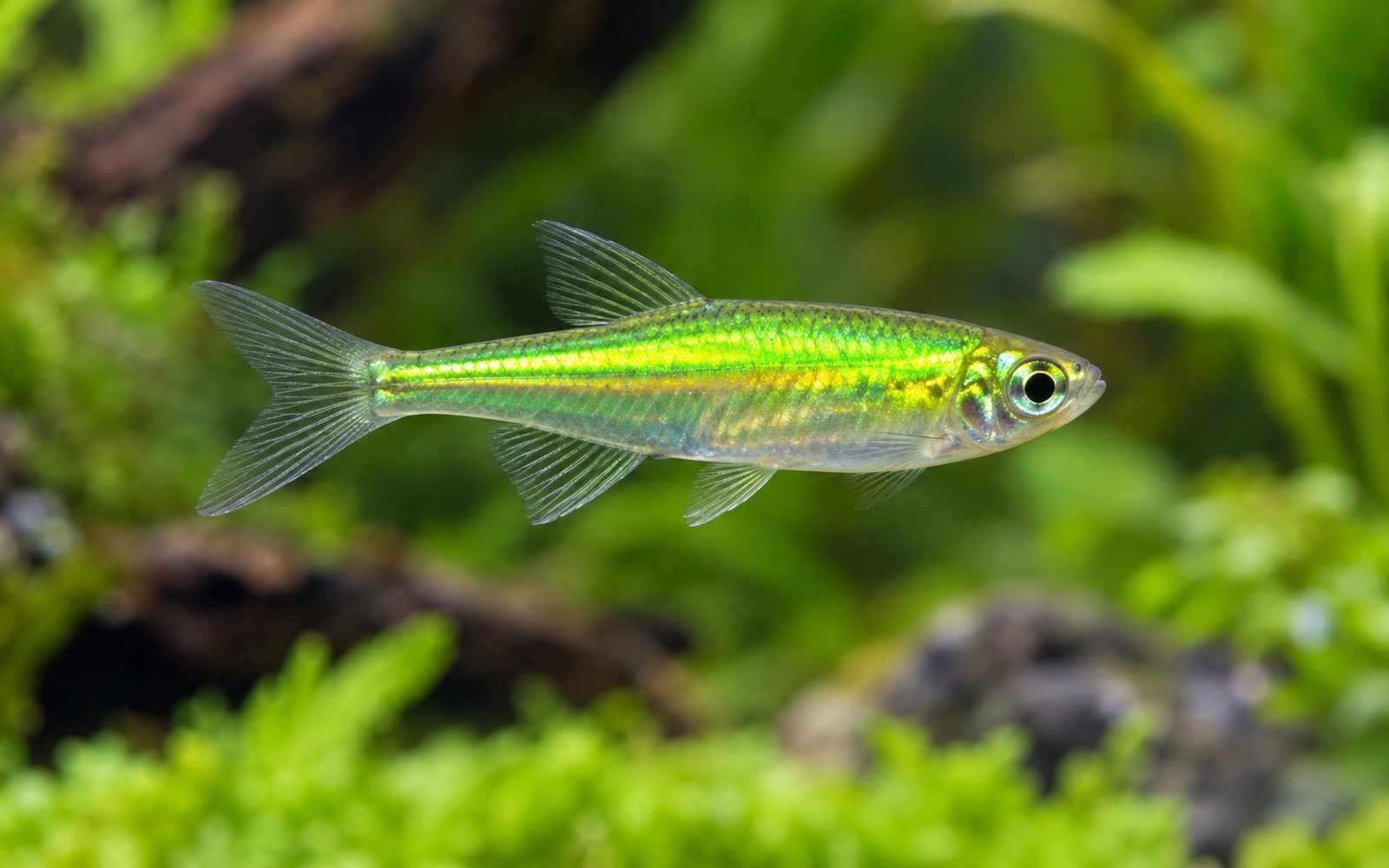
The kubotai rasbora was long known as Microrasbora kubotai; today it is placed in the genus Microdevario. Its body, about 2 cm long, is semi-transparent; the metallic scales along the back shine between neon green and lemon yellow depending on the angle of the light. Its fins are colorless.
Despite its small size, it is active and hardy. Unlike most nano fish, it forms a school that truly wheels together; in front of a dark substrate and green plants it looks like a glittering cloud. It is also a safe companion for shrimp tanks.
Natural Habitat
It lives in clear streams flowing through forested areas of western Thailand and southeastern Myanmar. These waters have gentle to moderate current and are clean and rich in oxygen, with aquatic plants and roots along the banks.
Tank Setup
- Volume: at least 30 liters for a school of 10–15; a long nano aquarium is better than a tall one.
- Water: 23–26°C, pH 6.5–7.5, soft to moderately hard water.
- Flow: it likes gentle to moderate current; keep oxygen levels high.
- Layout: plants along the sides, open swimming space in the middle. A dark substrate brings out its shine.
Diet
Omnivorous, with a small mouth. It accepts micro granules and finely crushed flakes; supplement with newly hatched brine shrimp, frozen cyclops and daphnia. Feed small amounts twice a day.
Behavior and Compatibility
Peaceful and social. As a school it is constantly on the move in the middle and upper layers. It shows no interest in other species; it leaves adult shrimp alone and may only catch very small shrimplets.
Good companions: Neocaridina and Caridina shrimp, Boraras species, celestial pearl danios, small tetras, otocinclus, dwarf corydoras species, nerite snails.
Avoid: any fish with a mouth big enough to swallow it, large and active species.
Group and Colony Structure
At least 10, ideally 15 or more individuals. In a large group the schooling behavior becomes pronounced and the fish come out into the open. Kept in small numbers they remain scattered and shy among the plants. The male-to-female ratio is not important.
Breeding
It scatters its eggs among moss and fine-leaved plants; there is no parental care. In a mature aquarium with moss, fry occasionally appear on their own. For controlled breeding, a small container filled with moss is used and the adults are removed after a few days. The fry are very small; start them on infusoria, then move on to newly hatched brine shrimp.
Health and Common Problems
- Newcomers: store-bought fish may look pale and thin in the first days; with good feeding they recover within a few weeks.
- Oxygen: it struggles in warm, still water; maintain surface movement.
- Water quality: do 20–30% water changes weekly.
Sexing
Females have a fuller belly. Males are slimmer and their metallic green-yellow sheen is slightly more intense. Sexing becomes easy only in mature individuals.
Tank mates
This list is calculated automatically from the species profile and grows as new species are added to the catalog. Try it in the planner for a definite answer.
Usually compatible
 Flame Tetra
 Blackfin Corydoras
 Polystictus Corydoras
 Emerald Cory
 Emerald Dwarf Rasbora
 Porthole Catfish
 Keyhole Cichlid
 Cupid Cichlid
 Geophagus surinamensis
 Cryptocoryne Parva
Should not be kept together





Hobbyist notes
Things you won't find in books, learned by trial and error. The most helpful ones are on top.
Change history and contributors
- Page created · October 16, 2026