
Water parameters
Overview
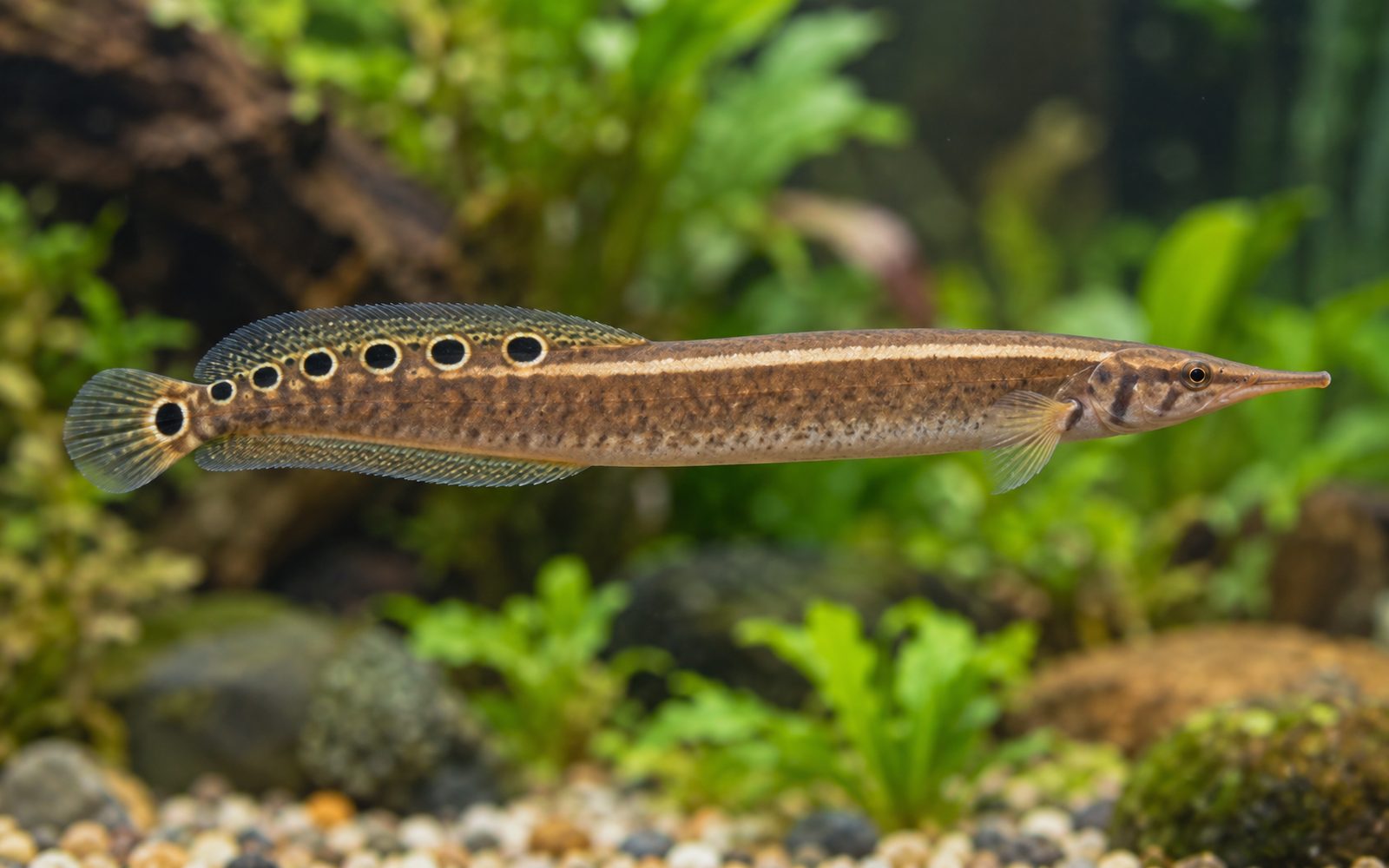
The peacock eel is not a true eel; it belongs to Asia's spiny eel family. Its light brown body has a cream-colored stripe running from snout to tail and black eyespots lined up at the base of the dorsal fin near the tail. Its snout is long and fleshy; it uses it to find food by smell.
It has small spines along its back, so it should be caught with a container instead of a net, as the spines get caught in the netting. During the day it buries itself in the sand with only its head sticking out; over time it becomes tame enough to take food from the hand.
Natural Habitat
It lives in the slow-flowing rivers, lakes and floodplains of Southeast Asia, along vegetated banks with soft mud and sand bottoms. During the day it burrows into the substrate, and at dusk it probes the sand with its snout, searching for insect larvae and small worms.
Tank Setup
- Volume: at least 150 liters and 100 cm length for a single fish.
- Substrate: fine, soft sand is essential; it rests buried in the sand. Sharp gravel injures its skin.
- Lid: a tight lid; it can escape through gaps for hoses.
- Decor: roots, pipes, plants; dim corners.
Diet
Carnivorous. Bloodworms, tubifex and similar worms, brine shrimp, mysis, small pieces of shrimp. It usually does not take flakes. It feeds at night; feed when the lights go out or in the evening so fast fish do not grab the food.
Behavior and Compatibility
Shy and peaceful. However, at night it may eat very small fish that fit in its mouth (neons, rasboras) and dwarf shrimp.
Good companions: calm, medium-sized species: gouramis, large rasboras, tetras (larger than neon size), calm barbs, Corydoras.
Avoid: very small fish, dwarf shrimp, aggressive cichlids that are territorial on the bottom.
Group and Colony Structure
It can be kept alone; with enough sand area, several individuals can also live together. Serious fights between conspecifics are rare.
Breeding
It rarely breeds in the aquarium; the eggs are reported to be laid among plants. Most of those sold are wild-caught.
Health and Common Problems
- Skin infections: common with hard substrate and poor water quality; its scales are very small.
- Medication sensitivity: sensitive to copper and some parasite medications; a half dose is recommended.
- Internal parasites: in wild-caught fish; weight loss is a sign.
- Escape: getting out through gaps for hoses and cables and drying out outside the aquarium.
Sexing
The sexes are hard to tell apart externally; females in breeding condition look plumper and thicker when viewed from above.
Tank mates
This list is calculated automatically from the species profile and grows as new species are added to the catalog. Try it in the planner for a definite answer.
Usually compatible
 Firemouth Cichlid
 Cupid Cichlid
 Chocolate Cichlid
 Festivum
 Geophagus altifrons
 Geophagus surinamensis
 Gymnogeophagus balzanii
 Pearl Cichlid
 Threadfin Acara
 Blood Parrot
Should not be kept together








Hobbyist notes
Things you won't find in books, learned by trial and error. The most helpful ones are on top.
Change history and contributors
- Page created · October 16, 2026