
Water parameters
Overview
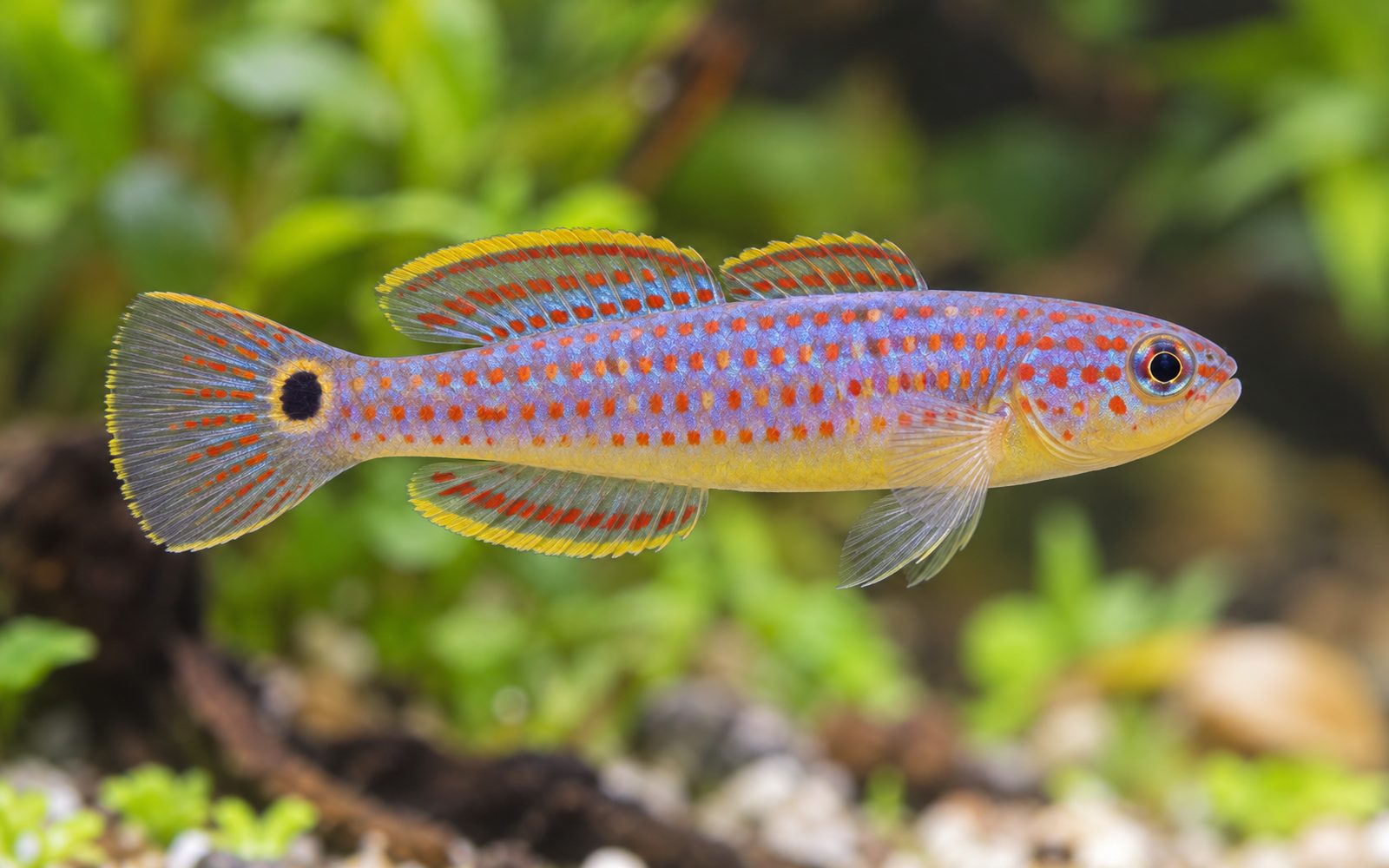
With red spots on its lilac-blue body, yellow and red banded fins and a black eyespot at the base of the tail, the peacock gudgeon is one of the most colorful bottom-to-midwater fish for small aquariums. It looks like a goby but belongs to the "sleeper" family (Eleotridae); its pelvic fins do not form a suction disc as they do in gobies.
It stays under 7 cm, is peaceful and looks superb in planted tanks. It gets used to dry food over time, but its colors and willingness to breed increase when it is fed live and frozen foods.
Natural Habitat
It lives in eastern Papua New Guinea, in slow-flowing streams and rivers running through forested areas, along planted, shaded banks.
Tank Setup
- Volume: at least 60 liters and 60 cm in length for a pair or a small group.
- Caves: a small cave, root hollow or clay pipe for each pair; necessary for breeding and territory.
- Water: 23–25°C, soft to moderately hard, close to neutral. Gentle flow.
- Decor: Dense plants, roots, dark substrate; dim light brings out the colors.
Diet
It leans toward a carnivorous diet. Frozen bloodworms, brine shrimp, daphnia, cyclops; small live foods. Most individuals accept small granules over time.
Behavior and Compatibility
Peaceful and somewhat shy. During the breeding season males defend the area around their caves, but injuries are rare.
Good companions: small, calm species: rasboras, pencilfish, small tetras, Corydoras, otocinclus, rainbowfish (small species). There are usually no problems with adult dwarf shrimp.
Avoid: large, fast-eating species, aggressive cichlids, fin-nipping barbs. Shrimplets may be eaten.
Group and Colony Structure
Kept as a pair or as a small group of several pairs. If you keep a group, give each male its own cave; females can outnumber males.
Breeding
It spawns in caves: the female sticks her eggs to the ceiling or wall of the cave, and the male guards them while fanning. The fry become free-swimming after a few days and are fed infusoria, then newly hatched brine shrimp. The parents usually do not attack the fry, but raising them separately is safer.
Health and Common Problems
- Poor water quality: fading color and refusing food.
- Nutritional deficiency: colors fade on a single type of dry food.
- In general it is a hardy species.
Sexing
Males have a humped bump on the forehead that becomes more pronounced with age, and their colors are brighter. Females are smaller; during the breeding season their bellies turn bright yellow.
Tank mates
This list is calculated automatically from the species profile and grows as new species are added to the catalog. Try it in the planner for a definite answer.
Usually compatible
 Flame Tetra
 Blackfin Corydoras
 Polystictus Corydoras
 Emerald Betta
 Emerald Cory
 Emerald Dwarf Rasbora
 Porthole Catfish
 Keyhole Cichlid
 Geophagus surinamensis
 Cryptocoryne Parva
Should not be kept together






Hobbyist notes
Things you won't find in books, learned by trial and error. The most helpful ones are on top.
Change history and contributors
- Page created · October 16, 2026