
Water parameters
Overview
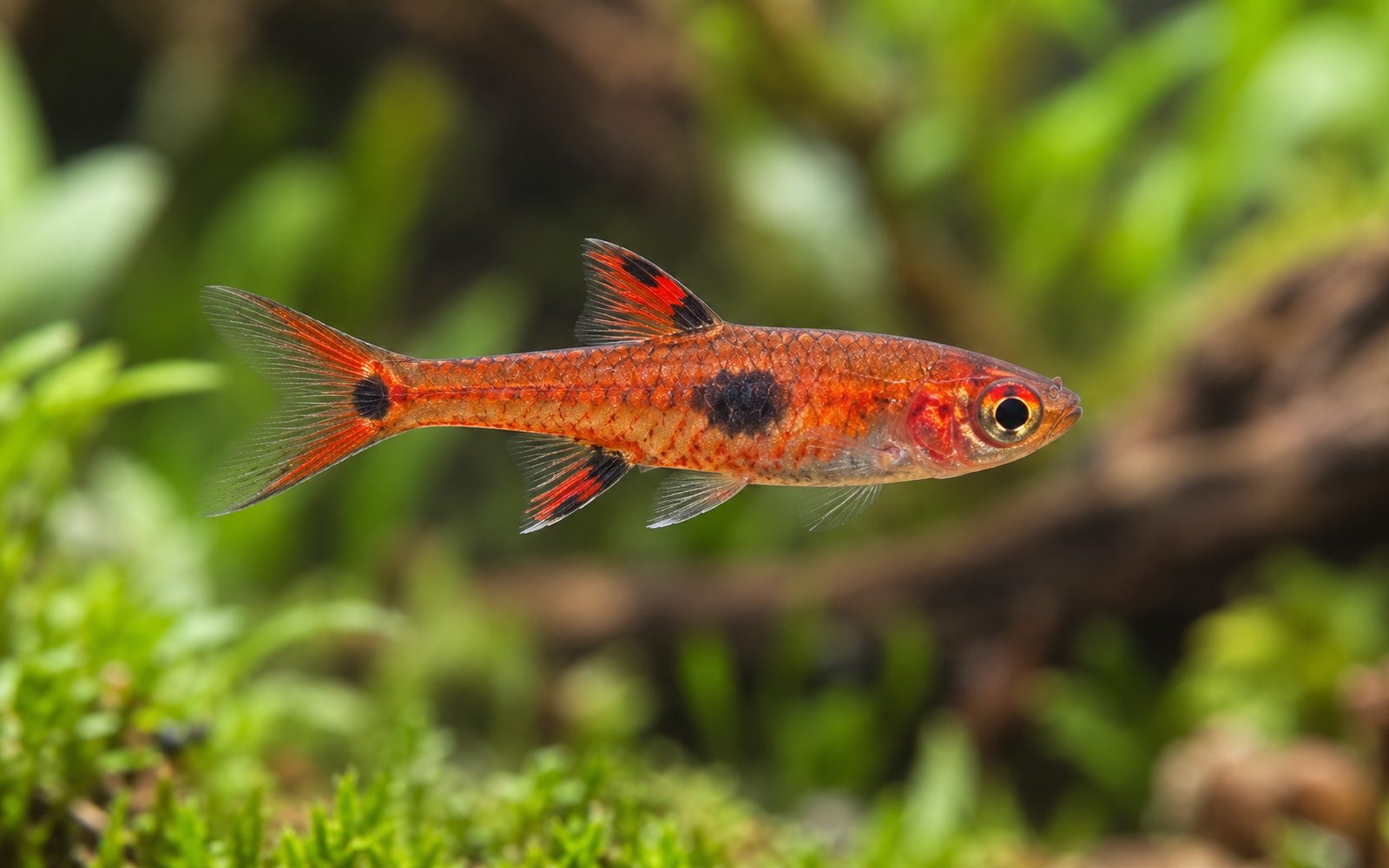
The phoenix rasbora is a dwarf species from the peat swamps of Borneo that reaches about 2 cm as an adult. Its scientific name comes from the word merah, meaning "red" in Malay and Indonesian. The males' body is orange-red, with a large, roundish dark blotch in the middle of the body. This blotch is markedly broader than the thin, continuous stripe of the chili rasbora and is the most useful clue for telling the two species apart.
Because the two species come from the same region and are often sold in the same tanks, they are frequently mixed up in stores. Their care is almost identical, so a mixed group causes no problems; still, keeping the species separate makes it easier to observe their colors and behavior.
Natural Habitat
It lives in forested peat swamps, shaded channels and slow-flowing small streams in Kalimantan. The water is dark tea-colored from tannins, very soft and acidic; the bottom is covered with decaying leaves and branches.
Tank Setup
- Volume: at least 25 liters for a group of 10–15; a long, low nano aquarium is ideal.
- Water: 24–27°C, pH 5.5–6.8, soft water. Dried catappa leaves and roots reflect the natural habitat and deepen the colors.
- Plants: moss, Cryptocoryne and floating plants; keep the light dim.
- Flow: very weak. A sponge filter is usually enough.
- Maturity: add it to an aquarium that has finished cycling and has developed biofilm.
Diet
It is a micropredator: in the wild it feeds on zooplankton, small insect larvae and worms. In the aquarium, give finely crushed flakes and micro granules; supplement with newly hatched brine shrimp, frozen cyclops and microworms several times a week. Feed little and often.
Behavior and Compatibility
Peaceful and somewhat shy. It moves in a loose group in the middle and upper layers, close to the plants. Males spread their fins and display to each other; these brief encounters are harmless.
Good companions: Neocaridina and Caridina shrimp, chili rasboras and other Boraras species, otocinclus, dwarf corydoras species, nerite snails.
Avoid: any fish with a mouth big enough to swallow it, active medium-sized species, bettas depending on the individual.
Group and Colony Structure
At least 10, ideally 15–20 or more individuals. As the group grows, the fish stop hiding and the males' red becomes more pronounced. Kept in small numbers they disappear among the plants. The sex ratio is not critical; having slightly more females spreads out the males' displays.
Breeding
It continuously deposits small numbers of eggs among moss and fine-leaved plants; there is no parental care. In a mature aquarium with dense moss, fry occasionally appear on their own. For controlled breeding, a few individuals are kept for a few days in a small container filled with soft, acidic water and lined with moss, then the adults are removed. The fry start on infusoria and take newly hatched brine shrimp after a few days.
Health and Common Problems
- Acclimation: fish coming from soft water are sensitive to sudden changes in pH and hardness; slow drip acclimation is recommended.
- Wasting: individuals that cannot find food of a suitable size for their mouth lose weight quickly.
- Water quality: in a small volume, do 20–30% water changes weekly; do not let nitrate build up.
Sexing
Males are an intense orange-red and slender; the red and black markings on the dorsal and anal fins are prominent. Females are paler and have a fuller belly; their flank blotches are smaller and less distinct.
Tank mates
This list is calculated automatically from the species profile and grows as new species are added to the catalog. Try it in the planner for a definite answer.
Usually compatible
 Flame Tetra
 Blackfin Corydoras
 Polystictus Corydoras
 Emerald Cory
 Porthole Catfish
 Keyhole Cichlid
 Cupid Cichlid
 Geophagus altifrons
 Geophagus surinamensis
 Cryptocoryne Parva
Should not be kept together





Hobbyist notes
Things you won't find in books, learned by trial and error. The most helpful ones are on top.
Change history and contributors
- Page created · October 16, 2026